The muscle car wars era is defined as the decade-long battle among American automakers from 1964 to 1974 to build the most powerful, affordable, and visually striking performance cars for young buyers. This was not just a product competition. It was a corporate arms race where engineering ambition, marketing budgets, and cultural timing collided in ways that have never been repeated. The Big Three, Ford, General Motors, and Chrysler, each threw their best engineers and boldest designs at a generation of buyers who wanted speed and were willing to pay for it.
What sparked the muscle car wars era?
The conditions for the muscle car wars were set long before the first shot was fired. Post-World War II economic prosperity created a large, young, and cash-flush demographic. The baby boom generation was reaching driving age in the early 1960s, and they wanted cars that felt alive.
The technical groundwork came even earlier. The 1949 Oldsmobile Rocket 88 planted the seed by dropping a high-compression V8 into a mid-size body. That formula, big engine in a lighter car, became the defining muscle car strategy for the next 25 years. Engineers learned that you did not need to build a new car from scratch. You just needed to fit the biggest engine into the most affordable platform.
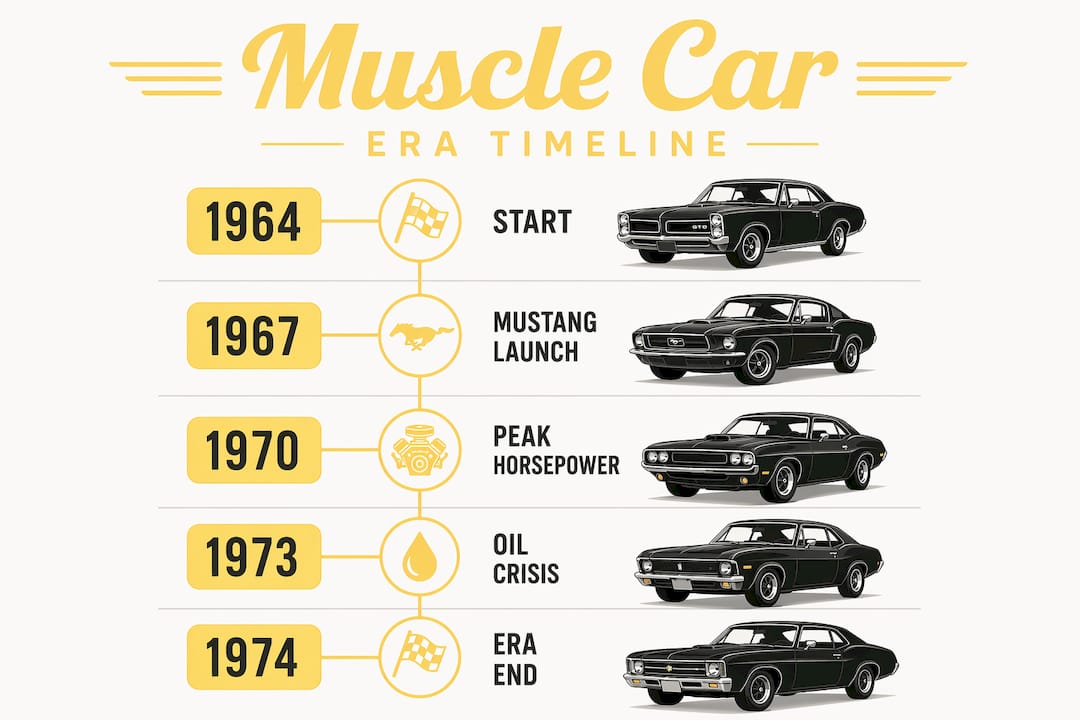
The era officially ignited in 1964 when Pontiac released the GTO. It ran 0–60 mph in 7.7 seconds and covered the quarter mile in 15.8 seconds. Those numbers destroyed what typical family sedans could do. Pontiac's team, led by John DeLorean, essentially broke General Motors' internal policy against racing by packaging the GTO as an option on the Tempest rather than a standalone model. That workaround changed everything.
- Post-WWII prosperity gave young buyers real purchasing power for the first time
- The baby boom created a massive demographic hungry for performance
- Corporate policy restrictions pushed engineers toward creative loopholes
- The GTO's option-package strategy bypassed GM's displacement limits
Pro Tip: If you want to understand why the GTO matters so much to classic car designers and historians, study how John DeLorean packaged it as an option rather than a model. That single decision launched an entire segment.
Who were the key players and iconic models?
The muscle car competition was dominated by three manufacturers, each with a distinct approach and a roster of legendary vehicles.
Ford entered the pony car segment with the 1964 Mustang, which created its own category entirely. The Mustang was lighter and more style-forward than traditional muscle cars. Shelby variants like the GT350 and GT500 pushed performance credentials further, giving Ford a racing pedigree that translated directly to showroom appeal.
General Motors fought on multiple fronts. The Chevrolet Camaro arrived in 1967 as a direct answer to the Mustang. The Chevelle LS-6 represented the peak of GM's horsepower ambitions, advertising 450 horsepower in 1970. That figure stood as the high-water mark of the entire era. GM also used the Central Office Production Order, known as COPO, to build limited-run vehicles that bypassed corporate displacement restrictions. The ZL1 Camaro, produced through this loophole, used an all-aluminum 427 engine that outperformed nearly every other muscle car of its time.
Chrysler brought raw power through the 426 HEMI engine. The HEMI was officially rated at 425 horsepower, but real-world output reached closer to 550 hp. Chrysler deliberately underrated the engine to keep insurance costs manageable for buyers. Mopar models like the Road Runner, Charger, and 'Cuda became icons of the era's bold styling and brute performance.
American Motors Corporation entered late with the Javelin and AMX. AMC lacked the budget of the Big Three, but the AMX's two-seat layout and competitive pricing carved out a loyal following among enthusiasts who wanted something different.
| Manufacturer | Signature Model | Notable Feature |
|---|---|---|
| General Motors | Chevelle LS-6 | 450 hp advertised, peak of the horsepower wars |
| Ford | Shelby GT500 | Racing pedigree driving showroom traffic |
| Chrysler | 426 HEMI 'Cuda | Underrated at 425 hp, real output near 550 hp |
| AMC | AMX | Two-seat layout, competitive entry-level pricing |
How did the horsepower wars shape marketing and motorsports?
The muscle car competition was never purely about engineering. It was about winning in public, on drag strips, oval tracks, and road courses, and then telling everyone about it.
Manufacturers used motorsports victories to legitimize their street cars. A win at a major drag event or a NASCAR superspeedway translated directly into showroom traffic. The logic was simple: if it wins on Sunday, buyers want it on Monday. Ford's "Total Performance" campaign in the mid-1960s made this connection explicit, tying racing wins to the Mustang and Fairlane in advertising.
The horsepower numbers themselves became a marketing tool. Chrysler's decision to underrate the 426 HEMI was not just about insurance. It also created a mystique. Buyers knew the official number was conservative, which made the car feel like a bargain secret. That tension between engineering ambition and insurance costs defined how manufacturers communicated performance throughout the era.
- Win on the track first. Manufacturers prioritized racing programs because track victories gave advertising claims credibility that no brochure could manufacture.
- Underreport horsepower strategically. Chrysler and others kept official figures low to reduce insurance premiums for buyers, while enthusiasts spread the real numbers by word of mouth.
- Use limited editions as halo vehicles. The ZL1 Camaro and Hemi 'Cuda were never meant to sell in large numbers. They existed to make the entire lineup look capable.
- Tie racing wins to production models. Ford's Total Performance campaign showed buyers a direct line between race results and the car in the lot.
Pro Tip: When evaluating muscle car performance claims from this era, always check whether the horsepower figure uses SAE gross or SAE net ratings. In 1971, the industry switched rating standards, which made the same engine appear significantly less powerful on paper without any mechanical changes.
What caused the decline and end of the muscle car era?
The golden age ended fast. Three forces hit simultaneously in the early 1970s, and the muscle car market could not survive all three at once.
- The 1973 oil embargo sent fuel prices soaring and made high-displacement engines a liability overnight. Buyers who once bragged about cubic inches suddenly cared about miles per gallon.
- Federal emissions regulations under the Clean Air Act forced manufacturers to detune engines, lower compression ratios, and add emissions equipment that robbed power. The same engines that made 450 hp in 1970 were producing far less by 1973.
- Rising insurance premiums priced young buyers out of the market. Insurers had been raising rates on high-performance vehicles throughout the late 1960s, and by the early 1970s, the cost of insuring a muscle car exceeded what many young buyers could afford.
The 1973 oil embargo, federal emissions laws, and rising insurance premiums together ended the commercial viability of muscle cars by 1974. Each factor alone might have been manageable. Together, they were fatal to the segment.
"The muscle car era did not fade. It was compressed from three sides at once: the gas pump, the government, and the insurance company. Engineers who had spent a decade finding ways to add power spent the next decade finding ways to keep any power at all."
The shift from SAE gross to SAE net horsepower ratings in 1971 made the decline look even steeper on paper than it was mechanically. Direct comparisons of muscle car output across 1970 and 1973 are misleading without that context. A 1973 engine rated at 245 hp net was often producing similar real-world power to a 1970 engine rated at 350 hp gross.
What is the legacy of the muscle car wars today?
The muscle car era left a permanent mark on American automotive culture. These cars are not just collectibles. They are cultural artifacts that represent a specific moment when corporate competition, consumer passion, and engineering ambition all peaked together.
Manufacturers have repeatedly returned to muscle car heritage for modern models. The Dodge Challenger, Chevrolet Camaro, and Ford Mustang all drew directly from their 1960s predecessors in design and naming. That nostalgia is not accidental. It reflects how deeply the original era shaped buyer expectations for what an American performance car should look like and feel like.
The collector market confirms the cultural weight. Rare variants like the ZL1 Camaro and the Hemi 'Cuda command multi-million dollar prices at auction today. These are not just expensive old cars. They are the physical record of a decade when American automakers competed harder and faster than at any point before or since. If you are thinking about muscle cars as investments, the classic car vs. stock market comparison is worth understanding before you buy.
| Legacy Factor | Impact Today |
|---|---|
| Collector values | ZL1 Camaro and Hemi 'Cuda exceed multi-million dollar auction prices |
| Modern revivals | Mustang, Challenger, and Camaro nameplates drew directly from 1960s originals |
| Cultural reverence | Muscle cars appear in film, music, and media as symbols of American freedom |
| Engineering lessons | COPO and HEMI strategies influenced how manufacturers handle performance variants today |
Key Takeaways
The muscle car wars era was a unique decade of corporate competition, engineering ambition, and cultural momentum that produced the most collectible American performance cars ever built.
| Point | Details |
|---|---|
| Era timeline | The muscle car wars ran from 1964 to 1974, bookended by the Pontiac GTO and the oil crisis. |
| Peak performance | The 1970 Chevelle LS-6 advertised 450 hp, the highest official output of the entire era. |
| Hidden horsepower | Chrysler rated the 426 HEMI at 425 hp, but real output reached near 550 hp to reduce buyer insurance costs. |
| Era's end | The 1973 oil embargo, Clean Air Act regulations, and rising insurance premiums together killed the segment by 1974. |
| Collector value | Rare variants like the ZL1 Camaro and Hemi 'Cuda now command multi-million dollar prices at auction. |
Why the muscle car wars still matter more than the numbers suggest
People talk about the muscle car era in horsepower figures and quarter-mile times. I get it. Those numbers are fun. But the real story is more interesting than any spec sheet.
What made this decade unique was the combination of corporate restriction and engineering creativity. The COPO loophole, the underrated HEMI, the GTO packaged as an option to dodge GM policy. These were not just clever tricks. They were the result of engineers who genuinely wanted to build something great and found ways around every rule that stood in their way. That tension between what the corporation allowed and what the engineers actually did produced cars that were more interesting than anything a fully unconstrained budget would have created.
I also think the era's end is underappreciated as a story. The muscle car wars did not lose steam because buyers stopped caring. They ended because three external forces hit at exactly the wrong moment. That makes the surviving cars feel even more significant. They are the last products of a window that opened fast and closed faster.
If you are restoring or buying one of these cars, do not just chase the highest horsepower number. The cars with the best stories, the COPO builds, the underrated Mopars, the late-production survivors, are the ones that reward you the most over time. Get a proper test drive checklist together before you commit to any purchase. The numbers on paper are only part of what you are buying.
— Tony
Classic muscle cars, ready for you at Butterclassics
Butterclassics specializes in curated classic and vintage vehicles, including the iconic muscle cars that defined the golden decade. Whether you are looking for a numbers-matching Mopar, a Camaro with documented history, or a Mustang ready to drive, the inventory is built for enthusiasts who know what they want.
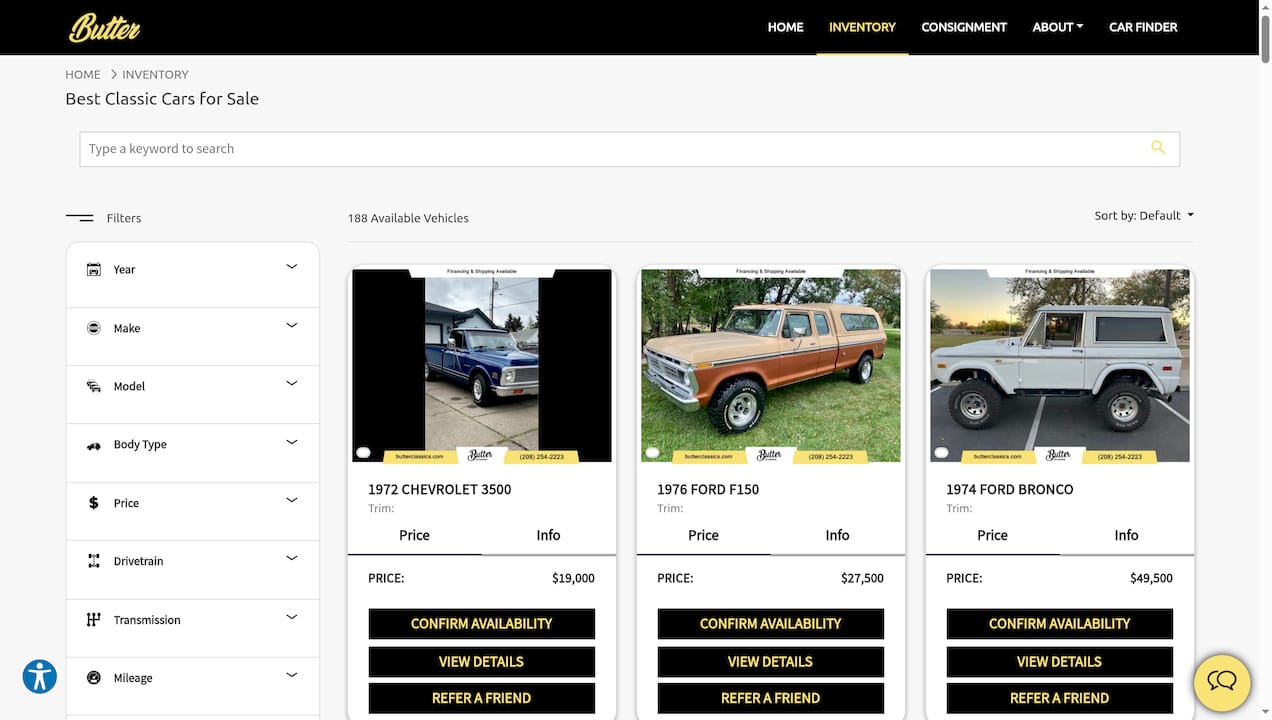
Every vehicle in the Butter Certified collection goes through a thorough review process so you can buy with confidence. Browsing is smooth as butter, with detailed photos, full specs, and financing pre-qualification available right on the site. If you are ready to find your next classic, browse the full inventory and call dibs before someone else does.
FAQ
What years did the muscle car wars era cover?
The muscle car wars era ran from 1964 to 1974, starting with the release of the Pontiac GTO and ending due to the combined pressure of the 1973 oil embargo, federal emissions regulations, and rising insurance costs.
What was the most powerful muscle car of the era?
The 1970 Chevrolet Chevelle LS-6 held the highest advertised output at 450 horsepower, making it the peak of the horsepower wars among production muscle cars.
Why did manufacturers underreport horsepower figures?
Manufacturers like Chrysler deliberately rated engines below their real output to keep insurance premiums lower for buyers. The 426 HEMI was officially rated at 425 hp but produced near 550 hp in real-world testing.
What ended the muscle car era?
The 1973 oil embargo, Clean Air Act emissions regulations, and sharply rising insurance premiums converged to make high-displacement performance cars commercially unviable by 1974.
Are muscle cars from this era good investments?
Rare variants like the ZL1 Camaro and Hemi 'Cuda command multi-million dollar prices at auction today, making them among the strongest performers in the collector car market.