
Color codes in classic cars are factory-assigned identifiers that link a specific paint color to a vehicle's original production specification. The role of color codes in classic cars goes far beyond a simple reference number. These codes determine whether a restoration is historically accurate, whether a car qualifies as numbers-matching, and ultimately how much a collector will pay at auction. Tools like spectrophotometers, documents like British Motor Heritage certificates, and resources like Classic Car Hub paint guides all feed into a process that is equal parts science and detective work.
How to find and interpret color codes on classic cars
Finding a paint code on a classic car is the first practical step in any serious restoration. The most common locations include firewall plates, door jambs, glove box lids, and commission plates mounted under the hood. Each manufacturer placed codes differently, and knowing where to look saves hours of guesswork.
The challenge gets real with older vehicles. Many pre-1980 classics do not have paint codes stamped anywhere on the body at all. For MG and Triumph models especially, British Motor Heritage certificates are considered the only reliable way to confirm what color left the factory. Without that paperwork, you are working from educated guesses.
Here is what to check on a typical classic car:
- Firewall plate: Common on American muscle cars and many European models from the 1960s onward
- Door jamb sticker or plate: Used widely by General Motors, Ford, and Chrysler through the 1970s and 1980s
- Glove box or trunk lid: Less common but found on select British and Italian models
- Commission plate under the bonnet: Standard on Triumph models, listing paint code alongside other build data
- Heritage certificate: The gold standard for MG, Triumph, and other British Leyland vehicles with no stamped code
When no code exists anywhere on the car, modern technology fills the gap. Spectrophotometers achieve 95–98% accuracy when analyzing faded or repainted surfaces, reading hue, saturation, and value from multiple angles to reconstruct the original color mathematically.
Pro Tip: Check hidden areas first. Paint in the trunk interior, under trim panels, and behind door seals is often original even on repainted cars. A spectrophotometer reading from these spots gives you the cleanest baseline for matching.
Why does original paint color affect classic car value?
Factory-original paint is one of the strongest value multipliers in the collector car market. Rare colors on the right model can produce price differences that seem almost unbelievable until you look at the data.
A 1973 Ferrari 365 GTB/4 Daytona finished in the rare factory color "Giallo Fly" sold for $1.21 million. Standard red versions of the same car average $623,298. That is nearly double the price for the same mechanical specification, separated only by paint. Dodge's "Sublime" green on early 1970s Challengers and Plymouth 'Cudas tells a similar story, commanding premiums that make restorers think twice before choosing a more common shade.
"Color is not cosmetic in the collector car world. It is provenance. It tells you who ordered this car, what they wanted, and how rare that combination was on the day it rolled off the line."
The classic car color significance runs deeper than rarity alone. Colors like British Racing Green, Corvette's Nassau Blue, and Ford's Wimbledon White are part of a brand's visual identity. They connect a specific model to a specific era. Stripping that away with a non-factory color does not just hurt resale value. It erases a piece of automotive history. The importance of paint colors in vintage cars shows up consistently in auction results, where originality commands a clear premium over condition alone.
Incorrect colors also raise red flags for experienced buyers. A numbers-matching car with the wrong paint code on its documentation is a car that needs explaining. That explanation costs you money at the negotiating table every single time.
What are the technical challenges in restoring vintage paint?
Matching vintage paint is harder than it looks, even with modern tools. Paint formulas from the 1950s through the 1980s are largely lost or reformulated. Manufacturers changed chemical compositions and pigments multiple times across those decades, meaning the color code on a heritage certificate does not automatically translate to a mix you can order today.
Here is a practical sequence for tackling a vintage paint restoration:
- Locate and document the original code. Pull the commission plate, heritage certificate, or firewall data before touching anything else.
- Analyze surviving original paint. Use a spectrophotometer on protected areas like the trunk floor or under door seals to capture the actual aged color.
- Account for regional fading. A car from Arizona will have oxidized differently than one from the Pacific Northwest. UV exposure shifts reds and yellows significantly over decades.
- Test under multiple lighting conditions. A match that looks perfect under shop fluorescents can look wrong in direct sunlight. Always test in natural light before committing.
- Consult a shop with vintage chemistry knowledge. Computers cannot fully replicate the trained eye of a technician who understands how lead-based and nitrocellulose-based paints behave differently from modern waterborne formulas.
The subjectivity in this process is real. British Racing Green has ranged from light olive to deep inky tones across different production years and manufacturers. There is no single correct hex code. That ambiguity means color matching for classic cars remains partly an art form, even when the science is dialed in.
Pro Tip: Always request a spray-out card from your paint shop before committing to a full panel. Spray the card, let it cure fully, and compare it to original paint in natural light. This single step prevents the most expensive mistakes in restoration.
How do MG, Triumph, and other makers compare on color coding?
British marques present some of the most complex color coding situations in the classic car world. MG and Triumph both went through major transitions as British Motor Corporation became British Leyland and eventually adopted the BLVC coding system. Each transition left gaps, overlaps, and opportunities for expensive mistakes.
| Manufacturer | Code location | Pre-1980 stamped code? | Key challenge |
|---|---|---|---|
| MG (BMC era) | Rarely stamped on car | No | Heritage certificate required for most models |
| Triumph | Commission plate under bonnet | Sometimes | Numeric codes vs. later three-letter BLVC codes cause confusion |
| Ford (USA) | Door jamb sticker | Yes | Multiple regional variations on same color name |
| GM (USA) | Cowl tag or door jamb | Yes | Color names changed by model year without code change |

The Triumph situation deserves special attention. Triumph collectors are specifically cautioned not to confuse internal factory paint codes with later BLVC codes. The two systems overlap in ways that look logical but produce the wrong color. A restorer who grabs a BLVC cross-reference without checking which system applies to their specific model year will end up with paint that was never on that car from the factory.
MG presents a different problem. The brand rarely stamped paint codes on pre-1980 cars at all. For these vehicles, the color coding for classic cars relies entirely on factory records and heritage documentation. Enthusiast resources like Classic Car Hub's model-specific paint guides help, but they work best when paired with a British Motor Heritage certificate rather than used as a standalone reference.
A few practical rules for navigating British marque color codes:
- Never assume a cross-reference code is correct without checking the production year against the applicable coding system
- Treat BLVC codes and earlier BMC or Triumph numeric codes as separate systems, not interchangeable references
- Use factory records for verification before ordering any paint
- When documentation is missing, forensic paint analysis of hidden panels is more reliable than any code guide
Key takeaways
Color codes are the definitive link between a classic car's factory specification and its current restoration accuracy, directly shaping both historical authenticity and market value.
| Point | Details |
|---|---|
| Codes confirm originality | Factory paint codes verify that a car's color matches its original production specification. |
| Rare colors multiply value | A factory rare color like "Giallo Fly" on a Ferrari can nearly double auction prices over standard shades. |
| Pre-1980 cars need certificates | Many British classics have no stamped code; British Motor Heritage certificates are the reliable standard. |
| Technology has limits | Spectrophotometers reach 95–98% accuracy, but vintage paint chemistry still requires human expertise. |
| Cross-reference codes mislead | Triumph and MG restorers must match codes to the correct era system to avoid selecting the wrong paint. |
Why color codes deserve more respect than they get
I have watched restorers spend serious money on mechanical work and then treat paint as an afterthought. That is the wrong order of priorities, and the market punishes it. A car with a documented, correct factory color and a solid paint job will outsell a mechanically superior car with a non-original color almost every time at a serious auction.
What I find genuinely fascinating is how the meaning of classic car colors shifts depending on who is in the room. A Corvette collector reads Nassau Blue as a specific year and trim level. A Triumph enthusiast sees Damson as a late-1960s British Leyland signature. These colors carry information that goes beyond aesthetics. They are shorthand for provenance.
The technology side has gotten impressive. Spectrophotometers reading metallic flake from multiple angles, digital mixing systems pulling from reformulated databases, shops that specialize in nothing but vintage paint chemistry. But I keep coming back to the same conclusion: the tool is only as good as the knowledge behind it. I have seen shops produce a mathematically perfect spectrophotometer match that looked completely wrong on the car because nobody accounted for how the original lacquer aged differently than modern clearcoat. The science gets you close. The expertise gets you there.
My honest advice is to treat the color code as the starting point, not the finish line. Get the heritage certificate. Analyze original paint in protected areas. Test your match in natural light. And if you are buying a classic as an investment, check the market trends around originality before you commit. The premium for a correctly documented, factory-original color is real and it is growing.
— Tony
Find your next factory-original classic at Butterclassics
If you are serious about color authenticity and investment-grade originality, the inventory at Butterclassics is worth your time.
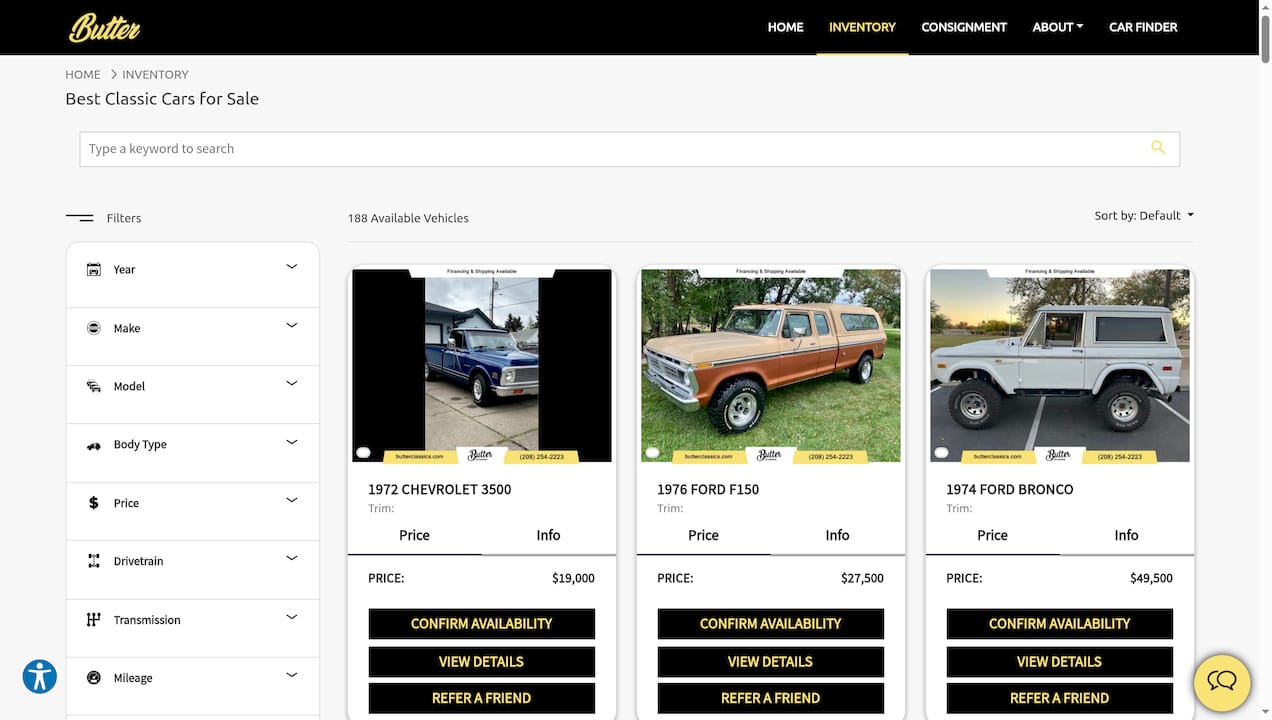
Butterclassics specializes in classic and vintage vehicles where provenance matters. Every listing in the certified inventory is vetted for originality, giving you confidence that what you see is what the factory built. Whether you are restoring a numbers-matching muscle car or adding a rare-color British classic to your collection, Butterclassics connects you with vehicles where the paint story is already verified. Browse the full classic car inventory and find the one worth calling yours.
FAQ
What is a paint code on a classic car?
A paint code is a factory-assigned alphanumeric identifier that specifies the exact color applied to a vehicle during production. It appears on firewall plates, door jambs, commission plates, or heritage certificates depending on the manufacturer and model year.
Where do I find the color code on my vintage car?
Check the firewall plate, door jamb sticker, glove box lid, or commission plate under the hood first. For many pre-1980 British cars like MG and Triumph, no code is stamped on the body, and a British Motor Heritage certificate is the most reliable source.
Does original paint color really affect resale value?
Yes, significantly. A 1973 Ferrari 365 GTB/4 Daytona in the rare factory color "Giallo Fly" sold for $1.21 million compared to a $623,298 average for standard red versions. Rare factory colors on the right model can nearly double market value.
Can modern technology match vintage paint accurately?
Spectrophotometers can reach 95–98% accuracy on faded or repainted surfaces. However, vintage paint chemistry knowledge is still required because original lacquer and enamel formulas behave differently from modern waterborne paints.
Why are Triumph and MG color codes confusing?
Both brands went through multiple coding system transitions as British Motor Corporation became British Leyland. Triumph's numeric codes and later BLVC three-letter codes overlap in ways that look interchangeable but produce different colors. Always verify which system applies to your specific model year before ordering paint.