If you're weighing whether to put money into a classic car this year, the answer is yes, but selectively: 2026 rewards buyers who target modern classics, low-production muscle and pony cars, and lifestyle trucks and SUVs over broad speculation. Think air-cooled Porsche 911s, early Ford Broncos, and late-1990s manual sports cars like the Mazda MX-5 Miata. The market is active but picky, and the cars that reward patience are the ones people actually want to drive, not just store.
TL;DR:
- Top investment cars in 2026 include air-cooled Porsche 911s, early Ford Broncos, and late-1990s manual sports cars like the Mazda MX-5 Miata, valued for rarity and drivability.
- Market trends show modest gains for muscle and pony cars, but American classics and traditional sports cars are softening, with high-end models remaining resilient.
- Buyers should prioritize documented rarity, provenance, and matching numbers, while avoiding poorly documented or heavily restored vehicles prone to disputes.
- Costs such as restoration, storage, insurance, and taxes significantly impact true returns, requiring long-term holding and careful financial planning.
- Diversify within the market by mixing eras, segments, and price tiers, favoring models with strong demand from younger collectors shifting toward analog, driveable vehicles.
Table of Contents
- What Makes Investment Classic Cars 2026 Worth Considering
- Curated Shortlist: 12 Classic and Modern-Classic Cars to Watch in 2026
- What Auction and Index Data Say About 2026
- How Do You Evaluate a Classic Car for Investment Potential?
- What Does Owning an Investment Classic Car Actually Cost?
- Where Should You Buy or Sell an Investment-Grade Classic?
- How Butterclassics Helps Investors Buy, Sell, and Finance
- How Will Regulations and Emissions Policy Affect Classic Car Values?
- What Tax and Legal Issues Should Classic Car Investors Know?
- How Should You Diversify Within a Classic Car Portfolio?
- What Will Drive the Classic Car Market Through the Rest of 2026?
- Buy for the Drive, Invest With Your Eyes Open
- Ready to Buy, Consign, or Finance Your Next Investment Car?
- Sources
- FAQ
What Makes Investment Classic Cars 2026 Worth Considering
The phrase "classic car investing" gets thrown around loosely, but the real term collectors and appraisers use is "collectible vehicle investment," and the distinction matters. A collectible vehicle earns that status through documented rarity, verified originality, and sustained buyer demand, not just age. That's the standard Butterclassics applies when curating inventory, and it's the standard this guide uses to separate cars worth chasing from cars that just look nostalgic.
Here's the honest framing for 2026: the collectible vehicle market has entered the year stable but increasingly selective, with buyers rewarding condition, documentation, and desirability while pulling back from anything mediocre. Muscle and pony cars have posted modest gains, while some American classics and traditional sports cars have softened, according to Black Book's Q2 2026 market update. That's not a market in decline. It's a market that has stopped rewarding mediocrity.
For enthusiasts asking "should I invest in classic cars," the honest answer depends on your time horizon and your tolerance for illiquidity. These aren't stocks you can sell in a click. But for buyers willing to hold five to ten years, pick the right segment, and budget realistically for upkeep, classic cars remain one of the few investment categories you can also drive to brunch on a Sunday.

Curated Shortlist: 12 Classic and Modern-Classic Cars to Watch in 2026
This list leans toward drivability and documented rarity over pure nostalgia. Every entry below reflects what's actually moving at auction and in private sales right now, not what moved a decade ago.
-
Datsun 240Z (1970-1973). The original Z car remains one of the most underpriced entry points into Japanese performance history. Rarity comes from rust attrition. Most early cars didn't survive Northeast winters, so a clean, rust-free example with its original inline-six is genuinely scarce. It fits a buyer who wants a usable weekend car with real upside, and the typical value band runs from solid drivers in the mid five figures to concours examples well above that. Before you buy, check the floor pans, rear frame rails, and battery tray for rust repair hiding under fresh paint.
-
Porsche 911 (air-cooled, 1965-1989). Air-cooled 911s remain the benchmark modern classic, and specific years within that range, particularly the 1973 Carrera RS and clean long-hood cars, command real premiums. They're investable because Porsche kept the platform mechanically consistent while continuously refining it, which means huge parts support and a global network of specialists. This one fits a buyer who wants both a blue-chip name and a car they'll actually enjoy driving hard. Values range enormously depending on generation and options, so get a marque specialist to verify matching numbers and confirm the car hasn't been re-bodied after accident damage.
-
Ford Bronco (1966-1977, early production). Early Broncos have graduated from farm truck to full collector status, driven partly by the lifestyle-SUV wave that's kept classic trucks and early SUVs in steady demand. Rarity stems from low original survival rates and heavy off-road use. It suits a buyer who wants a genuinely fun, go-anywhere collector vehicle rather than a garage queen. Values for clean, unmodified originals sit well above where they were five years ago, with restomod versions commanding their own premium. Inspect the frame and floors carefully. Off-road use means hidden structural rust is common.
-
Mazda MX-5 Miata (NB generation, 1999-2005). This is the clearest example of the shift toward what collectors are calling "modern classics." Demographic data shows younger buyers gravitating toward late-1990s and 2000s cars with manual transmissions and analog driving feel, and reporting from CNBC confirms this preference is reshaping demand across the hobby. The NB Miata fits a first-time investor perfectly: cheap to buy, cheap to maintain, and genuinely fun. Low-mileage, unmodified examples with clean tops are the ones appreciating. Check for frame rust near the rear subframe mounts, a known weak point.
-
Dodge Charger (1968-1970). The late-1960s Charger remains a muscle car icon, and clean, numbers-matching examples with desirable engine codes have held value better than softer segments of the American classic market. It fits a buyer chasing muscle car heritage with strong brand recognition. Values vary drastically by engine and trim, so a base six-cylinder car and a numbers-matching 440 Six Pack live in completely different price universes. Verify the VIN against the fender tag and confirm the engine block casting number before you get emotionally attached.
-
Modern-era Ferraris and limited-run exotics (as a category). Cars like the 360 generation and other limited-production modern Ferraris represent the high end of what's actually outperforming right now. The top of the market has stayed strong even as the broad middle softens, and supercars are one of the segments doing the heavy lifting. This category fits an experienced buyer with capital to deploy and patience for specialist maintenance costs. Values range from six figures into the millions depending on production numbers and provenance. A pre-purchase inspection from a factory-trained specialist isn't optional here. It's mandatory.
-
Chevrolet C2 Corvette (1963-1967, split-window and small-block cars). The split-window 1963 remains the crown jewel, but even later small-block cars in this generation have a devoted, well-funded buyer pool. It fits a buyer who wants unmistakable American design and strong club and parts support. Values for clean, numbers-matching cars sit firmly in blue-chip territory. Confirm the trim tag and block casting numbers match, since this generation attracts more clones than almost any other Corvette era.
-
Toyota Land Cruiser (FJ40, 1960-1984). Alongside the Bronco, the FJ40 has become a poster child for the lifestyle-SUV trend. It's mechanically simple, famously durable, and increasingly scarce in unmolested form. This fits a buyer who wants an investment they can genuinely use for camping trips and daily errands. Clean original examples and well-executed restomods both command strong prices. Check the frame and body mounts for rust, since these trucks lived hard lives off-road.
-
BMW E30 M3 (1986-1991). The original M3 is the blueprint for every performance compact that followed, and its motorsport pedigree keeps demand steady among younger, driving-focused collectors. It fits a buyer who values engineering credibility over outright horsepower. Values have climbed steadily for unmodified examples with documented service history. Watch for accident repair on the front strut towers, a common failure point on cars that saw track use.
-
Pontiac GTO (1966-1967). The "Goat" helped invent the muscle car category, and clean, numbers-matching Tri-Power and 389 cars remain desirable among a loyal, if aging, buyer base. It fits a buyer chasing genuine muscle car origin-story significance. Values are steady but not exploding, which can make this a patient buyer's opportunity if the broader American classic segment stabilizes. Confirm the engine and body match factory records, since GTO clones are common.
-
Restomod trucks and SUVs (well-executed, transparent builds). A tastefully done restomod, built with modern drivetrains inside a classic body and fully documented, has become its own investable category rather than a compromise. This fits a buyer who wants period looks with modern reliability. Values depend heavily on build quality and the reputation of the shop that did the work. Ask for a complete build sheet and receipts. An undocumented restomod is a liability, not an asset.
-
Chevrolet C10 pickup (1967-1972). Clean, original or lightly modified C10s have built a broad, enthusiastic buyer base that spans generations. It fits a buyer who wants low-stress ownership and strong parts availability. Values for solid, rust-free examples have climbed steadily as the truck segment overall keeps outperforming stale sedan categories. Check cab corners and bed floors for rust repair, the most common shortcut on resale trucks.
For a deeper look at which models are compounding value fastest, Butterclassics has broken down the best appreciating classic car models to buy in 2026 with more detail on production numbers and current pricing bands.
What Auction and Index Data Say About 2026
The evidence behind that shortlist comes from three places: live auction results, published market indexes, and shifting buyer demographics. All three tell a consistent story.
Auction season in early 2026, spanning Kissimmee, Scottsdale, and Amelia Island, showed strong sales volume paired with noticeably more disciplined bidding. Premium, well-documented cars still drew intense competition, but mid-tier examples only sold when sellers priced them realistically, a pattern confirmed across Black Book's auction summaries. That's a healthier market than the frenzied bidding wars of a few years ago, even if it feels less exciting from the sidelines.
Auction median sale prices actually fell in some months during 2026, even as top-end results stayed strong. That's the K-shaped pattern defining this market: the summit is fine, the middle is thinning out.
Key trends shaping winners and losers this year:
- Muscle and pony cars posted modest gains, while some American classics and traditional sports cars softened, based on segment-level Black Book data.
- Hagerty's market commentary shows the broad middle of the market cooling while high-end blue-chip cars and supercars hold firm, with the Hagerty Market Rating and Price Guide tracking that divergence directly.
- The HAGI Top Index has delivered strong multi-year returns historically, but recent quarterly readings point to a mixed-to-softening picture in several segments, per the same Hagerty reporting.
- Classic trucks, early SUVs, and well-executed restomods have kept climbing thanks to genuine lifestyle usability rather than pure speculation.
- Demand is shifting toward late-1990s and 2000s "modern classics" with manual transmissions, a trend CNBC attributes to a generational change in who's actually buying.
That demographic shift deserves its own emphasis. Buyers under 45 are increasingly the ones setting prices at auction, and they want cars they grew up wanting to drive, not cars their grandfather owned. That expands the buyer pool for driver-focused models and, in turn, reduces the liquidity risk of holding one.
Here's the part that trips up new investors: headline auction results can mask a bifurcated market. A single record sale at Amelia Island tells you almost nothing about whether the median example of that same model is appreciating or stagnant in private sales. Read segment-specific data, not just the splashy headline number, and check Butterclassics' classic car market trends checklist for 2026 buyers before assuming a single auction result represents the whole segment.
How Do You Evaluate a Classic Car for Investment Potential?
Every investment-grade candidate should pass the same five-point filter before you write a check. Skip a step here and you're gambling, not investing.
Core evaluation criteria:
- Rarity. Low original production numbers matter less than low surviving numbers. A car that sold in huge volume but rusted away by the thousands can be rarer today than one that was always scarce.
- Documentation and provenance. Service records, ownership history, and factory build sheets separate a verified investment-grade car from a good guess. This factor alone decides more appreciation outcomes than almost anything else on this list.
- Originality versus restomod quality. Unmolested originals command a premium in most segments, but a transparently documented, tastefully executed restomod can be just as investable in the right category, like trucks and SUVs.
- Matching numbers. For muscle cars, Corvettes, and most American classics, the engine and body matching the factory VIN and trim tag is often the single biggest value determinant.
- Condition grade. Understand the difference between a driver-quality car, a show-quality car, and a numbers-matching concours restoration. Each grade lives in a different price universe.
Market fit matters just as much as the car itself. A rare car nobody wants isn't an investment, it's a hobby with a sunk cost. Weigh desirability against parts and service availability, and give real weight to how the model appeals to younger collectors, since that pool increasingly sets resale demand.
Before any purchase, run through this due-diligence sequence: request a complete title history and confirm there are no liens, run a VIN check against factory records, commission a pre-purchase inspection from a specialist familiar with that specific model, and ask for full service history going back as far as records exist. Butterclassics' guide to classic car investment due diligence walks through exactly what paperwork to request before you wire a deposit.
Pro Tip: Bring a mechanic's inspection light and a magnet on any in-person viewing. A magnet that won't stick to a body panel usually means bondo hiding rust repair, and it takes thirty seconds to check.
Watch for these red flags, any one of which should slow you down: mismatched VIN stampings, a title that shows a salvage or rebuilt history, gaps of several years in the service record with no explanation, fresh undercoating on a car that supposedly never saw winter roads, and a seller who won't allow an independent pre-purchase inspection. That last one alone should end the conversation. For a deeper walkthrough of condition grading, see Butterclassics' guide on evaluating vintage car condition before you buy.
What Does Owning an Investment Classic Car Actually Cost?
Nominal appreciation and real return are two different numbers, and the gap between them is carrying costs. Classic cars can diversify a portfolio, but they routinely underperform once you subtract restoration, storage, insurance, commissions, and taxes according to Investopedia's analysis of collectible vehicle investing. Budget for these honestly before you fall for a great-looking price tag.
On a $100,000 car, carrying costs of $4,000 to $9,000 a year mean you need real appreciation, not just inflation, to come out ahead once a seller's commission and any buyer's premium are factored into the exit.
Tax treatment adds another layer. Profitable sales of collector vehicles held as personal property are typically taxed as capital gains in the United States, and the rate depends on your holding period and income bracket, so talk to a tax professional before assuming your gain is what you think it is.
Mitigate the risk with an agreed-value insurance policy rather than standard auto coverage, store the car in a climate-controlled, secure facility, and never skip the provenance verification step, since a title dispute can freeze a resale for months. Butterclassics' comparison of classic car returns against stock market benchmarks is worth a look if you're deciding how much of your portfolio this category should realistically occupy.

Where Should You Buy or Sell an Investment-Grade Classic?
Each channel has a different risk and cost profile, and picking the wrong one for your situation costs real money.
- Live auctions (Kissimmee, Scottsdale, Amelia, RM Sotheby's events) offer transparent price discovery and a built-in buyer pool, but expect a buyer's premium typically in the 5-12% range on top of the hammer price, and budget travel or remote-bidding fees.
- Consignment marketplaces connect sellers with vetted buyers while handling photography, listing detail, and paperwork, which suits sellers who don't want to manage inquiries themselves in exchange for a commission.
- Online marketplace listings give sellers direct control and typically lower fees than a live auction, but put the documentation and buyer-vetting burden on you.
- Private sales can avoid commissions entirely but carry the highest risk around payment security, title transfer, and verifying the buyer or seller is who they claim to be.
Timing tracks the auction calendar. January's Arizona and Florida sales set early-year price benchmarks, spring events like Amelia Island confirm those trends, and late-year sales often see softer bidding as buyers wait for next season. If you're selling, a consignment service that handles documentation and nationwide buyer reach can be worth the commission simply for the reduced hassle and faster close.
How Butterclassics Helps Investors Buy, Sell, and Finance
Butterclassics runs as a nationwide marketplace, not a single-lot dealership, which means inventory reach extends well beyond whatever happens to be sitting on one property. Every listing includes detailed specifications and extensive photography, so an investor can start due diligence before ever seeing the car in person.
For buyers who need capital flexibility, Butterclassics offers financing pre-qualification, letting serious buyers understand their budget before committing to a specific car. For sellers, the consignment service handles the listing, buyer inquiries, and much of the transaction paperwork that otherwise eats a seller's time.
A managed marketplace like this earns its keep specifically when documentation, transport logistics, or buyer verification would otherwise slow a transaction down. If you're evaluating a car sight unseen, detailed photos and spec sheets speed up your initial screening before you commission a specialist inspection, cutting weeks off a typical private-sale timeline.
How Will Regulations and Emissions Policy Affect Classic Car Values?
Regulatory exposure for classic cars is generally lower than for modern vehicles, and that gap is part of what makes them attractive right now. Most states exempt vehicles over 25 years old from emissions testing, and that exemption threshold is exactly why cars are crossing into "modern classic" status on a rolling basis every year. A 2001 model, for instance, aged into that exemption not long ago, which helps explain why late-1990s and 2000s manual sports cars are suddenly commanding investor attention.
Watch two things going forward. First, some states have floated tightening classic car registration and emissions rules, and any state that narrows its exemption window could dampen local demand for affected models, though national demand for genuinely desirable cars tends to hold. Second, low-emission zones in some cities restrict older vehicle access, which matters if you're buying a car for occasional street use rather than pure investment.
None of this currently threatens the core investment case for pre-1990s classics with existing exemptions. But it's worth tracking state-level legislation if your target car sits right at the edge of an exemption cutoff, since regulatory friction can quietly shrink a buyer pool over several years.
What Tax and Legal Issues Should Classic Car Investors Know?
Profitable classic car sales are generally treated as capital gains for tax purposes in the United States, and the rate you pay depends on how long you held the car and your income bracket. Short-term gains, on cars held under a year, are typically taxed at ordinary income rates, while long-term holdings usually qualify for lower capital gains rates. A tax professional familiar with collectible assets should review your specific situation before you sell, since the rules differ from standard investment property.
Sales tax exposure also varies significantly by state and by whether the transaction happens through a licensed dealer, a private sale, or an out-of-state purchase. Some states offer reduced rates or exemptions for classic vehicle transfers, while others tax the full purchase price regardless of the car's age.
Title and lien verification is the legal step buyers skip most often, and it's the one that causes the most expensive disputes. Always confirm a clean title history before wiring funds, and use an escrow service or a reputable marketplace's transaction process for any private sale involving significant money. A verbal handshake deal on a six-figure car is not a legal strategy.
How Should You Diversify Within a Classic Car Portfolio?
Spreading risk across a single asset class still means thinking in categories, not just individual models. A portfolio concentrated entirely in 1960s American muscle cars carries the same exposure risk as a stock portfolio concentrated in one sector: if that segment softens, as some American classics have in 2026, your whole collection moves the same direction at once.
Diversify across era, segment, and price tier instead. Pair a blue-chip air-cooled 911 with an entry-level modern classic like an NB Miata, and add one lifestyle vehicle like a Bronco or Land Cruiser that carries genuine usability value independent of collector trends. That spread means a downturn in one segment, say sports cars, doesn't sink your entire holding at once, since trucks and modern classics have moved on largely independent cycles this year.
Price-tier diversification matters too. A single six-figure exotic concentrates risk in one buyer pool and one specialist maintenance ecosystem. Three or four entry- to mid-tier cars across different segments spread that risk while also spreading your carrying costs into more manageable annual chunks, and give you more flexibility to sell one piece without liquidating your entire collection at once.
What Will Drive the Classic Car Market Through the Rest of 2026?
Interest rates remain the biggest macro lever on this market. Cheaper credit tends to pull more speculative capital into collectibles, while higher rates push buyers toward blue-chip, lower-risk purchases, which lines up with the flight-to-quality pattern already visible in 2026's auction results. Watch Federal Reserve policy signals as a leading indicator for how aggressive bidding gets at the next major auction cycle.
Generational wealth transfer is the other quiet force reshaping this market. As more of the buying power shifts to collectors under 50, demand keeps tilting toward the driveable, manual, analog-feel cars that generation actually grew up wanting, a trend confirmed by CNBC's reporting on shifting collector demographics. That's a structural shift, not a fad, and it's likely to keep favoring modern classics over the next several years regardless of short-term interest rate moves.
Supply constraints work in investors' favor for genuinely rare models. Cars don't get made anymore, and attrition through accidents, rust, and parting-out keeps shrinking the pool of surviving examples every year. That scarcity dynamic supports long-term appreciation for well-documented, desirable models even during a year when the broad market's median prices are cooling, as they have been through 2026.
Buy for the Drive, Invest With Your Eyes Open
Here's what I think the industry gets backwards: most guides treat buy-to-enjoy and buy-to-invest as opposite strategies, when the smartest move in 2026 is picking cars that satisfy both at once. A Miata you drive every weekend and a Bronco you take camping are still appreciating assets, and the joy you get along the way is a return spreadsheet math will never capture.
Patience beats timing in this market. Nobody flips a classic car for a quick profit without getting lucky or getting burned. Set a five-year minimum horizon, budget for carrying costs honestly, and buy the car you'd be happy to own even if the market went flat tomorrow. For the collector chasing pure numbers, blue-chip air-cooled Porsches and documented low-production muscle cars remain the steadier bet. For everyone else, buy something you'll actually drive.
— Tony
Ready to Buy, Consign, or Finance Your Next Investment Car?
Butterclassics gives you what a single-lot dealership can't: nationwide inventory reach, detailed listings with full specifications and extensive photography, and financing pre-qualification so you know your budget before you fall in love with a car.
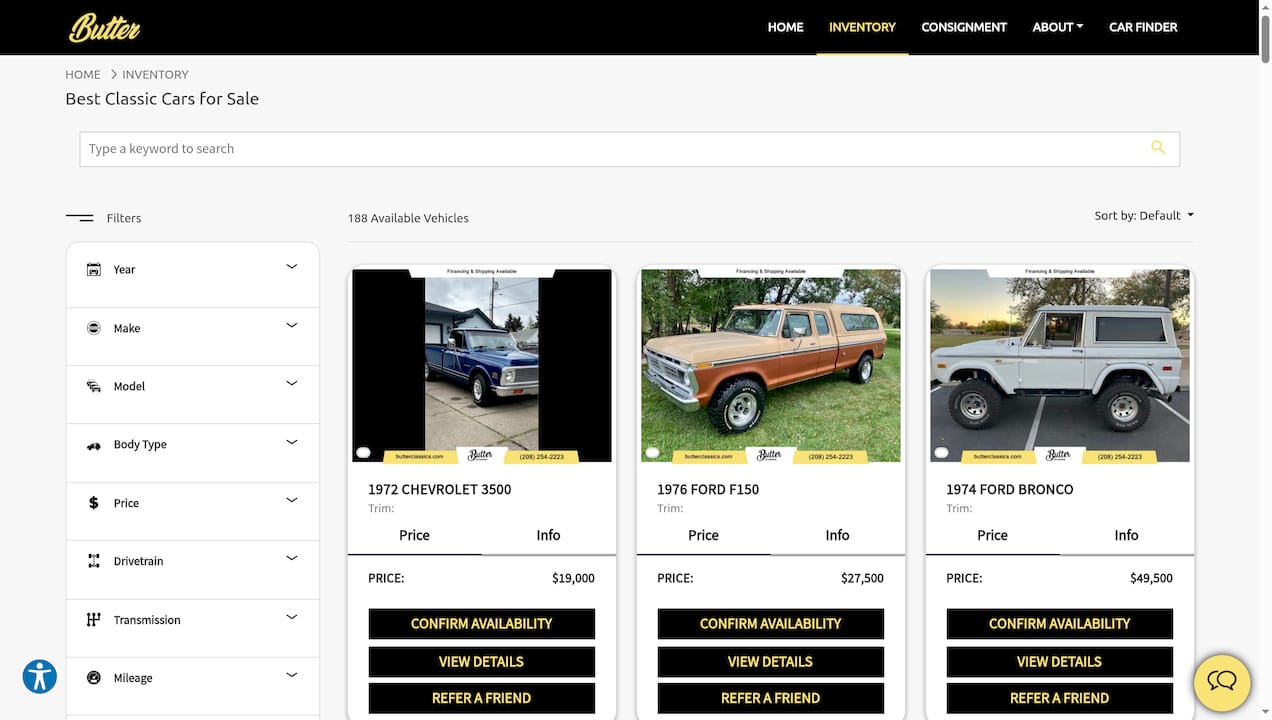
If you're holding a car that fits the profile this guide just walked through, a documented, desirable model with clean provenance, consigning your vehicle puts it in front of a nationwide buyer pool without you having to manage listings, inquiries, or paperwork yourself. If you're on the buying side, browsing the current inventory is the fastest way to see what's actually available right now, from early Broncos to muscle car icons, with the specs and photos you need to start your due diligence today. Whichever side of the transaction you're on, start by seeing what's live on the lot.
Sources
- Q2 2026 Collectible Cars Market Update - Black Book
- The collector car market continues to cool as summer heats up - Hagerty Media
- Classic car market demographic/taste shift coverage - CNBC
- Investing in collectible cars: top tips and risks - Investopedia
FAQ
What Is the Forecast for the Classic Car Market in 2026?
The market is forecast to stay selective rather than broadly booming. High-end blue-chip cars and supercars are expected to hold firm while the broad middle continues cooling, based on Hagerty's 2026 market commentary. Muscle and pony cars are showing modest gains, while some American classics and sports cars are softening.
What Are the Best Classic Cars to Buy as an Investment?
The strongest 2026 candidates combine documented rarity with genuine drivability, including air-cooled Porsche 911s, early Ford Broncos, the Datsun 240Z, and manual-transmission modern classics like the Mazda MX-5 Miata. A curated shortlist breaks down twelve specific models across price tiers.
Are Classic Cars Going Down in Value?
Some segments are softening while others hold or gain, so it depends entirely on which category you mean. American classics and traditional sports cars have shown weaker results in 2026, while muscle cars, trucks, and modern classics have generally held or improved according to Black Book's market data.
What Classic Cars Are Coming Back in 2026?
Late-1990s and 2000s manual-transmission performance cars, often called "modern classics," are seeing rising demand as younger collectors enter the market wanting analog driving experiences, per CNBC's coverage. Restomod trucks and SUVs are also gaining traction as buyers want usable vehicles that mix vintage looks with modern reliability.
Does Butterclassics Offer Financing for Investment Classic Cars?
Yes, Financing pre-qualification is available so buyers can understand their budget before committing to a purchase, alongside consignment services for sellers. Current inventory and pricing are available directly on the Butterclassics site.