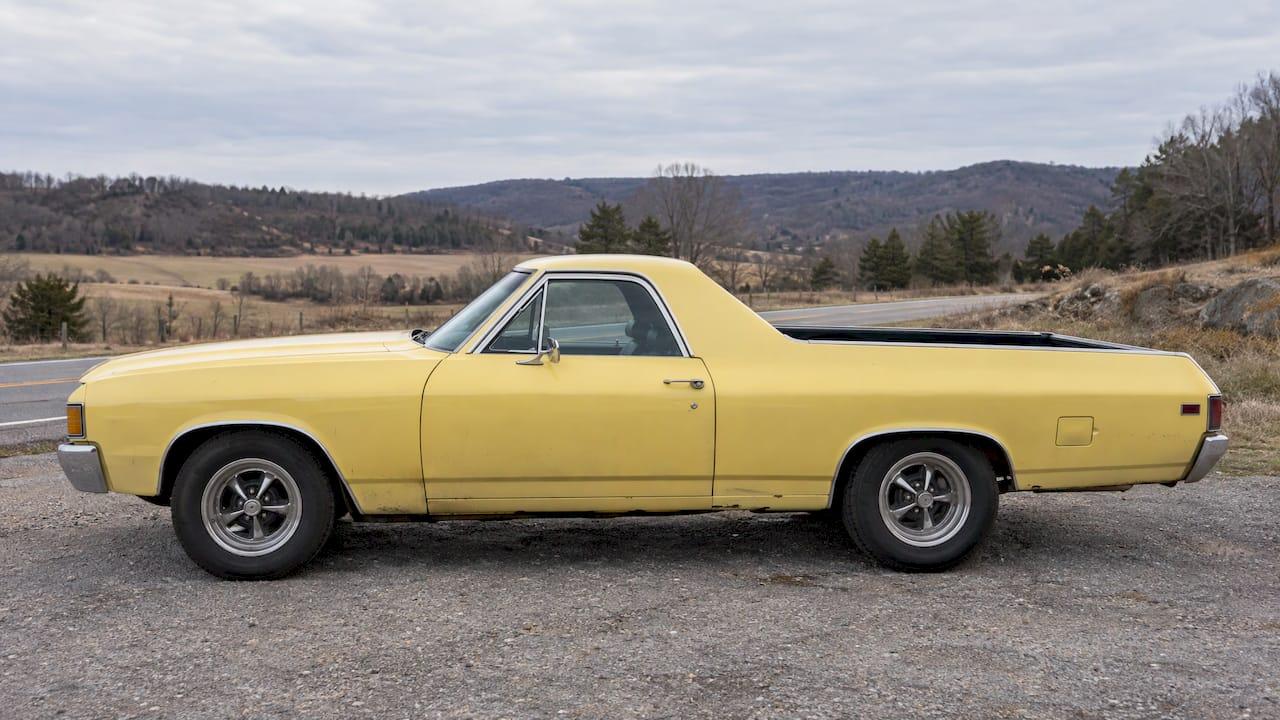
The best El Camino for most collectors is a 1968–1972 car with documented factory equipment. A late-run 1978–1987 car is the smart pick if you want a driver at a lower price. Whichever you choose, the three things that decide the deal are rust in the bed and rear window area, proof that the engine and SS equipment are real, and a total cost that includes repairs. We built this guide to walk you through each one, and when you're ready to shop, you can browse our classic inventory.
TL;DR
- 1968–1972 is the muscle-car era. Big-block SS cars sit at the top of the market, while non-SS cars with standard engines often trade under $40,000.
- The downsized later cars are the budget way in. Past auction results ran from about $3,000 to $4,000 for cars needing work.
- Rust collects around the wraparound rear window and under the bed. Check both before you look at anything else.
- An SS badge proves nothing. Ask for build-sheet paperwork and check the engine and VIN details against it.
- Budget for repairs. A pile of small fixes can quickly cost more than the car is worth.
Table of Contents
- What an El Camino Is, and Why Collectors Want One
- The 1968–1972 Muscle Years
- The Budget Route: 1973–1987
- Where El Caminos Rust
- Is It Really an SS? Verifying the Car
- Parts, Repairs and the Real Cost of Ownership
- Matching the Car to Your Goal
- Ready to Buy or Sell?
- FAQ
- Sources
What an El Camino Is, and Why Collectors Want One
The El Camino is Chevrolet's car-based pickup. It has a car's front end and cabin, with an open bed behind the seat. That mix is the appeal: you get muscle-car looks and a bed you can actually use.
The nameplate ran across several generations. Which one you buy changes everything about price, parts, and what you'll worry about. Here's the short version.
| Years | What it is | Who it suits |
|---|---|---|
| 1959–1960 | Rare first-generation cars | Collectors who want something unusual |
| 1964–1967 | Chevelle-based mid-sixties cars | Buyers who want classic lines at a moderate price |
| 1968–1972 | The muscle-car generation | Collectors and investors |
| 1973–1977 | Heavier mid-seventies cars | Budget buyers who accept lower power |
| 1978–1987 | Downsized final generation | Drivers and first-time classic buyers |
The 1968–1972 group is the one most buyers mean when they search for an El Camino. The rest of this guide spends the most time there, then covers the budget end.
The 1968–1972 Muscle Years
This is the generation with the horsepower. According to MotorTrend Classic's buyer's guide, the 1968 SS was its own distinct model with 396-cubic-inch engines rated at 325, 350 or 375 horsepower. By 1970, SS396 and SS454 choices were on the list, including the 454 LS5 at 360 horsepower and the LS6 at 450 horsepower.
That range explains the price spread you'll see. A 450-horsepower car and a six-cylinder car share a body, but they are very different purchases.

What these cars cost
Hagerty's 2024 market analysis shows a clear hierarchy. Rare high-performance SS cars such as the 1970 LS6 can command over $100,000, while non-SS models with standard engines often trade under $40,000. Engine rarity and displacement drive the gap, with big-block cars above small-block cars. That's a pattern you'll recognize from the wider muscle-car hobby.
What this means for you:
- Investment buyer: Pay for documentation. A real LS6 is valuable, and an unproven one is a gamble.
- Collector: Decide whether you need a big-block. A well-kept small-block car costs far less and still looks the part.
- Restorer: A non-SS car with a solid body is the usual starting point, because you control the build and avoid paying a premium for someone else's work.
Prices move with the market and with condition, so treat any figure here as a published snapshot. Check a current valuation guide and recent sale results for the exact year and engine before you make an offer.
The Budget Route: 1973–1987
Not every buyer wants a six-figure car. The later, downsized El Caminos are where most people get in.
Old Cars Weekly reported that third- and fourth-generation downsized cars could sell at local auctions for $3,000 to $4,000. After upgrades, some brought about $6,500 to $14,100 at larger collector-car auctions. The same article described the final generation as a possible new collecting trend after an above-average number crossed an auction block.
That's useful for two kinds of buyers:
- First-time classic owner: You get an easy-to-live-with truck-car and a low entry price.
- Flipper or restorer: Buying a rough one, fixing it right and selling it into rising interest is a real strategy. It only works if you buy the right car, which brings us to inspection.
As a rule of thumb, a good-condition late-run car is a driver, not an appreciating asset on the level of an SS. Buy it because you want to drive it, and any gain is a bonus.
Where El Caminos Rust
Rust is the first thing to check on any generation. Don't let a shiny paint job talk you out of looking.
Rear window and roof
On the 1968–1972 cars, MotorTrend notes that water can trap around the wraparound rear window and underneath the bed. That rusts the frame and the supports for the vinyl roof. If the car has a vinyl top, ask to look beneath it. A bubble in the vinyl or a wavy edge at the window can mean corrosion that's expensive to fix properly.

The bed and frame
The bed is a pickup bed bolted to a car body, so water sits where it shouldn't. Get under the car with a flashlight. Look at the bed floor from below, the bed supports, and the frame rails.
For the early cars, Hagerty's profile of the 1959–1960 El Camino points to metal fatigue and rust in the pickup bed as a critical issue on these rare models. Bed parts for the earliest cars are harder to find, so a rotten bed hurts more there.
A quick inspection order
- Walk around in daylight and look for uneven panel gaps and paint that doesn't match.
- Check the wraparound rear window seal and the area under any vinyl top.
- Lie down and inspect the bed floor, bed supports and frame rails.
- Open the doors and check the floor pans and rocker areas.
- Look at the engine bay for non-original parts, leaks and sloppy wiring.
- Test drive, then look underneath again for fresh drips.
Our classic car test drive checklist covers what to feel and listen for once the engine is running.
Is It Really an SS? Verifying the Car
This is where buyers lose the most money. Clone cars are common across the muscle-car hobby, and the El Camino is no exception.
MotorTrend points out that 1968 was the only year the SS was a separate model. In other years it was an option package, which makes it easier to imitate. A buyer should separate factory SS equipment from appearance-only modifications, and factory correctness can be checked against build-sheet documentation.
Here's what to ask for and compare:
- Build sheet or other factory paperwork. This is the strongest proof of what left the factory.
- VIN. It should match the title and the dash plate, and it should fit the model year and body style you've been told about.
- Engine stamping. The block carries codes that can be compared to the car's documented specs. If the seller says it's a numbers-matching big-block, the stamping should agree with the paperwork.
- Transmission and rear axle. Check that they make sense for the claimed engine.
- Seller's story. Ownership history and past photos help, and they should line up with everything above.
If you want a worked example of the same process on a sister car, our 1968–72 Chevelle SS inspection checklist walks through it. The El Camino shares a lot with the Chevelle, so most of those checks carry over.
If a seller can't produce paperwork for a car priced as a real SS, treat it as priced for a clone until proven otherwise. That's a negotiation point, not necessarily a dealbreaker, but only if the price reflects it.
Parts, Repairs and the Real Cost of Ownership
The good news is parts. MotorTrend Classic suggests the El Camino's close relationship with the Chevelle is a major benefit, with excellent parts interchangeability and a wide aftermarket supporting many components. Mechanical parts are generally easier to find than for rarer classics. Body panels, trim and bed pieces are more specific, so check what's available before you commit to a restoration.
The bad news is how repair bills behave. Old Cars Weekly warns that repair costs, whether from a serious problem or lots of small ones, can quickly add up and eclipse the vehicle's value. A $4,000 truck that needs paint, a bed, brakes and an interior is no longer a $4,000 truck.
Here is a simple way to budget:
- List everything wrong after your inspection, including the small stuff.
- Price each item with quotes from a shop, not guesses.
- Add the total to the purchase price.
- Compare that number to what a finished, comparable car sells for. If the total is higher, walk away or negotiate.
The cheapest car is rarely the cheapest outcome. A better-condition car at a higher price often costs less overall than a project that needs everything.
Matching the Car to Your Goal
| Your goal | Best fit | What to prioritize |
|---|---|---|
| Investment | Documented 1968–1972 SS | Paperwork, matching numbers, original panels |
| Show and collect | Correct, well-restored 1968–1972 car | Restoration quality, rust-free structure |
| Weekend driver | 1978–1987 car in good shape | Mechanical condition, a clean body, low cost |
| Restoration project | Non-SS 1968–1972 or a solid 1964–1967 | Frame and cab integrity, parts availability |
| Dealer or flipper | Late-run cars you can buy under market | Buying right, accurate repair estimates |
If you're newer to older trucks and car-based pickups in general, our classic truck buying guide covers the fundamentals. For the bigger picture on pricing, see our classic car market trends checklist for 2026 buyers.
What We Think
Here's how we look at an El Camino. It's one of the most fun cars in the hobby, and it's easy to buy badly. The truck is half car, half pickup, so it hides problems in both halves.
That's why we like to see the paperwork before the paint, and why we think buyers do best when the car's details are laid out clearly: lots of photos, full specs, and a straight description. Our listings are built that way on purpose, so you can judge a car before you ever travel to see it.
We also like buying from a marketplace that isn't limited to one lot. A nationwide inventory means you can compare cars across the country instead of settling for whatever is local. Our vehicles come with our Worry Free Guarantee, and we can help with delivery or pickup, so the car you pick ends up in your driveway without a headache.
If you're selling, consignment lets you put a car in front of serious buyers without running the process yourself. Either way, we want the deal to feel smooth as butter.
Tony
Ready to Buy or Sell?
When you're comparing cars, you want clear photos, full specs and a straightforward process. Our marketplace lists classic cars, vintage trucks, muscle cars and collector vehicles with detailed listings you can browse by price or type. You can also get pre-qualified through classic vehicle financing, schedule a test drive or request a quote.
Have an El Camino or another classic to sell? Consign your vehicle with us and reach buyers nationwide.
FAQ
Which El Camino years are best?
For collectors and investors, 1968–1972 is the strongest generation, and documented SS cars lead the market. For a budget driver, a late-run 1978–1987 car in good condition is a sensible choice. Match the year to your goal rather than chasing one answer.
How much does an El Camino cost?
It depends on generation, engine and condition. Hagerty's 2024 data shows rare 1968–1972 SS models like the 1970 LS6 can pass $100,000, while non-SS cars with standard engines often trade under $40,000. Downsized later cars have sold in the low thousands, so always check current sale results for your exact year.
Where do El Caminos rust the most?
Check the wraparound rear window, the area under the vinyl roof, the underside of the bed and the frame. MotorTrend says water can trap around the rear window and beneath the bed. Early 1959–1960 cars also need a close look at the bed for rust and metal fatigue.
How do I know an El Camino is a real SS?
Ask for build-sheet documentation and compare it to the VIN and the engine stamping. MotorTrend notes the SS was a separate model only in 1968, and in other years it was an option, so badges alone prove nothing. A seller who can't supply paperwork for a car priced as an SS leaves you paying for a claim.
Are El Camino parts hard to find?
Mechanical parts are generally easy to source because the El Camino shares so much with the Chevelle, and MotorTrend notes a wide aftermarket. Body, trim and bed pieces can be harder to find, especially on the oldest cars. Check availability before you start a restoration.
Sources
- Buyer's Guide: 1968–1972 Chevrolet El Camino, MotorTrend Classic
- Despite Riding a High, Values of Most '68–72 El Caminos Are Modest, Hagerty Media
- Hauling interest: final-gen El Caminos are picking up steam, Old Cars Weekly
- Collectible Classic: 1959–60 Chevrolet El Camino, Hagerty Media