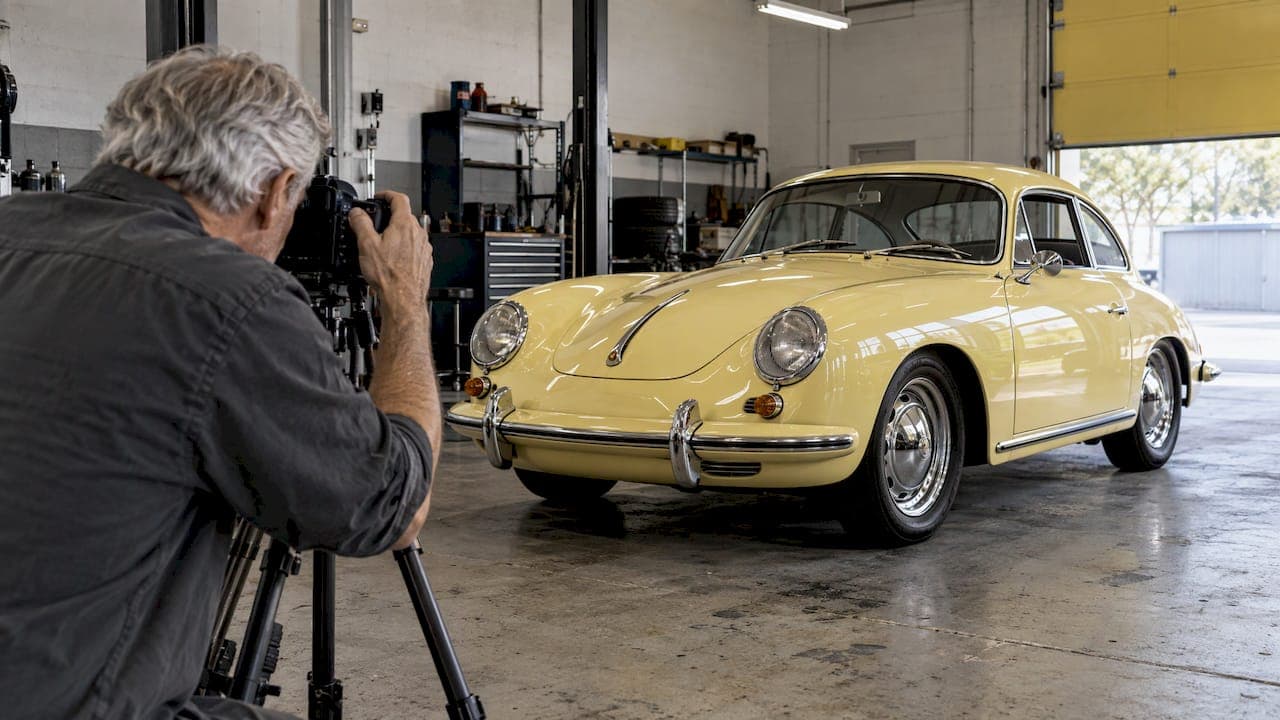
Most classic car consignments run in four stages: prep and onboarding, listing and marketing, the sale itself, and payout. The first two are quick. The third depends on your car, your price and the season. The last depends on paperwork and how the buyer pays. No honest seller can promise a fixed number of days for the whole thing, but you can know what each stage involves and what slows it down. That's what this guide covers.
TL;DR
- Think in stages, not one number: onboarding and prep, listing, finding a buyer, closing, then payout.
- The biggest swing factor is the time on the market, and that comes down to price, photos, documentation and condition.
- Payout usually follows the sale once the title work is done and the buyer's funds have cleared. Get the payout deadline in writing.
- Read the agreement for the sale period, extension terms, notice period for pulling the car and who pays for what.
- You can consign more than one car. Each one runs on its own clock, so agree on terms car by car.
Table of Contents
- The consignment timeline at a glance
- Stage 1: Onboarding and the agreement
- Stage 2: Prep and photography
- Stage 3: Pricing and going live
- Stage 4: Finding the buyer
- Stage 5: Closing the sale
- Stage 6: When the payout arrives
- Consigning more than one car
- How to shorten your timeline
- Ready to consign with us?
- FAQ
- Sources
The consignment timeline at a glance
Here's the simplest way to picture it. Each stage has its own job and its own usual delays.
| Stage | What happens | What can slow it down |
|---|---|---|
| 1. Onboarding | You share details, agree on a price range, sign the agreement | Missing paperwork, unrealistic price expectations |
| 2. Prep | Cleaning, inspection, photos and a full write-up | Mechanical fixes, weather, scheduling |
| 3. Listing and marketing | The car goes live and buyers see it | Weak photos, thin descriptions, a price set too high |
| 4. Buyer search | Inquiries, questions, test drives, offers | Season, niche demand, buyer financing |
| 5. Closing | Offer accepted, deposit, bill of sale, title work | Liens, lost titles, out-of-state registration |
| 6. Payout | Buyer's funds clear, the seller is paid, fees come out | Payment method, title delays, agreement terms |
Stages 1 to 3 are the part you can influence the most. Stages 4 to 6 are where patience comes in.
Stage 1: Onboarding and the agreement
This is the stage where you can save yourself weeks later. You describe the car, share its history and agree on a target price. You also sign a consignment agreement.
Before the car goes anywhere, gather these:
- The title, in your name, and a lien payoff letter if there's a loan
- Service records, restoration receipts and build sheets
- Any documentation that supports originality, like a window sticker, a Marti Report for a Ford, or owner history
- A list of known issues, because buyers find them anyway
A missing or clouded title is the single most common reason a straightforward sale turns into a slow one. If your title has a lien or an old owner's name on it, start fixing that now, not after you have a buyer.
We go deeper on agreement language in our guide on consignment agreement terms, and our best practices for consignors cover the handoff in detail.
What to check in the agreement
Read these items line by line and ask questions before you sign:
- The sale period. How long does the agreement run, and what happens at the end? Does it renew automatically or stop?
- Extensions. Who can extend the term, and do you have to agree to it?
- Notice to withdraw. If you change your mind, how much notice do you give? One UK dealer's commissioned sales FAQ says there's no penalty for reclaiming a car, subject to the agreed notice period. That's one business's policy in one country, but it shows the kind of clause to look for in a US agreement too.
- Payout deadline. How many days after funds clear do you get paid? Write the number into the agreement.
- Costs. Who covers storage, transport, detailing and advertising? Are they deducted at sale or billed up front?
- Price changes. Who decides on a price drop, and how do you approve it?
If an answer isn't in the agreement, it isn't a promise. Get it added.
Stage 2: Prep and photography

This stage is usually measured in days, not weeks, as long as the car is sound. A car that starts, stops and drives right can move through it fast. A car with a stalled project or a leaking seal can sit while parts are sourced.
Good prep covers three things:
- A mechanical check. Fix safety items first: brakes, tires, lights, steering. Cosmetic touch-ups can come second.
- A thorough clean. Paint, chrome, glass and engine bay all show up in photos. Even a detailing step as simple as using a spray and rinse coating panel by panel helps avoid streaks before photos are taken.
- A full photo set. Walkaround, interior, engine bay, undercarriage, trunk, odometer, VIN plate and any flaws. Our guide to photographing classic cars for listings walks through the shots buyers look for.
Photos are worth the time. A buyer three states away decides whether to call based on what's on the screen. Rushing this stage often costs you more weeks in stage 4.
Stage 3: Pricing and going live
Once the listing is live, the clock on the market starts. Pricing is the lever with the most effect on how long that clock runs.
A price set a little above the market can leave a car sitting while newer listings take attention. A price set to the market gets inquiries early, when a listing is freshest. If you're unsure where the number should land, our 2026 guide to pricing classic cars for resale shows how to build a range from comparable sales, condition and documentation.
A few tips for the first few weeks after listing:
- Treat the first couple of weeks as your best window. Early attention is highest, so the price and photos need to be right on day one.
- Agree up front when you'll review the price if inquiries are slow.
- Make sure the description answers the obvious questions: matching numbers, originality, rust history, recent work, what's included.
Stage 4: Finding the buyer
This is the part nobody can put a firm date on. Classic cars are not commodities. A clean, well-documented, popular model, like a Mustang, a Bronco or a square-body truck, tends to draw more eyes than a rare but obscure one. Rare cars can still sell well, but the right buyer takes longer to find.
These things shape the length of this stage:
- Model demand. Broad-appeal cars have a bigger pool of buyers.
- Condition and documentation. A car with records and clean photos earns trust faster.
- Price relative to the market. The simplest factor, and the most common reason for a long wait.
- Season. Warm months generally bring more drive-it-now interest in much of the US, while winter can be slower for convertibles and project cars. Use it as a rough guide, not a rule.
- Reach. A listing seen by buyers across the country has a bigger pool than one seen only by people who walk through a lot.
A quick note on test drives: they take scheduling, and buyers often want a pre-purchase inspection too. Both add days, but they also lead to cleaner closings, with fewer surprises after the deal.
Wondering how this compares to other sales routes? Our breakdown of consignment versus a private sale looks at the money side, and the consignment versus auction piece covers timing.
Stage 5: Closing the sale
An accepted offer is not the end. Closing is a short checklist, but every item has to be done right:
- The buyer puts down a deposit.
- Both sides sign a bill of sale.
- The title is signed over, and any lien is released.
- The buyer pays the balance, by wire, cashier's check or financing.
- Transport is booked, or the buyer picks the car up.
The most common closing delays are:
- A lien on the title. The lender has to be paid and has to release the title. That can take a while, so ask for the payoff letter early.
- A lost or incorrect title. Replacement titles come from your state's motor vehicle agency, and processing times vary by state. Check your state's official page for the current process.
- Buyer financing. If the buyer is financing, the lender's approval and paperwork add time. Buyers who prequalify before they shop tend to close faster.
- Out-of-state registration. Different states have different rules for older vehicles, and the buyer handles those, but they can pause pickup.
Stage 6: When the payout arrives
This is the question most consignors ask first: how long after the car sells do I get paid?
The honest answer is that payout follows the clearing of the buyer's money, and the agreement sets the deadline. In general, the order goes like this:
- The buyer's funds arrive and clear.
- The title is transferred.
- Agreed fees and any approved costs are deducted.
- The balance is paid to you.
The payment method matters. A wire usually clears fast. A personal check or a financing draw can take longer, and a responsible consignor waits until funds have actually cleared before releasing the car or paying out. That protects both of you.
If you want a sense of how payout timing compares between routes, our article on consignment versus auction, with payment expected in weeks lays it out. Whatever the route, ask for the payout window as a number of days in writing, plus how you'll be paid.
Here's a quick payout checklist to use with any consignor:
- How many days after cleared funds will I be paid?
- Will I be paid by wire, check or something else?
- Which fees come out, and will I see an itemized statement?
- What happens to the money if the buyer's payment is delayed or disputed?
- Is the car insured while it's in your care, and does the agreement say so?
Consigning more than one car
Yes, you can consign multiple cars. Collectors often do, whether it's a few cars from an estate or a collection that's being trimmed down. Here's how it works in practice:
- Each car runs on its own clock. One may sell in a short time while another sits longer. Don't expect them to move in lockstep.
- Agree on terms car by car. Price range, minimum, sale period and fees can differ from one car to the next, and each should be spelled out in writing.
- Stagger listings if you can. Listing a Bronco and a Mustang together is fine because they attract different buyers. Listing three near-identical cars at once can mean they compete with each other.
- Ask about payouts. Each sale should come with its own payout, so you aren't waiting on the slowest car to get paid for the fastest one.
- Keep paperwork organized. Titles, records and photos for each car should be in separate folders, so nothing is held up.
If you're consigning a collection, tell us about it up front. That helps plan photos, transport and pricing across all the cars.
How to shorten your timeline
You can't control the buyer, but you control plenty:
- Start with a clean, in-your-name title or a lien payoff letter.
- Fix safety and drivability items before listing.
- Invest in photos and a full description.
- Price to the market, backed by comparable sales.
- Respond quickly to questions and test drive requests.
- Get the payout terms in writing before you sign.
Sellers who follow these steps tend to spend less time waiting, not because there's a trick, but because buyers can say yes with confidence.
Our take on consignment
Most sellers come to us wondering one thing: how long is this going to take? We get it. But in our experience, the better question is: what's going to hold my car back? Usually it's the same short list: a price that's out of step, thin photos, missing paperwork or a vague agreement.
That's why we built our consignment service around clarity. You sit down with us, talk about what the car is worth, and set expectations on the process before anything is listed. Our inventory isn't tied to one lot, so your car is in front of buyers nationwide. And because we focus on enthusiasts and collectors, the people looking at your car are there for a classic, not a daily driver.
We also stand behind what we sell. Our Butter Certified vehicles come with our Worry Free Guarantee, and we offer personalized delivery or pickup. For consignors, that means a smoother path from the first call to the final handshake, as smooth as butter.
Tony
Ready to consign with us?
If you have a classic car, truck, muscle car or 4x4 and you want it in front of serious buyers, we can walk you through the process, from the first conversation to the sale. We list cars with detailed specs and extensive photos, and buyers can schedule test drives, request quotes and get financing prequalified, all in one place.
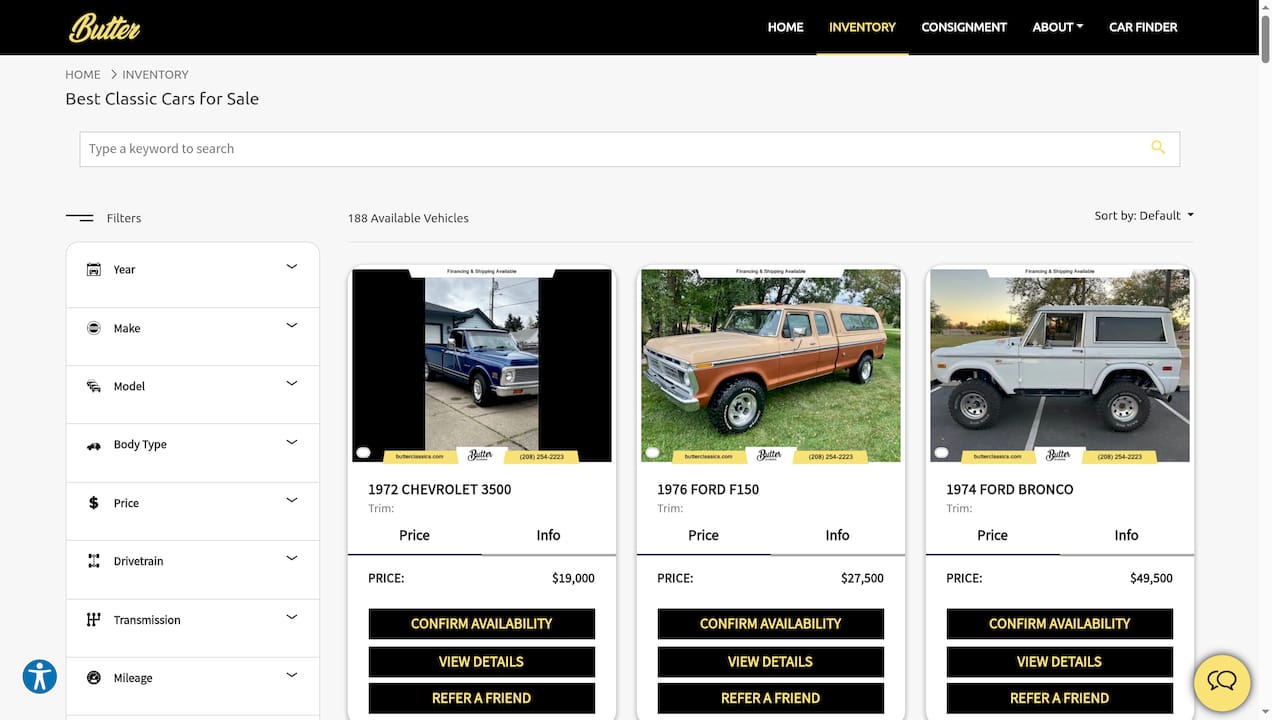
Start on our Consign Your Vehicle page to share your car's details. Want to see what buyers see? Browse our current inventory first.
FAQ
How long does classic car consignment take?
It varies from car to car. Onboarding and prep can take days, but the time on the market depends on the model, price, condition and season. Ask your consignor how they handle price reviews, so a slow start doesn't turn into a stalled listing.
How long after the car sells do I get paid?
Payout follows the sale once the buyer's funds have cleared and the title work is done. The exact number of days should be written into your consignment agreement. Ask about the payment method and what fees will come out of the total.
Can I consign more than one car at a time?
Yes. Each car should have its own terms, price range and payout. They'll sell on their own timelines, so don't expect them all to move together. Staggering similar cars can help them avoid competing with each other.
Can I pull my car back before it sells?
That depends on your agreement. Look for the notice period and the return process, plus any costs due on withdrawal. If the terms aren't clear, ask for them in writing before you sign.
What paperwork do I need before consigning?
At minimum, a title in your name or a lien payoff letter, plus any records you have. Service receipts, restoration photos and original documents all help buyers trust the car, and that tends to speed up the sale.