
A solid consignment agreement guarantees four things: the consignor keeps title until the item sells, the commission and payment deadlines are spelled out in exact numbers, every item has an agreed value on a written inventory schedule, and there's a clear process for returns, insurance, and inspection. Skip any one of these and you're trusting a handshake instead of a contract.
TL;DR:
- Filing a UCC-1 financing statement is critical if the consignment meets the $1,000 threshold to protect your security interest from creditors.
- Clearly specify that the consignee acts solely as a bailee and never gains ownership through detailed ownership clauses and inventory documentation.
- Avoid ambiguous commission terms by defining a fixed percentage or flat fee based on a specified sale amount, with explicit controls on discounts.
- Set firm reporting and payment timelines, requiring detailed sales reports and establishing interest and penalties for late payments.
- Include precise expiration, return procedures, and insurance requirements, especially for high-value items like vehicles, to reduce disputes and maximize legal protections.
Table of Contents
- Ownership, title, and bailee language
- Commission, pricing control, and discounts
- Payment timing, reporting, and accounting access
- Term length, unsold goods, and return logistics
- Risk of loss, damage allocation, and insurance requirements
- Inventory schedule, identification, inspection and audit rights
- Disclosures and compliance under UCC and FTC rules
- Termination, settlement, and dispute resolution
- Clause checklist and sample phrasing to adapt
- How Butter Classics approaches consignment terms
- Weighing commission against control
- Ready to consign your classic vehicle?
- FAQ
- Sources
Ownership, title, and bailee language
The whole point of a consignment agreement is that you, the consignor, never stop owning your property until it sells. The consignee (the dealer, shop, or marketplace holding your item) is legally a bailee, meaning they have possession but not ownership. That distinction needs to be written in plain words, not implied.
A clean ownership clause reads something like this: "Consignor retains title to the goods at all times prior to a completed sale to a third-party buyer. Consignee holds the goods solely as bailee for the purpose of display and sale, and acquires no ownership interest."
Precise identification matters just as much as the title language itself. For vehicles, that means VIN, mileage, and condition notes. For smaller goods, SKU or serial numbers do the job. Either way, the details belong in an attached inventory annex, not buried in the body text.
- Name the consignor as title holder in the opening paragraph of the contract.
- Attach a signed inventory schedule listing each item's identifying number and condition.
- Label the consignee explicitly as a bailee, never as a buyer or owner.
- Reference the inventory schedule by exhibit number so it's legally part of the agreement.
Here's where the law adds a wrinkle. Under UCC §9-102, a consignment qualifies for Article 9 treatment when the consignee is a merchant dealing in goods of that kind, is not generally known by its creditors to be selling consigned goods, and the aggregate value of goods delivered is $1,000 or more. If your deal meets that bar, filing a UCC-1 financing statement can perfect your security interest and protect your goods from the consignee's creditors.
One rule changes everything if you skip the paperwork: under UCC §9-319, a consignee in possession of your goods is treated as having rights and title for purposes of its own creditors and purchasers, unless you've perfected a security interest. That means an unperfected consignor can lose a dispute with the consignee's bank or a bankruptcy trustee, even though the goods were always "yours." Filing early removes the ambiguity.
Commission, pricing control, and discounts
Ambiguous commission splits cause more consignment disputes than almost anything else. The fix is simple: write the formula as a number, apply it to a defined base, and say who controls pricing.
Decide upfront whether the commission applies to the gross sale price or the net amount after processing fees, shipping, or marketing costs. That gap adds up fast across multiple sales, so the contract should state the base explicitly rather than leaving it to interpretation.
- State the commission as a fixed percentage or flat fee tied to a named base (gross or net).
- Specify who approves markdowns and by what percentage threshold.
- Address how bundled sales or partial payments get split between consignor and consignee.
- Note which party absorbs payment-processor fees before the commission is calculated.
Discount authority deserves its own sentence. Any discount exceeding that threshold requires written consent. That single line prevents a consignee from quietly selling your item at half price to clear inventory faster.
Pro Tip: Write out one full sample calculation in the contract itself, showing the commission applied to an example sale price, so there's no room for a "that's not what I meant" argument later.
Payment timing, reporting, and accounting access
Vague payment terms are the second-biggest source of consignment disputes after pricing confusion. Fix it by nailing down three things: how often the consignee reports sales, what the report must contain, and exactly how many days they have to pay after the report goes out.
- Set a reporting cadence, such as monthly, and require the report to include units sold, sale price, discounts applied, returns, and remaining stock.
- Define a firm payment window, commonly 15 to 30 days after the reporting period closes, per common contract template guidance.
- Grant the consignor reasonable inspection or audit rights over sales records tied to their goods, with a notice period for requesting access.
- Include a late-payment interest rate and a set-off clause letting you deduct unpaid commissions from future settlements if the consignee falls behind.
For high-value items, consider routing proceeds through escrow or requiring certified funds before releasing title paperwork. That extra step protects you if a buyer's check bounces after the consignee has already reported the sale as final.
Pro Tip: Tie every payment to a fixed reporting format rather than a narrative email. Numbers in columns are harder to dispute than a paragraph of explanation.
Term length, unsold goods, and return logistics

Every consignment agreement needs an expiration date and a plan for what happens if the item doesn't sell by then. Leaving the term open-ended invites your goods to sit forgotten on a shelf for a year.
A typical term runs 60 to 90 days, with either party able to terminate early on 14 to 30 days' written notice. Build the return mechanics into the same clause so there's no separate negotiation needed when the deadline arrives.
- Specify the exact term length and renewal process, including whether renewal is automatic or requires new written consent.
- Decide who pays to ship or transport unsold goods back to the consignor.
- Require consignor written consent before any donation of unsold inventory, rather than letting the consignee decide unilaterally.
- Set automatic markdown schedules (for example, a 10% reduction every 30 days) if you want the item to sell faster instead of just sitting.
- Note the condition the item must be returned in, and whether a restocking or handling fee applies if it comes back damaged.
End-of-term reporting should mirror the regular sales reports: a final accounting of what sold, what's unsold, and what's owed. That closes the loop cleanly and gives both sides a paper trail if a dispute surfaces later.
Risk of loss, damage allocation, and insurance requirements
Once your item leaves your hands, someone has to be on the hook if it's stolen, damaged, or destroyed. Two approaches dominate consignment contracts: the consignee assumes risk of loss from the moment of delivery, or risk shifts only at the point of sale. For higher-value goods, including classic vehicles, the safer default is the first option, paired with a hard insurance requirement.
- Require the consignee to carry insurance covering the full agreed value of consigned goods while in their possession.
- Name the consignor as an additional interested party or loss payee on the policy.
- Set a minimum coverage amount tied to each item's listed agreed value, not a blanket policy limit that might fall short.
- Include a claims notification window, such as 48 hours after discovering loss or damage.
Agreed values do double duty here. Guidance on drafting strong consignment contracts recommends recording an agreed value for each item upfront, since that figure speeds up insurance claims and removes the "what was it actually worth" argument that stalls settlements. A written, signed agreed value on the inventory schedule is one of the simplest protections available, and it costs nothing to add. Subrogation language, letting the insurer pursue a negligent third party after paying your claim, belongs in the same section so you're not left negotiating that separately after a loss.
Inventory schedule, identification, inspection and audit rights
An inventory schedule isn't paperwork for paperwork's sake. It's the document that proves what you handed over, in what condition, and at what value, which matters enormously if goods go missing or a dispute reaches a courtroom.
- List each item's description, condition notes, serial number or VIN, and agreed value on the schedule.
- Attach timestamped delivery photos as an exhibit, since a photographic record is one of the cheapest and most effective protections against "it was already damaged" disputes.
- Require the consignee to physically segregate and label consigned goods from their own inventory or goods consigned by others.
- Set inspection rights with a reasonable notice period, such as 5 business days, and a defined scope covering stock counts and sales records.
- Require written records to be retained for a set period after the item sells or the term ends, commonly at least a year, with electronic copies accepted.
Practical drafting guidance consistently points to segregation and inspection rights as the clauses most often missing when disputes escalate into insolvency or theft claims. Building them in from the start costs a few extra sentences and saves a lot of argument later.
Disclosures and compliance under UCC and FTC rules
Consignment contracts don't exist in a vacuum. Two federal frameworks shape what you can and can't put in the fine print, and ignoring either one creates real legal exposure.
- Confirm your deal meets UCC §9-102's definition before assuming Article 9 protections apply: merchant status, a different trade name, and an aggregate delivery value of $1,000 or more.
- Remember that under UCC §9-319, an unperfected consignor's rights can lose out to the consignee's creditors or a good-faith purchaser.
- For vehicles specifically, confirm the consignee complies with the FTC Used Car Rule, which requires a Buyers Guide displayed on any vehicle offered for sale.
- Flag state dealer licensing rules for legal review, since several states require written consignment agreements and quick remittance timelines specific to vehicle sales.
A dealer who displays a consigned vehicle for sale is still responsible for the Buyers Guide and disclosure obligations that apply to any used car on the lot.
That last point catches a lot of first-time consignors off guard. Just because you're not the one legally selling the car doesn't mean disclosure rules disappear. Build a clause requiring the consignee to confirm in writing that they'll meet applicable state licensing and vehicle disclosure duties, and keep that confirmation on file.
Termination, settlement, and dispute resolution
A good termination clause answers three questions before trouble starts: how much notice is required, how the final accounting gets settled, and where a dispute gets resolved if talks break down.
- Set a standard notice period, commonly 14 to 30 days, for either party to end the agreement without cause.
- Allow immediate termination and return of goods if the consignee becomes insolvent, misuses the goods, or refuses to pay on schedule.
- Require a final accounting and settlement within a fixed window, such as 10 business days, after termination takes effect.
- Include a late-payment interest rate and the right to pursue injunctive relief if the consignee refuses to return unsold goods.
- Name a governing law and venue, and decide whether disputes go to mediation, binding arbitration, or court.
Mediation first, arbitration second, is a common structure: it gives both sides a shot at a cheaper resolution before locking into a more expensive process. Whatever you choose, write it into the contract rather than figuring it out after a disagreement is already underway.
Clause checklist and sample phrasing to adapt
Reviewing or drafting a consignment agreement gets easier with a short checklist in front of you. Here's the order that matters most, from protecting ownership down to exit terms.
- Title and bailee language confirming the consignor owns the goods until sale.
- Commission formula tied to a defined base (gross or net).
- Payment timeline with a fixed number of days after each sales report.
- Inventory schedule with agreed values, condition notes, and identifying numbers.
- Insurance requirements naming the consignor as an interested party.
- Term length, renewal terms, and return logistics for unsold goods.
- Termination triggers, notice periods, and dispute resolution method.
Sample ownership clause: "Consignor retains title to all goods listed on Exhibit A until the date of a completed sale to a third party. Consignee acts solely as bailee."
Sample payment clause: "Consignee shall remit payment to Consignor within 20 days of the end of each calendar month, accompanied by a written sales report."
For automotive consignments especially, state vehicle-disclosure rules and dealer licensing requirements vary enough that a generic template needs a legal review pass before signing.
How Butter Classics approaches consignment terms
Classic vehicles raise the stakes on every clause above. A missing VIN or an undocumented dent isn't a minor paperwork gap, it's a five-figure argument waiting to happen. Our consignment process starts with the same fundamentals: detailed photography, a written condition report, and an agreed value recorded before the vehicle ever goes live on the site.
That documentation does real work. It speeds up insurance claims if something happens in transit, and it gives both the consignor and the eventual buyer a shared reference point instead of competing memories of "how it looked when we handed it over." Our listing and buyer-handling process follows that same standard across every vehicle in inventory, from trucks to muscle cars to Broncos.
Payment handling follows the same logic as the clauses outlined above: a clear reporting cadence, a defined payment window, and records the consignor can review on request. None of this is unique to Butter Classics. It's simply what a well-drafted consignment agreement requires, applied consistently to vehicles that often carry more value than typical consigned goods.
Weighing commission against control
Here's the trade-off most first-time consignors underestimate: a lower commission rate usually comes with less price flexibility for the consignee, which can mean a slower sale. If you want speed, a consignee with room to discount and negotiate will often move your item faster, but you're trading some control over the final number for that speed.
Exclusivity requests from a consignee aren't automatically a red flag. A shop that wants exclusive rights for a defined term is often just protecting its own marketing investment, and that's a fair ask if the term is reasonable and tied to real effort on their end. What should concern you is anything vaguer: a consignee who won't commit to specific payment timing, resists giving you access to sales records, or hesitates to physically segregate your goods from their general stock. Those are the signs worth walking away from, not negotiating around.
— Tony
Ready to consign your classic vehicle?
Getting the paperwork right matters just as much for a 1967 Mustang as it does for any consigned good, and Butter Classics builds every one of the protections covered above into how we handle vehicle consignments. 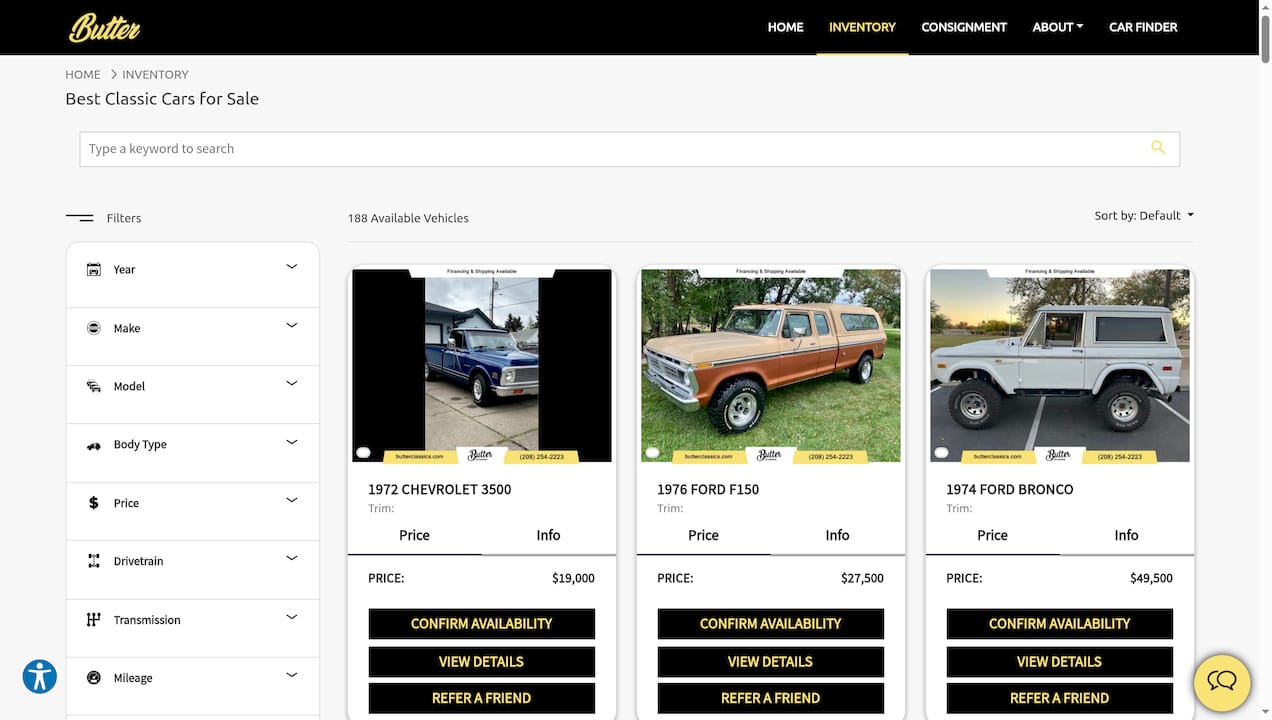
We list vehicles with full photography, a written condition report, and an agreed value recorded upfront, so there's no ambiguity about what you handed over or what it's worth. Our reach means your vehicle gets seen well beyond a single regional lot, which matters for a niche audience of collectors and investment buyers. Payment handling follows the same reporting and timing standards outlined in this article, with records available to you on request.
- Agreed values and condition reports are recorded before your vehicle goes live.
- You can review our current inventory to see the photography and detail standard we apply to every listing.
- The consignment service handles pricing strategy and buyer inquiries so you're not fielding calls yourself.
Starting the process is simple: visit our Consign Your Vehicle page, and we'll walk you through the paperwork, from title verification to the inventory schedule, step by step.
FAQ
What should be included in a consignment agreement?
A consignment agreement should include title retention language naming the consignor as owner until sale, an exact commission formula, a defined payment timeline, an inventory schedule with agreed values, insurance requirements, and a clear return process for unsold goods. Termination terms and a dispute resolution method round out a complete contract.
What does a typical consignment agreement look like?
A typical agreement opens with ownership and bailee language, followed by sections on commission, payment timing, the inventory schedule, insurance, and term length. It closes with termination triggers, notice periods, and a choice of governing law or arbitration for disputes.
What are the rules of consignment?
Under UCC §9-102, a consignment is a delivery of goods to a merchant for sale, where the merchant deals in goods of that kind, isn't known by its creditors to be selling consigned goods, and the aggregate delivery value is $1,000 or more. If that test is met, UCC §9-319 governs how creditor and purchaser rights work against an unperfected consignor.
What is a consignment agreement?
A consignment agreement is a contract where one party, the consignor, gives goods to another party, the consignee, to sell on their behalf while retaining ownership until the sale completes. The Legal Information Institute's definition describes it as combining elements of storage and agency, since the consignee holds and markets the goods without ever owning them.
Sources
- § 9-102. Definitions and index of definitions. | Uniform Commercial Code | US Law | LII / Legal Information Institute
- Federal Trade Commission - Dealers guide to the used car rule
- Consignment agreement template | Contractbook
- Consignment contracts | UpCounsel