
The best windows to buy a classic car are late fall into early winter and the post-holiday slowdown from January through March, when sellers get motivated and prices soften. The tradeoff is real: cheaper deals often come with a smaller pool of cars and a higher chance you will need to put in some work. Get your inspection checklist, financing pre-approval, and inventory alerts ready before those windows open.
TL;DR:
- Buying during late fall or early spring often yields the best prices due to seller motivation driven by storage costs and slow demand.
- Seasonal softening usually affects models unrelated to show season or warm-weather demand, making flexible buyers more likely to find bargains.
- Long-term market trends and auction results are better indicators for price direction than seasonal dips, especially for appreciating or flat-value cars.
- Online marketplaces and smaller regional auctions tend to offer better deals than top-tier sales, but require careful inspection and pre-arranged logistics.
- Hidden costs like repairs, transport, and storage can quickly offset lower purchase prices, so thorough cost analysis is essential before finalizing a deal.
Table of Contents
- 1. Seasonality: months and seller behaviors that create bargains
- 2. How market cycles and valuation trends change the ideal timing
- 3. Where deals actually show up: timing by channel
- 4. Timing tradeoffs: calculating total cost when a lower price hides extra work
- 5. Preparation checklist: inspection, financing, title checks, and logistics
- 6. Negotiation tactics and consumer protections
- 7. How a nationwide marketplace changes the timing calculus
- 8. How Butter Classics helps you act fast when the timing is right
- Sources
- FAQ
1. Seasonality: months and seller behaviors that create bargains
Classic car sellers behave a lot like anyone with a big object they need to move before winter. As storage season approaches, owners without heated garages face a choice: pay for storage or sell now. That pressure builds through October and November, and it shows up in lower asking prices from sellers who would rather take a smaller number than pay months of storage fees on a car they are not driving anyway.
The second big window comes right after the holidays. January through March tends to be the slowest stretch for classic car sales, and dealers and consignors both feel it. Showrooms and consignment lots want inventory turning over, not sitting under a cover, so this is when you will see price cuts and more willingness to negotiate. Buyer-advice reporting on classifieds and private sales has long noted that informed buyers often land better prices by timing purchases around exactly these storage and slow-demand moments.
That said, not every model follows the pattern. Cars tied to a strong show season, convertibles, and anything popular in warm-weather states can stay firm year round because demand never really dips. A numbers-matching muscle car heading into a spring show circuit is not going to get cheaper in February just because the calendar says so.
A few patterns worth watching for:
- Late fall: owners facing winter storage costs list at softer prices to avoid paying to store a car they will not drive.
- January through March: dealer and consignor inventory sits, so this is prime negotiating season.
- Pre-show clearouts: some owners sell right after a show season wraps, wanting to reinvest before the next one starts.
- Warm-climate markets: convertibles and drivable-year-round classics resist seasonal softening.
If you are flexible on make and model, autumn and late winter are when your dollar goes furthest. If you have your heart set on a specific low-mileage Bronco or a particular Corvette trim, you may have to buy whenever that car surfaces, season be damned.
2. How market cycles and valuation trends change the ideal timing
Seasonal dips and long-term market cycles are two different animals, and mixing them up costs buyers money. A seasonal dip is short and predictable: prices soften for a few months, then bounce back once spring driving season and show season pull buyers back in. A market cycle is bigger and slower, driven by collector demand, interest rates, and how much disposable income buyers have for a hobby car.
Auction results are the clearest near-term signal. When a model's recent sale prices start sliding across multiple auctions, that is a sign supply is catching up with demand, and waiting a season or two might get you a better deal. When results are climbing and bidding is aggressive, waiting usually costs more than it saves. Interest rates matter too: higher rates make classic car financing pricier and can cool demand overall, which sometimes creates buying opportunities even outside the usual seasonal windows.
The decision boils down to two questions. Is the softness you are seeing a predictable seasonal thing, or a real shift in the market? And is the specific model you want appreciating steadily or plateauing? A car with strong long-term appreciation is rarely worth waiting on just to save a few percent, because the next uptick can erase that saving fast. A car that has been flat or sliding for a year or two is one where patience pays off.
Butter Classics tracks these signals in its market trends checklist, which breaks down the auction and demand indicators worth watching before you decide to buy now or wait.

3. Where deals actually show up: timing by channel
Different channels reward different kinds of patience, and knowing which one to watch when saves you a lot of scrolling.
- Auctions run on a schedule, and the best value often shows up at smaller regional sales rather than the marquee events, where bidding wars push prices past retail. Watch the catalog a few weeks out and set a hard bidding limit before the gavel starts.
- Classifieds reward speed over patience. New listings get the most attention in the first 48 hours, so daily alerts matter more than weekly browsing.
- Consignment marketplaces tend to move on a slower, more predictable cycle, with fresh inventory added as sellers list and prices adjusted as cars sit. This is where nationwide listings, detailed specs, and photos make it easier to compare condition without driving anywhere.
- Forums and community boards surface pre-storage and post-show listings early, often before they hit a classifieds site, but expect more legwork verifying condition and title since these are peer-to-peer deals.
Each channel trades one thing for another. Auctions offer transparency on final price but add buyer's premiums. Classifieds and forums can be cheaper but put more inspection and paperwork burden on you. Consignment marketplaces sit in the middle: less haggling, more documentation, and a broader selection to compare against.
To spot an underpriced listing fast, compare the asking price against at least three recent comps for the same model, trim, and condition grade, and flag anything priced noticeably below that range for an extra look at photos and history before you get excited.
4. Timing tradeoffs: calculating total cost when a lower price hides extra work
A cheaper purchase price only means something once you know the real cost of getting that car road-ready. Buyer-advice coverage on classic car deals consistently flags hidden costs like transport, storage, and parts sourcing as the things that quietly erase a good deal.
Before you commit to a bargain, run the numbers on these common add-ons:
- Mechanical or cosmetic repairs the inspection turns up
- Title or VIN issues that need resolving before registration
- Transport from the seller's location to yours
- Storage costs while repairs or restoration happen
- Scarce parts that cost more and take longer to source on older or rarer models
The simple framework: total cost equals purchase price, plus expected repairs, plus transport, plus any storage you will need before the car is usable. Say a car lists substantially below your target comp, but the inspection flags significant costs for needed work, transport, and storage that quickly reduce the apparent savings. That "deal" just cost you roughly $5,100 off the top, and the real saving versus comps shrinks fast.
A workable rule of thumb: if expected repairs run under a third of what you are saving versus comparable listings, the deal likely still makes sense. If repairs start eating half the saving or more, walk away or renegotiate. The lower the sticker price, the harder you should look before you sign anything.
5. Preparation checklist: inspection, financing, title checks, and logistics
Timing a purchase well does nothing for you if you cannot close the deal once a good listing appears. Get these pieces in place before you start seriously looking, not after you find the car.
Start with financing. Getting pre-approved for classic car financing before you shop sets a firm budget and lets you move the moment the right listing shows up, instead of scrambling while someone else calls dibs. Pair that with a realistic ceiling on total cost, repairs included, so a good deal does not turn into a stretch you regret.
Inspection comes next. A basic checklist covers frame and floor pan rust, fluid leaks, panel gaps, and a test drive for unusual noises or handling. For rare or high-value models, it is worth bringing in a specialist who knows that specific car's known weak points. Butter Classics' test drive checklist walks through what to check before you commit, and its condition evaluation guide goes deeper on red flags specific to vintage vehicles.
Title and provenance matter just as much as mechanicals. Ask the seller directly whether the title is clean, whether the VIN matches the body and engine, and whether there is documented ownership history. A mismatched VIN or a title with a lien still attached can stall a purchase for weeks.
Last, line up logistics before you need them: a transport quote, a storage spot if the car will not be your daily project right away, and insurance coverage that starts the moment you take ownership.
Quick-reference checklist:
- Get financing pre-approved and set a firm total-cost ceiling.
- Complete a frame, fluid, and test-drive inspection, or hire a model specialist for rare cars.
- Verify VIN, title status, and ownership history before you make an offer.
- Line up transport, storage, and insurance so you can take the car home immediately.
Pro Tip: Book your inspection specialist and transport quote before you make an offer, not after, so you are not stuck waiting once a seller says yes.
6. Negotiation tactics and consumer protections
Good timing gets you to the table. Good negotiation and knowing your rights get you a fair deal once you are there.
Three moves work especially well for classics. First, make your offer contingent on inspection results, so any surprise the mechanic finds becomes leverage rather than a sunk cost. Second, bring three comparable sales to the table and reference them directly instead of just saying the price feels high. Third, decide your walk-away number before you start talking, and stick to it even when a seller pushes back.
Know your protections too. The FTC's CARS Rule requires dealers to disclose the full offering price and get your express consent before charging for any add-ons, which means you can and should demand the total out-the-door price in writing before you sign anything. There is no official federal rule that caps a dealer's commission at a set dollar amount, despite what you might read online. What actually exists is a disclosure requirement, and that is your real leverage.
Watch for these red flags:
- A seller who will not put the agreed price in writing before you pay.
- Add-on fees that appear only after you have already said yes to a price.
- Pressure to wire money or pay in cash before you have seen the title.
- A VIN, mileage, or title story that changes between the listing and the conversation.
Stick to traceable payment methods, verify the title before funds change hands, and get every add-on and the total price in writing.
7. How a nationwide marketplace changes the timing calculus
A nationwide inventory changes the math on timing because you are no longer waiting for the right car to show up locally. You can browse listings from across the country the moment a seasonal window opens, which cuts down the weeks you might otherwise spend hoping something decent surfaces nearby.
That said, local private sales still win for rare barn finds or when you want your own eyes on a car before anyone else does. One honest limit of any marketplace: you are relying on listing photos and specs until you schedule a closer look, so inspection still matters just as much as timing.
— Tony
8. How Butter Classics helps you act fast when the timing is right
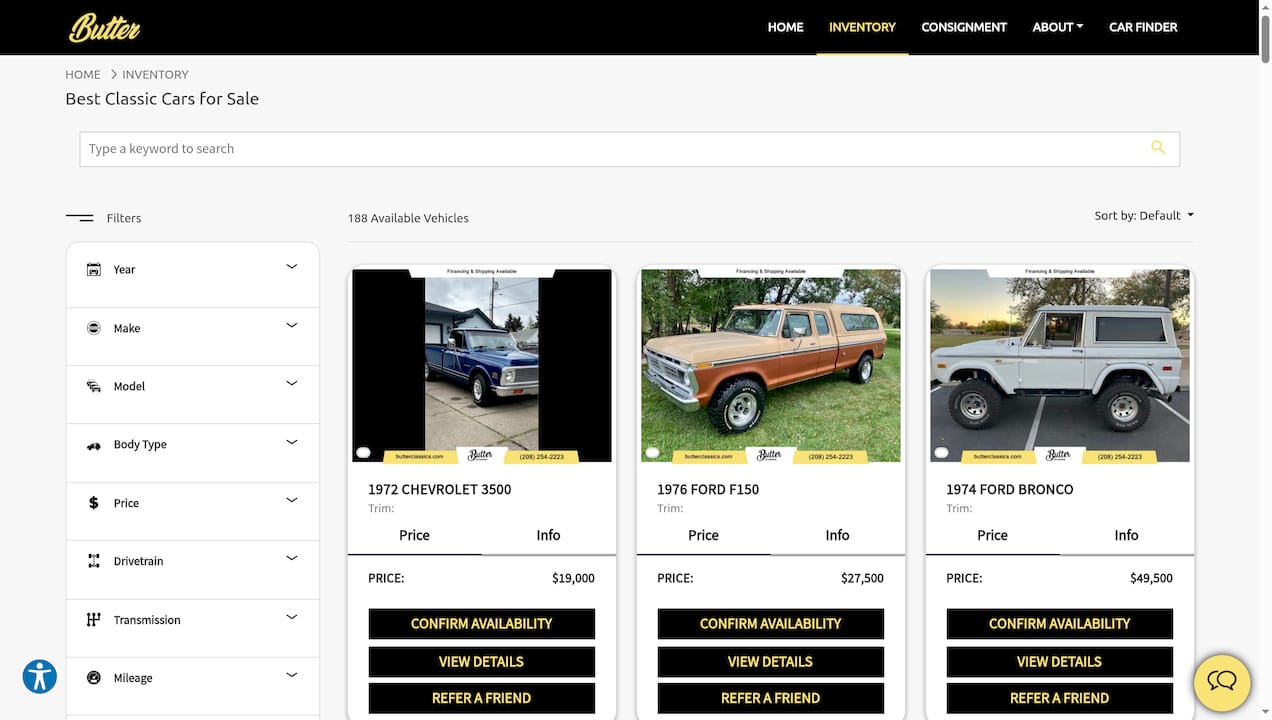
Knowing that late fall and early spring are your best windows only helps if you can actually find and close on a car during those weeks. That is where a nationwide inventory earns its keep: instead of waiting on one local lot to get lucky, you can browse classic cars, vintage trucks, muscle cars, and more from sellers across the country, with detailed specs and photos that make it easier to judge condition before you ever schedule a look.
A few ways to put that to work right now:
- Set up alerts on the Butter Classics inventory so new listings hit your inbox the moment they post.
- Get pre-qualified for financing so you are ready to move the day the right car appears.
- If you are selling into this same market, consign your vehicle with Butter Classics to reach buyers nationwide instead of just your local classifieds.
Every vehicle listed undergoes a thorough verification process, giving you an extra layer of confidence on top of your own inspection. Browse the current inventory and set your alerts before the next seasonal window opens.
Sources
- FTC announces CARS Rule to fight vehicle-shopping scams
- Best classic car price is far more achievable for informed buyer
FAQ
What is the $3,000 rule for cars?
There is no official federal "$3,000 rule" governing car sales or dealer commissions. Consumer protection instead centers on the FTC's CARS Rule, which requires dealers to disclose the full offering price and get your consent before charging for add-ons.
Are classic car prices dropping?
Pricing moves in cycles tied to auction results, interest rates, and collector demand rather than a single ongoing trend across all models. Some models soften seasonally in late fall and early winter, while others tied to shows or warm-climate demand hold steady, so it depends heavily on the specific car you are watching.
How much does a car salesman make on a $10,000 car?
There is no published federal standard or fixed commission rate for dealer sales, and figures vary by dealership and deal structure. What buyers can rely on instead is the FTC's disclosure requirement, which means you can request the full offering price in writing rather than guessing at markup.
What is the cheapest month to buy a car?
For classic cars specifically, late fall through early winter and the January through March stretch tend to bring the softest prices, as owners avoid winter storage costs and dealer inventory sits during the slow season. Selection tends to be thinner during these windows, so you may trade some choice for a better price.