
What makes a classic car a liquid asset?
A liquid classic car asset is a collectible vehicle you can sell relatively quickly and at transparent market value, thanks to strong demand, documented provenance, and investment-grade status. Think of it as the difference between a well-documented 1967 Shelby GT500 with matching numbers and a modified muscle car with a murky history. One sells smoothly; the other sits.
Liquidity in the classic car world looks very different from liquidity in stocks or bonds. You cannot sell a classic car on a Tuesday afternoon and have cash in your account by Thursday. The market is niche, buyers are selective, and the transaction process takes time. That said, certain cars move far faster than others, and understanding what drives that speed is the whole game for serious collectors.
Key attributes that boost a classic car's liquidity:
- Documented provenance: Factory records, marque-club registries, and a clear ownership chain
- Matching numbers: Original engine, transmission, and body codes that match factory documentation
- Originality: Unrestored or correctly restored to factory spec, with authentic parts
- Strong collector demand: Models with an active, global buyer base (think air-cooled Porsche 911s or pre-1970 Ferraris)
- Transparent pricing history: Recent comparable sales data available through tools like Hagerty Valuation Tools
- Investment-grade condition: Rated "Fine" to "Excellent" on standard collector car condition scales
Butterclassics specializes in exactly this kind of vehicle, curating investment-grade classic cars with the documentation and condition that serious buyers expect.
How does liquidity actually work in the classic car market?
Classic cars are highly illiquid alternative assets compared to public equities. Standard models typically take weeks to sell; top-tier blue-chip cars can take many months. That gap between "I want to sell" and "I have cash" is the core liquidity challenge every collector faces.
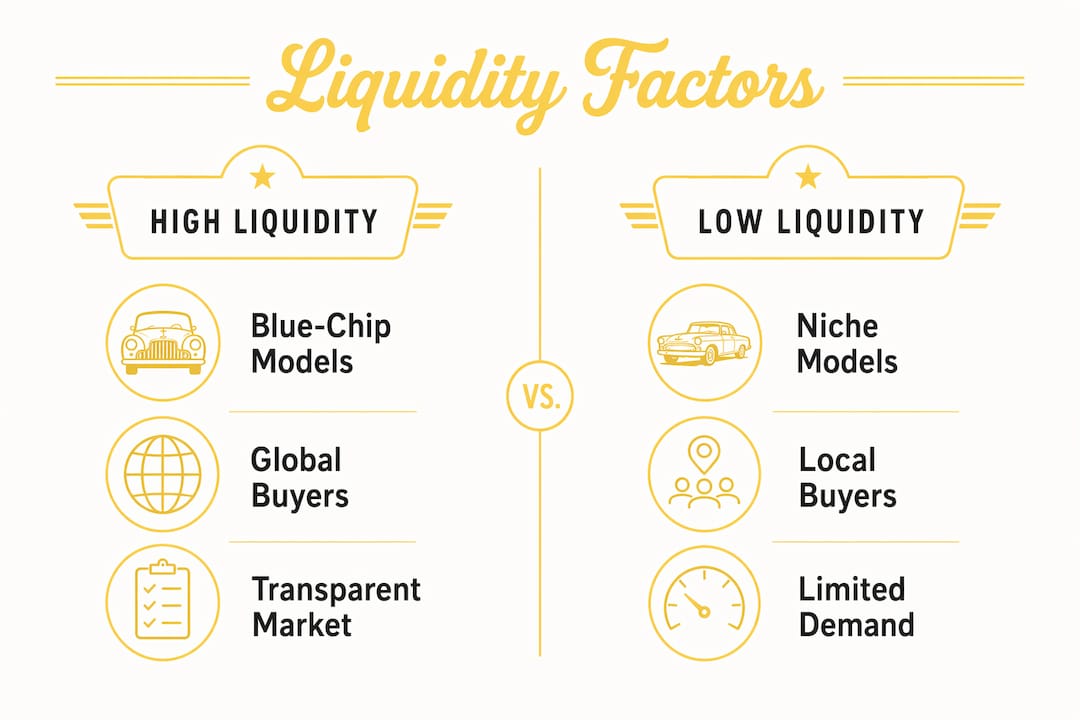
Several factors slow the process down. The buyer pool for any specific model is small and geographically scattered. Auctions, the most transparent sales channel, run on fixed schedules, as explained in our detailed buyer's guide to auction cars. Private sales require negotiation, inspections, and title transfers. And unlike stocks, there is no centralized exchange where you post a price and a buyer appears instantly.
Economic conditions add another layer. When credit tightens or consumer confidence drops, discretionary spending on collectibles contracts. The recent down-cycle saw many models decline in value, and sellers who needed liquidity during that window often had to accept discounts. The classic car market rewards patience and punishes urgency.
Key liquidity challenges at a glance:
- Limited buyer pool for any specific model
- No centralized marketplace or real-time pricing feed
- Auction schedules dictate timing, not the seller
- Condition disputes can stall or kill deals
- Geographic logistics add cost and delay
- Economic downturns compress both demand and prices
| Factor | Impact on Liquidity |
|---|---|
| Blue-chip model (Ferrari, Porsche 911) | Faster sale, global buyer base |
| Standard collector car | Weeks to months to find the right buyer |
| Modified or non-original vehicle | Significantly slower; smaller buyer pool |
| Economic downturn | Compressed demand, longer hold times |
| Transaction fees total 15–20% of asset value | Buyer's premiums and consignment costs come directly out of net proceeds at sale. |
Understanding classic car liquidity considerations before you buy is far easier than learning them under pressure when you need to sell.
What criteria make a classic car investment-grade?
Investment-grade status requires a liquid secondary market, documented originality, complete provenance, and matching numbers. That is not a suggestion; it is the floor. Cars that meet these criteria attract confident buyers and sell faster. Cars that fall short sit longer and often sell for less.
Restoration and modification are the two biggest liquidity killers. A car that has been repainted in a non-original color, fitted with a replacement engine, or modified for performance loses a meaningful portion of its appeal to serious collectors. Restored or modified cars often suffer a significant value penalty compared to original examples, and that penalty shows up directly in how long the car takes to sell.
The requirement for a liquid secondary market is worth unpacking. A car is only as liquid as the community of buyers willing to pay market price for it. Pre-1970 racing Ferraris, air-cooled Porsche 911s with documentation, and select Mercedes models have deep, global buyer bases. A mid-tier American muscle car from a common production run has a narrower audience, which means longer sale times even in a healthy market.
Investment-grade qualifications and their liquidity impact:
- Complete provenance: Shortens buyer due diligence, builds confidence, speeds closing
- Matching numbers: Non-negotiable for top-tier buyers; absence kills deals
- Undisturbed history: Low-mileage, single-owner cars command premiums and sell faster
- Correct color and trim: Original factory combinations outperform respray or retrim jobs
- Active marque community: Cars with strong clubs and registries have built-in buyer networks
What are the US tax and cost realities of classic car investing?
The federal collectibles tax rate on long-term gains for classic cars is 28%, which is higher than standard long-term capital gains rates for most investors. That gap directly reduces your net return and raises the bar for what a car needs to appreciate before the investment makes financial sense.
Carrying costs compound the challenge. Storage, insurance, and maintenance add up every year you hold a vehicle. On a lower-priced car, those annual costs can consume a disproportionate share of the asset's value, making the math structurally difficult. On a $500,000 blue-chip vehicle, the same fixed costs represent a much smaller percentage of value, which is one reason the asset class works better at the top of the market.
Transaction fees including buyer's premiums and consignment can total 15–20% of asset value. That is money that comes directly out of your return, and it applies on both the buy and sell side when you use auction houses or dealers. Building a long-term collection with these costs in mind from day one is the only way to avoid unpleasant surprises.
Tax and cost factors to plan for:
- A federal collectibles tax rate on long-term gains that is higher than standard long-term capital gains rates
- Annual carrying costs for storage, insurance, and maintenance
- Auction buyer's premiums and consignment fees that can be a significant portion of the asset value
- Restoration costs that may not be recoverable at sale
- State-level taxes and registration fees vary by location
What do experts say about classic car investing in 2026?
SoFi's 2025 assessment frames classic cars as satellite portfolio assets, not core holdings. The case for inclusion is diversification and inflation hedging, not outperformance. That framing matters because it sets realistic expectations: you are not replacing your stock portfolio with a garage full of Ferraris; you are adding a non-correlated tangible asset to a diversified book.
Autobahn Alpha analysts point out that collector cars produce no cash flow and require active management, making them fundamentally different from dividend-paying equities or rental real estate. The emotional utility of owning and driving a collector car sustains demand and creates a pricing floor, but it also complicates objective valuation. Market segmentation creates a "K-shaped" recovery where blue-chip segments reach record highs while broader mass-market collectibles hit multi-year lows.
Academic research reinforces the caution. A peer-reviewed analysis of classic car price indices covering 1994–2021 found moderated volatility, a low range of returns, and weak expectations of financial gain once ancillary costs are factored in. The conclusion: investing in classic cars is more of a passion and emotional investment than a straightforward financial play.
Principal market insights for 2026:
- Blue-chip cars (HAGI Top constituents) have historically outperformed broader collector indexes
- The broader mass-market collectible segment faces prolonged correction pressure
- Typical holding periods run three to five years or longer; patience is not optional
- "Booming market" narratives mislead collectors focused on mid-tier segments
- Sellers who need quick liquidity risk accepting discounts, especially in down cycles
- Butterclassics' curated inventory and expertise help you buy the right car at the right price, reducing the risk of a costly misstep
Pro Tip: Before you buy any classic car as an investment, run the numbers on all-in costs across a five-year hold: purchase price, annual carrying costs, transaction fees on exit, and the 28% federal tax on gains. If the math does not clear those hurdles, the car may be a great passion purchase but a poor financial one.
Key Takeaways
A liquid classic car asset requires documented provenance, matching numbers, strong collector demand, and investment-grade condition to sell quickly and at fair market value.
| Point | Details |
|---|---|
| Liquidity is model-dependent | Standard models take weeks to sell; top-tier blue-chip cars can take many months. |
| Investment-grade criteria drive speed | Matching numbers, complete provenance, and originality shorten sale times and protect value. |
| Tax rate is 28% on gains | The federal collectibles rate exceeds standard long-term capital gains rates for most investors. |
| Transaction fees total 15–20% | Buyer's premiums and consignment costs come directly out of net proceeds at sale. |
| Satellite allocation, not core holding | Experts frame classic cars as diversification assets, not replacements for stocks or bonds. |
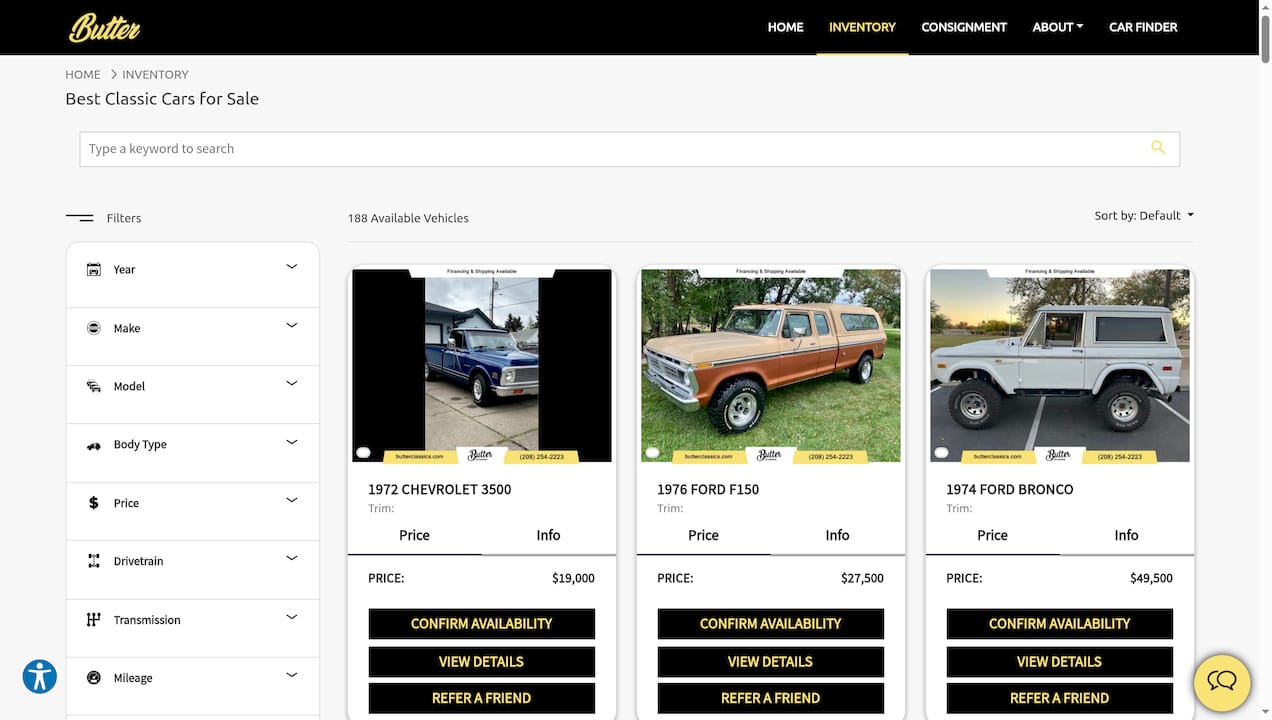
Ready to find a classic car that holds its value and moves when you need it to? Browse the Butterclassics inventory at butterclassics.com and explore vehicles hand-selected for collectors who care about both passion and performance. Whether you're buying your first investment-grade vehicle or adding to an existing collection, we're here to make the process smooth as butter.