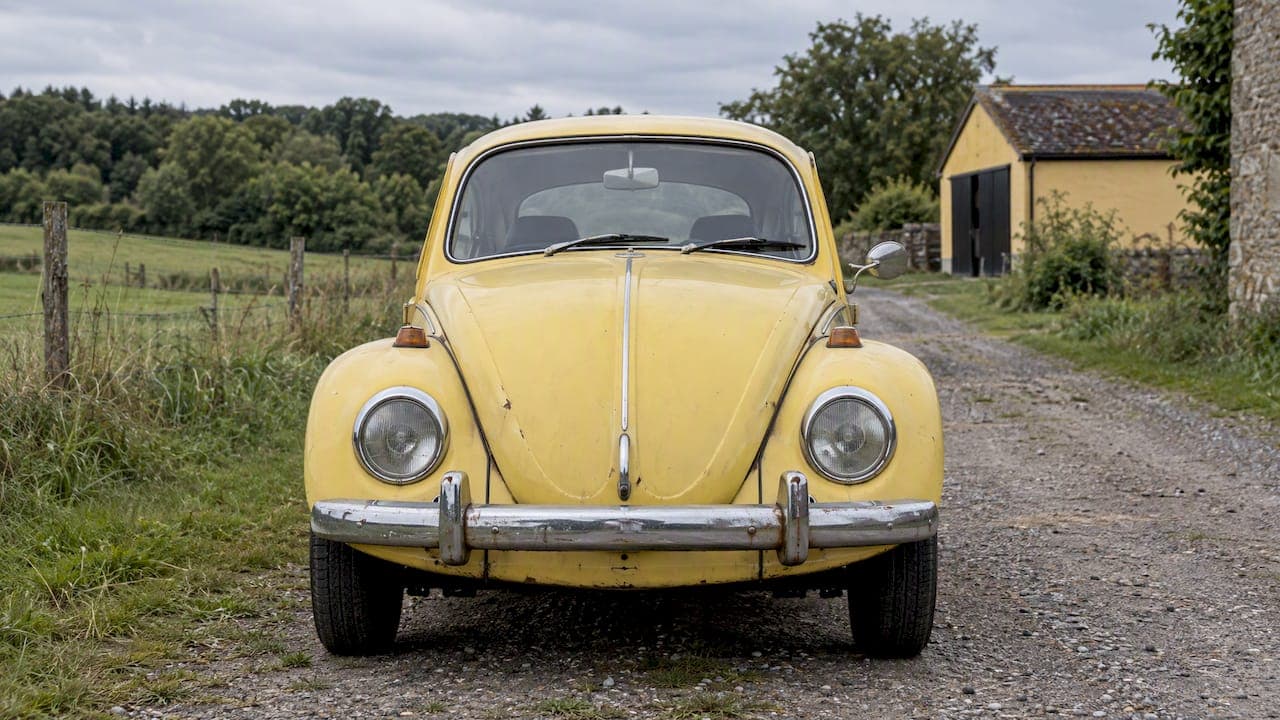
A good classic Beetle is one of the easiest old cars to live with, and a bad one is one of the easiest to overpay for. Most of the difference comes down to rust, especially hidden rust, and to paperwork that matches the car. This guide walks you through the Beetle years that matter, the inspection order that saves you money, how to verify a VIN, and what changes if you are shopping for a VW Bus instead.
TL;DR
- Rust decides the price of a classic Beetle. Check the floor pans, heater channels and the area behind the front wheels first, and walk away from soft metal or sagging bodywork.
- Beetles from 1971 onward can hide moisture-trapping foam in the C-pillars, so look closely at those corners.
- The air-cooled engine is simple and forgiving, but oil leaks, smoke and poor cold starts tell you how it was treated.
- A Bus is a different animal: it is a unibody, so structural rust means cutting and welding, not swapping bolt-on panels.
- Match the VIN, title and the car itself before you pay a deposit, and pay an independent specialist to look it over.
Table of Contents
- Know which Beetle you are looking at
- Rust: where to look first
- The engine and transmission
- Electrics, interior and the "previous owner mods" problem
- Check the identity, title and history
- The test drive
- Buying a VW Bus: what changes
- Our take on buying a Beetle
- Find your next classic with Butter Classics
- Before you pay: a short checklist
- FAQ
- Sources
Know which Beetle you are looking at
The classic Beetle ran for decades, and the cars differ more than the shape suggests. Hagerty's 1949 to 1979 Beetle buyer's guide notes that in 1967 the Beetle got a 1493-cc "1500" engine as standard in North America. That is a handy dividing line when you are sorting cars by how they drive on today's roads.
A few practical ways to think about the eras:
- Early cars (pre-1967): Smaller engines and a slower, more vintage feel. Charming, but you will feel every hill and every highway on-ramp.
- 1967 and later: More power from the larger engine, which makes a Beetle easier to use for regular drives.
- 1971 and later: Better in some ways, but this is where the C-pillar foam issue shows up (more on that below).
Do not buy on year alone. A well-kept car from an "average" year beats a rusty one from a "great" year every time.
And if you are here because you typed in the newer cars: the 1998 to 2019 New Beetle and Beetle are a separate world. They are modern front-engine cars with water-cooled engines. This guide focuses on the air-cooled classics, because that is where collectors and restorers put their money.
Rust: where to look first
Rust is the big one. Soft metal, holes or a body that sags are all warning signs, and the places that rot first are predictable. Start here:
- Floor pans. Get on the ground with a flashlight. Pay special attention around the battery tray, where leaking acid has eaten many a floor.
- Heater channels. These are the structural boxes along each side under the doors. They are expensive to repair correctly, so a car with bad ones is rarely a bargain.
- Behind the front wheels. Hagerty points to corrosion commonly occurring behind the front wheels and at the bottom of the heater channels.
- Panel gaps and filler. Uneven gaps, ripples or a magnet that will not stick usually mean body filler hides something.
The tricky part is that some corrosion hides inside the car's structure. Hagerty reports that on Beetles from 1971 onward, spray-in expansion foam used in the C-pillars acts as a moisture trap and can cause severe hidden corrosion, sometimes nicknamed "death foam." Check the rear pillars, the window seals and any bubbling paint around them.
If the floor and channels already look questionable, look at how the car has been kept. Moisture, leaks and long idle stretches are what feed corrosion, and the way a seller stores the car tells you a lot. If you buy and plan to park it for the winter, a dry, sealed space matters, and this guide on rodent-proof long-term car storage covers the gap-sealing basics that also keep damp out.
The engine and transmission
The air-cooled flat-four is one of the friendliest old engines to own. Parts are everywhere, and the design is simple enough that a patient owner can learn it. Still, a rough one costs money, and a smooth one is worth paying for.
What to check:
- Cold start. Ask the seller not to warm the car before you arrive. A healthy engine fires quickly and settles into an even idle.
- Oil leaks. A little seepage is normal on an old Beetle. Drips pooling under the car are not.
- Smoke. Hagerty says persistent engine smoke points to a bad seal. Blue smoke that keeps coming after warm-up deserves a price discount or a pass.
- End float. Pull and push the crankshaft pulley fore and aft. Excess movement means a tired bottom end.
- Clutch and gearbox. The clutch should engage cleanly without slipping. Gears should select without crunching or popping out.
If the engine seems borderline, do not guess. Have a mechanic run proper checks before you commit. For buyers who want on-site help with diagnostics, engine diagnostics and repair from a mobile mechanic is the kind of service that saves a drive back to a shop, though availability depends on your area.
Electrics, interior and the "previous owner mods" problem
Electrical problems are usually cheaper than rust, but they can still be annoying. Check that the lights, wipers, horn, gauges and heater controls work. Look under the dash and in the engine bay for old wiring, twisted splices and tape.

Practical Classics, in its buyer's brief for the 1965 to 1978 Beetle, says earlier Beetles may have been converted from 6V to 12V. A conversion is not automatically bad, but you want to know who did it and how well.
The same brief makes a fair point about modifications: they are not necessarily bad. A tasteful, well-done upgrade can make a Beetle more fun to drive. Poor workmanship is the real concern, so ask for receipts and look at the quality of the work, not just the list of parts.
Inside, check the seat frames, the headliner, door seals and the carpets. Lift the carpets if the seller allows it. Damp, musty floors are a sign of leaks, and leaks lead right back to rust.
Check the identity, title and history
Before you fall in love, make sure the car is what the seller says it is. The chassis number on a classic Beetle is typically stamped on the floor pan tunnel under the rear seat. Engle Cams' chassis number reference says that beginning with the 1965 model year, a nine-digit serial system was used to identify the model and year.
Here is a simple process:
- Find the number on the car, then compare it to the title and registration.
- Make sure the car's year, color and body style match what is on paper.
- Look for signs that a plate or stamping has been altered or replaced.
- If something does not line up, ask the seller to explain, and resolve it through your state's motor vehicle agency or an independent specialist before you pay a deposit.
A note on shorter numbers: the 17-character VIN standard became mandatory for 1981 model-year vehicles, so a Beetle from the air-cooled era will have a shorter number, and online history reports are less useful than they are for later cars. For these, the car itself, the title and the paper trail carry the weight.
Speaking of paper trails, dated photographs and invoices are a good sign when a car has been restored. Even so, verify the work on the car. Records tell you what was supposed to happen, and your eyes tell you what did.
The test drive
A proper drive tells you more than any listing. Take your time and bring someone who has owned an old VW if you can. Listen for:
- Clunks or looseness in the front end
- Pulling under braking
- Gearbox whine or hard shifts
- An engine that stumbles when warm
- A car that wanders on the highway
For a full routine you can print and take with you, see our classic car test drive checklist. If this is your first old car, our classic car buying guide for first-time buyers covers the basics that apply to every make.
Buying a VW Bus: what changes
People who search for a Beetle guide often end up looking at buses too, and for good reason. A Bus is roomier and more adventurous, and it is also a bigger commitment.
The models break down roughly like this. Split-window buses came first, from 1949 to 1967, and the Bay window followed from 1968 to 1979. Each year brought mechanical and body changes, so two buses that look alike can be very different to own. Bentley, which publishes the manual, says its U.S. Type 2 service manual covers 1968 to 1979 models, including the Station Wagon, Panel Truck, Pickup Truck, Kombi and Campmobile. That is a useful reference to have on your bookshelf once you own one.
The biggest difference from a Beetle is construction. A Bus is a unibody, so structural rust repair means precise cutting and welding, not unbolting a panel. That matters when you look at these areas:
- The front axle beam
- Under the sliding door
- Wheel wells and rocker panels
- Front floors and front-door steps
- Under the windshield seal
On the mechanical side, later Bay window buses use a different engine family from early ones. Make sure all four cylinders run strongly, and be cautious with an engine that has overheated, since valve seat trouble is a known risk on those motors. Smaller items like the horn, hazard switch and fuel gauge are worth testing too, along with any camper equipment such as the sink pump.
Here is the honest part: a professional restoration can cost more than buying a Bus that does not need the work. If you are choosing between a cheaper project and a solid driver, the solid driver is usually the better value.
Our take on buying a Beetle
We talk to buyers all the time, and the pattern is the same. People get excited about a color or a year and skip the boring checks. Then the car shows up, and the floor is soft.
Here is what we tell friends:
- Pay for condition, not for the story. A great story and a rusty floor still add up to a rusty floor.
- Buy the best car you can afford. Bringing a tired Beetle back almost never costs less than buying a good one.
- Get a second set of eyes. Someone who knows air-cooled VWs will spot things you will not, and an hour of their time is cheap compared with a bad purchase.
- Think about the whole experience. Delivery, paperwork and financing matter as much as the car. We built Butter Classics around making that part smooth as butter.
And if a seller will not let you inspect the car properly, that tells you what you need to know.
— Tony
Find your next classic with Butter Classics
Shopping for a classic should be fun, not stressful. At Butter Classics you can browse a nationwide inventory of classic cars, trucks, muscle cars and 4x4s with detailed listings, plenty of photos and specs, then ask questions, request a quote or schedule a test drive. If you need help paying for it, you can start with classic vehicle financing pre-qualification.
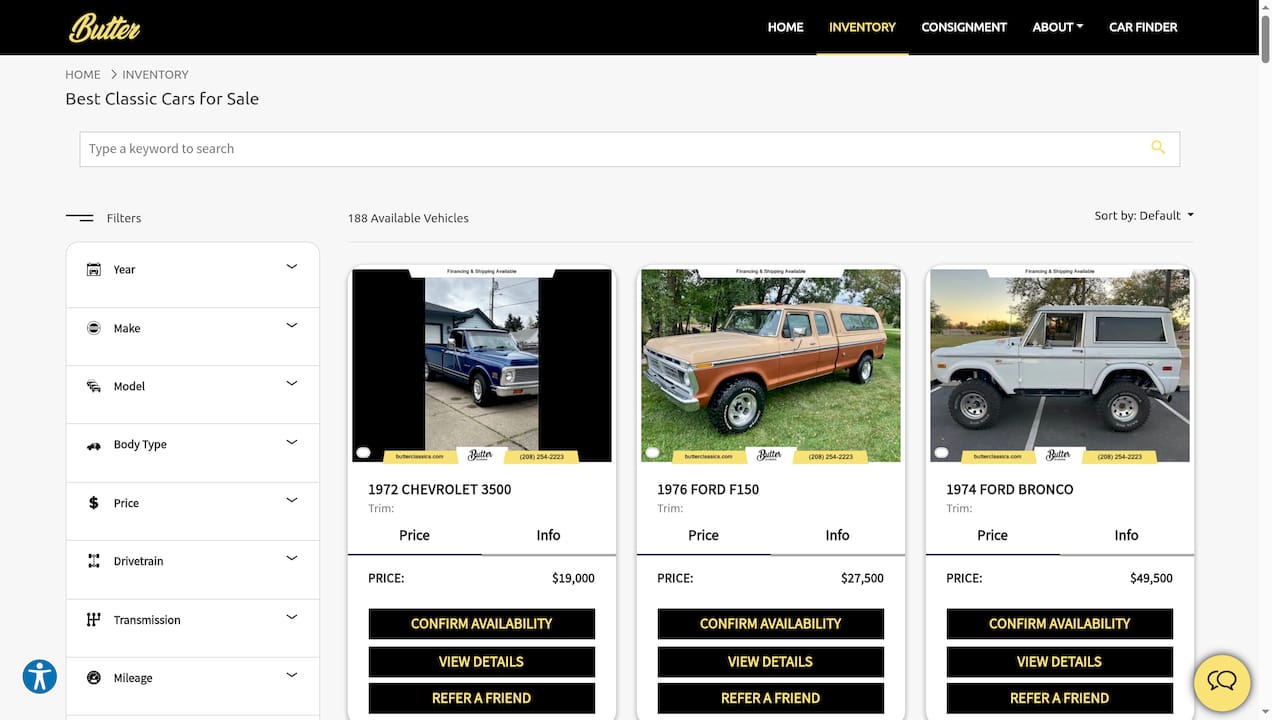
Ready to look around? Search our classic car inventory, or tell us what you want and let the Car Finder help. Have a classic to sell? You can consign your vehicle with us.
Before you pay: a short checklist
When you have found a car you like, run through this list one more time.
- The title and VIN match the car.
- You checked the floor pans, heater channels and the area behind the front wheels.
- You looked at the C-pillars if the car is a 1971 or later.
- The engine started cold and ran without heavy smoke.
- The seller showed receipts, not just stories.
- An independent specialist inspected it, or you used a seller who stands behind the car.
For a deeper look at how to judge condition, read our guide to evaluating vintage car condition before you buy, and see what a dealer inspection checklist should cover.
FAQ
What is the most important thing to check on a classic Beetle?
Rust. Look at the floor pans, heater channels and the area behind the front wheels, and be wary of soft metal or a sagging body. Heater channels are expensive to repair correctly, so a clean set is worth paying for.
Are Beetles from 1971 and later a bad buy?
Not necessarily, but they need extra attention. Hagerty reports that the spray-in foam in the C-pillars of these cars can trap moisture and cause hidden corrosion. Inspect those areas carefully and ask about past bodywork.
Where is the VIN or chassis number on a classic Beetle?
On many cars it is stamped on the floor pan tunnel under the rear seat. Check it against the title and registration, and settle any mismatch before you hand over a deposit.
Is a VW Bus harder to buy than a Beetle?
Usually, yes. A Bus is a unibody, so structural rust repair takes cutting and welding, and there are more model-year differences to learn. Take your time, inspect it thoroughly and bring in a specialist.
Should I buy a restored Beetle or a project?
For most buyers, a solid, already-sorted car is the better deal. Restoration work adds up fast, and it can cost more than buying a car that does not need it.
Sources
- Your handy 1949 to 1979 Volkswagen Beetle buyer's guide, Hagerty
- Buyer's Brief: VW Beetle (1965 to 1978), Practical Classics
- Volkswagen Production by Chassis Number, Engle Cams
- Technical coverage, VW Type 2 1968 to 1979 repair manual, Bentley Publishers
- Classic Car VIN Check