
If you need cash fast or you owe more than your classic is worth, trade it in. If you want the highest possible payout and can handle some legwork, sell it privately. Your state's trade-in tax credit and the car's condition tip the scale between those two, so run a trade-in calculator and collect a few written offers before you commit either way.
TL;DR:
- Private sales can typically yield higher net proceeds, especially for high-value, documented cars, once all sale costs are deducted.
- Trade-in offers benefit from tax credits in states that allow deducting the trade value from the next vehicle’s taxable amount, possibly saving hundreds or over a thousand dollars.
- A trade-in usually provides a faster transaction, but private sales may outperform trade-ins by an average of $2,418 after all costs over the life of the sale.
- For collector cars, consignment or auction often results in better prices if the vehicle has proven rarity, provenance, or unique features, despite longer sales timelines.
- Owners should evaluate their financial situation, such as negative equity or urgency, and condition or rarity of the car before choosing the best route.
Table of Contents
- Trade vs Sell Classic: The Main Routes Explained
- Trade-In vs Private Sale: Run the Numbers
- Decision Checklist: Pick Your Route in Six Steps
- Prepare Your Classic Before You List or Trade
- When Consignment or Auction Beats a Simple Trade or Sale
- How Butter Classics Helps You Sell or Trade
- A Collector's Take on Trading vs Selling
- Ready to Sell or Consign Your Classic?
- Sources
- FAQ
Trade vs Sell Classic: The Main Routes Explained
Every classic car owner has five real paths to a sale, and each one fits a different kind of seller.
- Private sale puts the most money in your pocket in most cases, but you handle the ads, the calls, and the paperwork yourself. Expect a typical timeline from about one to several months and a price close to private-party valuation guides.
- Dealer trade-in is the fastest route, often done in a single afternoon. Dealers pay less because they need margin to resell, but the sales-tax credit can close much of that gap in states that offer it.
- Consignment works well for cars with genuine collector appeal. A specialist handles marketing and buyer vetting while you wait out a longer sales window, typically 60 to 120 days, in exchange for a fee.
- Auction suits rare or documented cars where competitive bidding can push the price above private-party estimates, though reserve risk and seller fees eat into the upside.
- Specialist marketplaces and enthusiast forums put your car in front of buyers who already know what they're looking at, which shortens the education process compared to a general classifieds listing.
Collector cars carry extra wrinkles no matter the route. Transport costs for a car that can't be safely driven long distances, provenance documentation for anything with real history, and a pre-purchase inspection buyers will insist on before wiring money all factor into your net proceeds and your timeline.
Trade-In vs Private Sale: Run the Numbers
The dollar gap between trading in and selling privately is smaller than most owners assume, and sometimes it flips entirely in the trade-in's favor.
Start with the tax math. Most states let you deduct your trade-in's value from the taxable price of your next vehicle, which means you never pay sales tax on that portion of the purchase. A trade-in calculator shows that tax savings equal to your trade value multiplied by your combined state and local rate can shave hundreds to over a thousand dollars off your effective cost. A handful of states don't apply this credit at all, so check your state's specific trade-in tax rules before you assume it applies to you.
Private sale costs work against you in the opposite direction. Before comparing offers, subtract:
- Advertising and listing fees across marketplaces
- Detailing and any repairs needed to pass a buyer's inspection
- Time spent on calls, showings, and paperwork
- Escrow or payment-processing fees if you use a service to protect the transaction
A 2026 analysis of matched vehicles found private sales returned an average of $2,418 more than dealer trade-in offers. But that average hides real variation. A $12,000 driver-quality classic might net $1,500 more privately after costs, barely worth the hassle. A $35,000 documented survivor could clear $6,000 more privately, which changes the calculus fast. A $70,000-plus investment-grade car often does better in consignment or at auction than either simple route, because the buyer pool that pays top dollar rarely shops trade-ins.
Run your own numbers with a calculator and get three written offers before deciding. That single step exposes lowball trade-in quotes faster than anything else.

Decision Checklist: Pick Your Route in Six Steps
Work through these in order. Each one can override the step before it.
- Check your lien status. If you owe more than the car is worth, a dealer can often roll that negative equity into new financing. A private buyer's lender requires the loan paid off at closing, which complicates the deal considerably.
- Estimate your private-sale uplift. Pull a private-party value and compare it to a dealer quote. If the gap is modest after costs, the extra hassle may not be worth it.
- Confirm your state's tax treatment. A trade-in credit can add real value to a dealer offer that looks weak on paper.
- Weigh condition and pedigree. Rare trim, original paint, or documented ownership history usually earns more through consignment or auction than through a quick trade.
- Gauge your urgency. Need the car gone this week? Trade-in wins on speed alone.
- Rate your risk tolerance. Private sales carry no-show buyers, payment scams, and negotiation fatigue. Trade-ins carry none of that.
Pro Tip: Score each factor 1 to 5 for "trade" and 1 to 5 for "sell." Whichever side totals higher after all six steps is your answer, no second-guessing.
Owners with negative equity or a job relocation deadline should default to trade-in unless the private-sale gap is dramatic. Everyone else has room to shop around.
Prepare Your Classic Before You List or Trade
A little prep work moves the needle on both routes at once.
- Documentation. Have a clear title ready, and if there's a lien, know the exact payoff amount and process. Pre-1981 vehicles sometimes carry title quirks tied to VIN format changes, so confirm your state's title office recognizes yours without issue. Service records and any provenance or authentication paperwork build buyer confidence fast.
- Presentation. Shoot photos in natural light, include the engine bay and undercarriage, and disclose known issues upfront rather than letting an inspection surface them later. Fix genuine safety items; skip cosmetic upgrades that won't return their cost.
- Payment safety. For private sales, insist on a cashier's check verified with the issuing bank, or use an escrow service for higher-value deals. Never release the title until funds have fully cleared.
A documentation checklist built specifically for classic sellers can save you from last-minute scrambling.
When Consignment or Auction Beats a Simple Trade or Sale
Rare and collector-grade cars often outperform both a private sale and a trade-in when they go through the right specialized channel.
Consignment fits cars that need a curated buyer, someone already searching for that exact model and story. You get marketing help and buyer vetting in exchange for a consignment fee, usually a percentage of the final sale price, and a longer sales window than a private listing.
Auction fits cars with documented rarity or a built-in bidding audience. Competitive bidding can push the final price above private-party estimates, but reserve risk is real. Set your reserve too high and the car doesn't sell; set it too low and you leave money on the table. Buyer's and seller's fees apply on top of the hammer price.
A specialist online marketplace splits the difference: nationwide exposure with curated buyers who already understand what they're looking at, without the unpredictability of a live auction floor.

How Butter Classics Helps You Sell or Trade
Specialist marketplaces offer consignment services and financing pre-qualification for buyers, plus nationwide listing exposure that puts your car in front of collectors instead of just local browsers. Our trade-in evaluation checklist and seller guides walk you through preparation before you ever request a quote. Starting is as simple as visiting the consignment page and telling us about your car.
A Collector's Take on Trading vs Selling
Sometimes the smartest financial move is keeping the car. If it still gets driven and enjoyed, a slightly better sale price rarely justifies letting it go. Market timing matters too. General collector values have cooled from pandemic-era peaks, but certain niches remain genuinely strong, which can make consignment worth the wait.
— Tony
Ready to Sell or Consign Your Classic?
Selling privately means running your own ads, fielding lowball calls, and hoping the right buyer finds your listing before it goes stale. Trading at a generic dealer often means a rushed appraisal from someone who doesn't know what a numbers-matching engine is worth. Specialist marketplaces split the difference: nationwide exposure to collectors who already understand what they're looking at, paired with consignment processes built specifically for classic and collector vehicles rather than daily drivers.
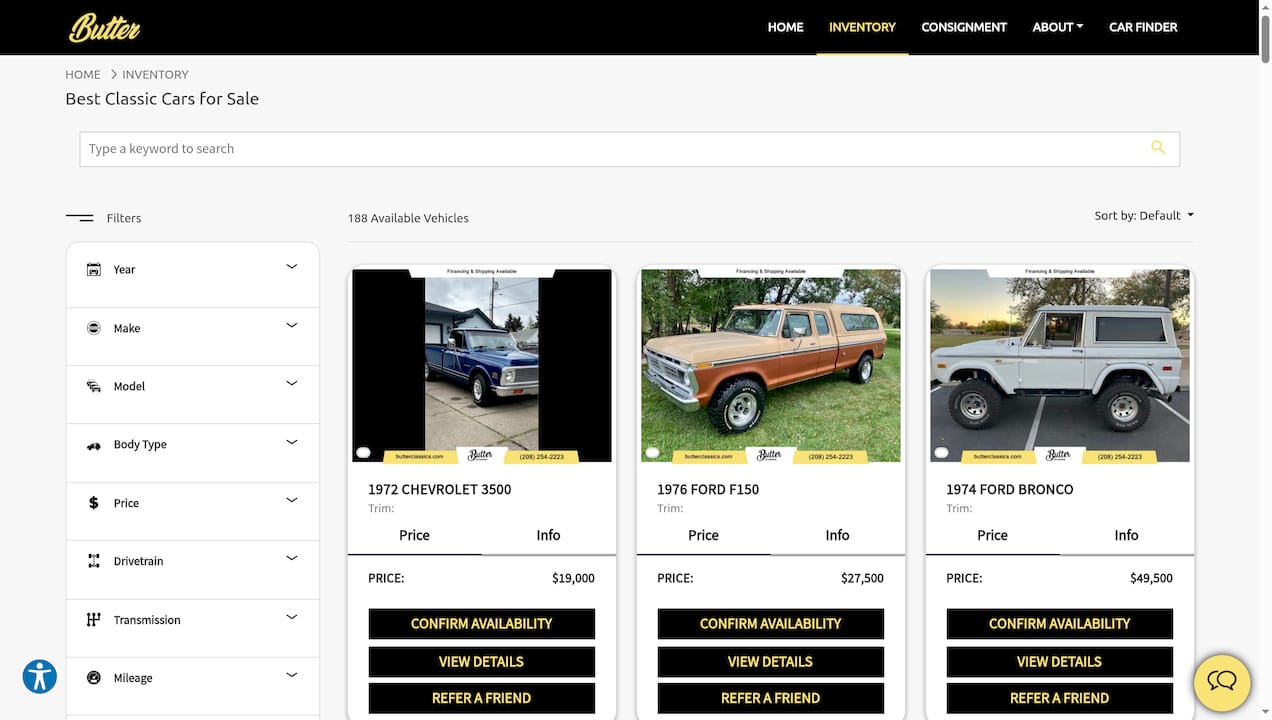
If your car fits the profile we've walked through, curated buyer pool, real provenance, worth more than a quick trade-in quote, consignment is worth exploring before you commit to a private listing marathon. Visit the Consign Your Vehicle page to see how the process works, or browse current inventory to see how similar cars are priced before you set your own number. Financing pre-qualification is also available for buyers on the other side of your sale, which can widen your pool of serious offers.
Sources
- Car Trade-In Calculator - Free Online Tool | Numeraty
- Trade-In vs Private Sale: Which Pays More in 2026… | CarCheckerVIN
- Ez
- By the Numbers: The Collector Car Market in 2025 - Hagerty Media
FAQ
What Is the Best Site to Sell a Classic Car?
The best option depends on your car's value and rarity. High-value or documented classics usually do best on specialist marketplaces like Butter Classics or through consignment, where buyers already understand collector vehicles, while general classifieds work fine for lower-value drivers.
What Is the $3,000 Rule for Buying Cars?
This isn't a formal industry standard, and definitions vary by source. Some buyers use it informally as a rule of thumb to avoid financing very small amounts due to high relative interest costs, but no consistent official rule exists.
Are Classic Car Prices Dropping?
Overall collector-market values have cooled from pandemic-era peaks, but the picture isn't uniform. Hagerty's market reporting shows certain niches and top-tier cars have held strong even as broader values stabilized or softened.
Who Pays the Most for an Old Car?
Private buyers typically pay the most for a well-presented classic, since dealers need margin to resell. For rare or documented cars, auction bidders or consignment buyers sourced through a curated marketplace often pay more than either a private classifieds sale or a dealer trade-in.
Should I Trade In or Sell My Classic Car Privately?
Trade in if you have negative equity, need speed, or live in a state with a strong trade-in tax credit. Sell privately or consign if you can handle the process and your car's value justifies the extra effort, which a 2026 matched-vehicle analysis found averages $2,418 more than a dealer trade-in offer.