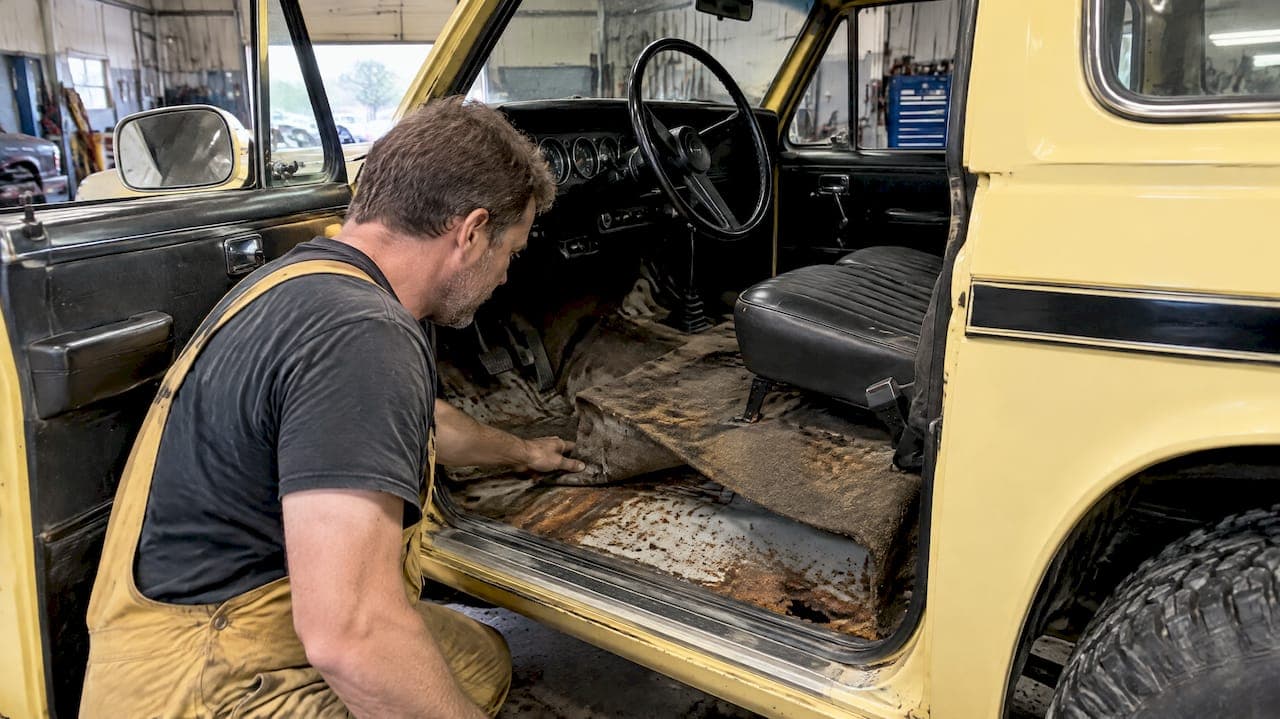
For buyers prioritizing a lower-risk restoration, a rust-free Scout II may be a practical option to consider alongside an original Scout 80/800. Hagerty's analysts call the Scout II a "bull market" selection, so entry prices are climbing. Whatever you find, pry up the floor coverings. If the floor pans or cab mounts are eaten through, walk away.
TL;DR:
- A 1979 Scout II in Hagerty’s #2 condition was valued at $25,500–$32,500 in 2020; treat that figure as historical, not current pricing.
- Pull back floor coverings and inspect the pans, cab mounts, frame rails, and rockers; walk away if structural rust has eaten through.
- A driver refresh is estimated at $30,000–$55,000, while frame on modernization costs $60,000–$95,000; structural rust can make a cheap truck uneconomic.
- For remote purchases, require floor and undercarriage photos, verify the VIN against the title, and arrange an independent inspection costing $150–$600.
Table of Contents
- Which Scout is right for you: the 80/800 or the Scout II?
- What should you expect to pay for a Scout?
- How do you inspect a Scout before you buy it?
- What does a Scout restoration really cost?
- Where can you find a Scout for sale?
- How do you turn inspection findings into a deal?
- How do you verify authenticity and check for stolen or tampered titles?
- What should you ask sellers, and which red flags matter for international Scout purchases?
- What should you know about importing a Scout internationally?
- What insurance do vintage Scouts need?
- Why do we care so much about frame integrity?
- Ready to find your Scout?
- FAQ
- Sources
Which Scout is right for you: the 80/800 or the Scout II?
Picking a generation comes down to how you plan to use the truck and how much metalwork you can stomach. Here is how we see the two families:
- Scout 80/800 (1961–71): Rarer and more collectible, but attrition has been high. Sheet metal and some trim pieces are harder to find, so expect more fabrication.
- Scout II (1971–80): A potential daily-driver candidate. Hagerty reported that Gen‑X and millennial buyers account for over 70% of insurance quotes for Scouts.
- Which years to prioritize: Favor the cleanest, driest chassis within either family, whatever the trim. Skip heavily corroded trucks unless a ground-up project is exactly what you want.
- Practical rule: Pay more up front for a dry, low-rust chassis. Cheap rust is what we call the IH "rust tax," and you pay it later in metalwork.
If you want something to drive on weekends without a multi-year build, start with a solid Scout II. If rarity is the goal and you have the patience, the earlier trucks reward you.
What should you expect to pay for a Scout?
Prices split into three rough bands: project or "for parts" trucks, driver-grade examples, and fully restored showpieces. The gap between a rough truck and a clean one is usually smaller than the restoration bill needed to close it, which is why condition matters more than the asking price.
Hagerty's analysts say the Scout II has been a "bull market" pick because it offers off-road capability and style similar to pricier rivals at a lower entry point. Scout II values have trailed some rival vehicles, according to Hagerty's 2020 coverage. Hagerty's 2020 coverage also noted that Scout II values had risen but still trailed some rivals.
Hagerty's value example: A 1979 Scout II in #2 condition carried a Hagerty value range of $25,500–$32,500, an indicative figure from that 2020 coverage rather than today's market. Use it as a yardstick for how values stack up by condition tier.
Media attention can move prices fast. Hagerty has discussed whether the new Scout revival will grow demand for the vintage version, and it reported that Gen‑X and millennial buyers account for over 70% of insurance quotes for Scouts. Quick spikes can cool just as quickly, so buy the truck you love at a price you can defend.
How do you inspect a Scout before you buy it?
Rust hides. Our inspection-first approach to classic 4x4s applies directly to Scouts. Work through these in order:
- Pry up the floor coverings and inspect the floor pans and cab mounts.
- Check the frame rails and rockers for rot, patches and fresh undercoating that may hide repairs.
- Look for oil in the coolant and milky residue under the oil cap.
- Test the transfer case: shift linkage play and 4x4 engagement should feel positive, not sloppy.
- Drive it, listening for drivetrain noise, steering slop and brake pull.
- Match the VIN plate to the title and look at the title history.
Hidden damage can change a purchase overnight. One first-person rebuild report described floor pans eaten through beneath vinyl, plus linkage failures, that turned a manageable truck into a $30,000, 13-month rebuild.
Pro Tip: Buying remotely? Ask for close-ups of the floors with the carpet or vinyl pulled back, the undercarriage, the VIN plate and the title.
Our broader checklist for evaluating vintage car condition goes deeper. When you need a professional, budget for $150–$600 for a classic car inspection. Our dealer inspection checklist shows what a good report covers.
What does a Scout restoration really cost?
Plan the budget before you fall in love. Scout restoration research for 2026 lays out three tiers, and the numbers are sobering. This is the framework we use:
- Tier 1, driver refresh: $30,000–$55,000. Mechanical sorting, brakes, cooling, tires and tidy cosmetics on a solid truck.
- Tier 2, frame-on modernization: $60,000–$95,000. Deeper mechanical work, updated drivetrain components, interior refresh and paint.
- Tier 3, full frame-off restomod: $100,000–$175,000+. Bespoke builds with every system reworked, often with custom extras.
Restoration cost research: Tier 1 runs $30,000–$55,000, Tier 2 $60,000–$95,000, and Tier 3 $100,000–$175,000+, and the same research warns that structural rust often makes cheap finds uneconomic.
The biggest cost drivers are structural metalwork, then the engine choice (a rebuild of the original powerplant versus a modern swap), then brakes, interior and A/C. Lighting is a smaller line item but worth planning, and DOT-compliant lighting upgrades are a common one.
Smaller builds can come in lower. A hands-on playbook from ScoutII.com estimated a $35K–$40K example rebuild for a minimally rusted Scout II, and it advises building a contingency into your plan. That is the IH rust tax again: a clean, rolling chassis often beats a "cheap" rusty project on total cost.
If a buyer decides a badly rusted Scout isn't worth rescuing, a rusted car sale service can be an exit option in the Northeast.
Where can you find a Scout for sale?
Scouts turn up in a handful of places, and each rewards a different approach:
- Classic marketplaces: Curated listings with better photos and descriptions, our own inventory among them.
- General classifieds and auctions: Wider selection, more variability. A buyer guide to Scouts on eBay Motors suggests filtering by year, price, condition and location and asking sellers for more images.
- Owner forums and specialist sellers: Often the best way to find enthusiast-owned trucks with known history.
Auctions can produce bargains but give you less time to inspect, so set a hard ceiling before you bid. Buy-it-now listings let you negotiate and arrange an inspection first. For any remote buy, request detailed photos, check the title history, run a VIN search and book a professional inspection. Our classic truck buying guide walks through these buying paths.
How do you turn inspection findings into a deal?
Once you have a report in hand, here's the order we suggest:
- Convert every finding into a repair estimate and ask for a price reduction or repair credit.
- Order a professional inspection if you haven't. Budget $150–$600 for the inspection itself.
- Get shipping quotes. Enclosed transport costs more but protects a vintage SUV from road debris and weather.
- Line up financing before you commit. We offer classic vehicle financing, and you can start with us here.
- Confirm title and payment terms in writing, then schedule delivery.
Negotiation works best when you point to documented issues, not hunches. Photos and written estimates give a seller a reason to meet you partway.
How do you verify authenticity and check for stolen or tampered titles?
Start with the VIN. Compare the number on the dash plate and any frame stampings with the title, and look for mismatched rivets, scratches or signs the plate was removed. Run a VIN history search and ask the seller for a clear title and any prior ownership records. If the paperwork shows liens, gaps or recent state hops, slow down.

Next, check authenticity. Original Scouts have specific engine, drivetrain and trim combinations by year, and a truck that has been heavily modified may not match its documents. That isn't automatically a problem, but you should know what you're buying. Ask for build sheets, restoration receipts and old photos, then compare them to what you see in person.
For remote buys, borrow a few verification habits from international trade. General guidance on checking counterparties stresses confirming legal existence and trade activity, and a four-level check recommends verifying identity and contact details in progressive steps. Apply the same logic to sellers: confirm the person, the address and the vehicle all line up before you send money. If anything feels rushed or evasive, walk away.
What should you ask sellers, and which red flags matter for international Scout purchases?
Good questions save expensive surprises. Ask:
- Where is the truck now, and where has it lived? Salted-road states are tougher on frames.
- Has the floor ever been replaced, and can you see photos of the work?
- What has been rebuilt, and are receipts available?
- Is the title clear and in the seller's name?
- Will the seller allow a third-party inspection?
Red flags: refusing to pull back floor coverings, pushing you to wire money before inspection, a title that doesn't match the seller, vague answers about where the truck is, and photos that always avoid the undercarriage. Buying from another country adds more risk. A collector's checklist for international purchases advises you to confirm seller location and history, estimate shipping and customs, insure for replacement value and add a currency and fee cushion. Treat anything that can't be verified as a reason to pause, not a reason to hurry.
What should you know about importing a Scout internationally?
Import rules vary a lot by country, and they change. We can't give you a single set of rules, so treat this as a framework and confirm the details with your own country's customs authority or a licensed customs broker before you buy.
Plan for these categories of cost and compliance:
- Duties and taxes: Many countries charge import duty and sales or value-added tax on a vehicle's value. Ask what value they use and whether age-based exemptions exist for classics.
- Vehicle eligibility: Some places restrict imports by age, emissions or safety rules, and left-hand-drive trucks may face extra registration steps.
- Documentation: Expect to need the title, bill of sale, export papers from the origin country and shipping documents.
- Shipping: Compare container and roll-on/roll-off options, and ask about port fees and insurance during transit.
- Cushion: The collector's checklist above recommends a currency and fee cushion, and we agree. Build one into your budget before you commit.
Do this homework first. A great Scout that can't be registered at home is just an expensive driveway ornament.
What insurance do vintage Scouts need?
Treat insurance as part of the purchase, not an afterthought. Arrange coverage before the truck leaves the seller, and confirm whether transport carriers carry their own cargo coverage. For shipping, insure the Scout for its replacement value rather than a bargain-bin number.
After you take delivery, look at specialty classic coverage. Classic policies usually offer agreed-value options, which lock in what the truck is worth so you aren't arguing over depreciation after a claim. Usage limits, storage requirements and mileage caps are common, so match the policy to how you'll really use the Scout. A daily driver and a weekend cruiser need different coverage.
Documentation helps at claim time. Keep photos, receipts, appraisals and the inspection report. Collector interest is strong, and Hagerty says Gen‑X and millennial buyers account for over 70% of insurance quotes for Scouts, so insurers know these trucks well. Get several quotes and compare agreed-value terms side by side.
Why do we care so much about frame integrity?
I've seen enough Scouts to know that a shiny paint job tells you almost nothing. A truck with solid frame rails and sound floors can be sorted one system at a time, while a rotten one eats your budget and your enthusiasm. That's why we put structure first and style second. At Butter Classics we aim to help buyers see clearly what they're getting through detailed listings, plenty of photos and honest specs, so the surprises come before the purchase and not after. Tony here, a Butter Classics contributor, and that's the advice I'd give my own friends.
— Tony
Ready to find your Scout?
We help you find, finance and vet your next classic. A friendly, hassle-free path is waiting at Butter Classics:
- Browse our inventory or use our Car Finder to hunt down a Scout.
- Consign your vehicle if you're selling.
- Request a financing quote or schedule a test drive today.
FAQ
Is an International Scout a good daily driver?
A well-sorted Scout II can handle regular driving, but expect more maintenance than a modern SUV. Brakes, cooling and steering upgrades make a big difference. A rust-free truck is the foundation for dependable use.
How much does it cost to restore a Scout?
It depends on the tier. Research on Scout restoration puts a driver refresh at $30,000–$55,000, with deeper builds costing much more. Budget a contingency for surprises.
What is the biggest red flag when inspecting a Scout?
Structural rust in the floor pans, cab mounts or frame. Pull up the floor coverings, because the damage often hides underneath. If the structure is gone, the deal usually isn't worth pursuing.
Can you buy a Scout sight unseen?
You can, but only with strong verification. Ask for detailed photos of the floors and undercarriage, check the title and VIN history, and hire a professional to inspect it. Skip any seller who won't allow that.
Sources
- 2020 Hagerty Bull Market selection: 1971–80 International Harvester Scout - Hagerty Media
- Scout Restoration Cost in 2026 - The Real Numbers by Tier