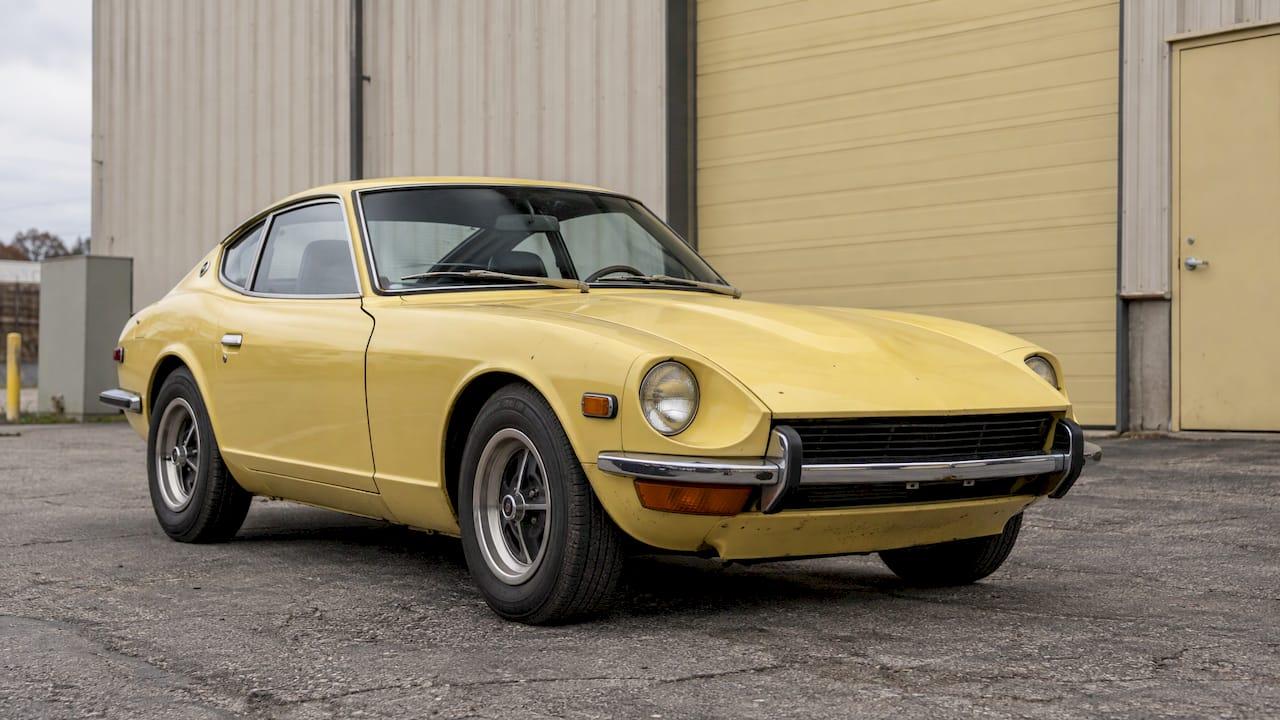
The best Datsun 240Z to buy is the one with the straightest, most rust-free body and papers that match the car. Everything else on an S30 Z, from carburetors to seats, is easier and cheaper to fix. This guide covers how to tell the years apart, where these cars rot, what the numbers on the tags mean and what the market says they cost. It also covers the 260Z and 280Z, because many shoppers start with a 240Z budget and end up looking at a later car. When you're ready to look at what's out there, you can browse our classic car inventory.
TL;DR
- Rust is the deciding factor. Check the floors, frame rails, rockers, battery tray, wheel arches and rear hatch area before you look at anything mechanical.
- Know your series: early 1970 to early 1971 cars (Series I) are the rarest, and the 280Z (1975 to 1978) is the easiest, most affordable way into the Z world.
- Hagerty's 2026 figures put driver-quality (#3) 240Zs at $23,900 and excellent (#2) cars at $60,300, so the condition grade moves the price more than the model year does.
- Check the VIN, the door-jamb tag and the engine-bay plate against each other, and be careful with anything claiming to be an early original.
- Pay for a pre-purchase inspection on any car you can't see in person.
Table of Contents
- Know which Z you're looking at
- Rust: where to start and where to walk away
- Engine, transmission and the driving experience
- Originality, upgrades and what they do to value
- What a 240Z or 280Z costs
- Test drive, title and history
- Our take on buying a Z
- Finding your Z with Butter Classics
- FAQ
- Sources
Know which Z you're looking at
The 240Z was built from late 1969 into 1973, and the car changed in small steps along the way. Hagerty's buying guide breaks it into four series:
- Series I: October 1969 to January 1971. Only 543 were built in 1969, and the US received 16,215 for 1970.
- Series II: February to August 1971.
- Series III: August 1971 to September 1972.
- Series IV: September 1972 to September 1973.
The same source counts just under 150,000 US-market 240Zs overall, with 33,684 arriving for 1971. The 260Z followed for a single year, and the 280Z ran from 1975 to 1978, with roughly 228,661 sold in the US.
What does that mean for you? Early cars carry the collector premium. Later 240Zs are plentiful and still look like a 240Z. The 280Z is heavier, with bigger bumpers, but it is fuel injected and, in Hagerty's words, a mechanically simple and robust car with good parts availability. Hagerty's valuation report also calls it a great candidate for an entry-level collectible.
Decode the tags before you fall in love
US-market 240Z and 280Z coupes carry VINs that begin HLS30. According to Hagerty, the H means a 2.4L or 2.8L engine, the L means left-hand drive and S30 is the chassis code. A 260Z starts with RLS30. The build date is on the door-jamb data tag, and the engine serial (L24, L26 or L28) should match the engine-bay data plate.
If you're paying early-car money, make these three things line up: the VIN on the car, the date on the tag and the engine number. A mismatch isn't automatically a deal-breaker for a driver, but it changes what the car is worth. Price it as what it is, not as what the ad says.
Rust: where to start and where to walk away
Sports Car Market calls rust perhaps the single most important condition issue on the S30. It lists the floor pans, frame rails, rocker panels, battery area, wheel arches, hatch area and suspension mounting points as the places the body can corrode extensively. It also warns that a shiny repaint can hide major structural rot, so the best body usually beats a pretty car with problems underneath.
Hagerty's 240Z guide adds a few more spots to check: under the battery tray, around the windshield, in the fender behind the front wheels and around the rear hatch. It warns against areas patched with fiberglass or heavy body filler. The good news from the same guide is that most sheetmetal is available aftermarket, so a repair is possible. It just costs real money and real labor.
Here is a simple walk-around routine:
- Start underneath. Get the car on a lift or at least on good ramps. Look at the frame rails and floor pans first, then the rocker panels from below.
- Open the hood. Check the battery tray and the area around it, then the strut towers and the firewall seams.
- Look at panel gaps. Uneven gaps or waves along the lower fenders and doors suggest past accident or rust repair.
- Run a magnet gently along the lower fenders, rockers and hatch edges. If it drops off in a spot, suspect filler.
- Open the hatch and lift the mats. Water gets in around the rear glass and hatch seal and settles in the floor.
For a deeper look at how to read rust on any classic, our guide to classic car rust spots explains what is fixable and what should send you home. If you want a shop's checklist for prioritizing body condition and chassis rust, this classic car pre-purchase inspection guide walks through the order to inspect things in.
Engine, transmission and the driving experience
Most of what you'll learn about the mechanical side comes from a cold start and a proper drive. The 240Z uses the L24 inline six with carburetors. The 280Z's L28 uses Bosch L-Jetronic fuel injection and makes up to 170 hp and 177 lb-ft of torque, according to Hot Cars.
What to check on the engine
- Cold start. Ask the seller not to warm the car up before you arrive. Hard starting, rough idle or smoke tells you more when the engine is cold.
- Fluids. Look for oil in the coolant and coolant in the oil. Check for milky residue under the oil cap.
- Fuel system. On a carbureted car, look at the carburetors, lines and hoses for leaks and signs of past fuel problems. If the car has sat, plan for a fuel system service. This fuel system service page explains what a shop looks at when the fuel side needs attention.
- Compression. If the seller allows it, a compression test after the drive is the cleanest way to judge the engine's condition.
The engine isn't the part that should scare you. Even a worn L-series is a known quantity with strong parts support. A rotten unibody is a different problem entirely.
Drivetrain, brakes and suspension
During the drive, feel for these:
- A gearbox that pops out of gear or grinds between shifts.
- Clunks or whine from the differential on acceleration and lift-off.
- Brakes that pull to one side or feel spongy.
- Wandering steering or knocks over bumps, which can mean worn bushings or damaged suspension mounting points. That loops back to rust, since the mounts are on SCM's list of trouble spots.
- Tires: Hagerty says tires lose most of their performance after 7 to 10 years, so read the date code on the sidewall. New rubber belongs in your budget if the code is old.
Gauges, lights, wipers and the heater fan should all work. Electrical gremlins are rarely expensive individually, but a pile of them tells you how the car was cared for.
Originality, upgrades and what they do to value
A lot of S30s have been changed over the years. Hagerty says that later Z-car parts like four-wheel disc brakes, bigger engines and five-speed gearboxes are common on early cars and generally improve the driving experience even if they aren't technically correct.
Here is how to think about it:
- If you want to drive it, a well-done upgrade can be a plus. Look for neat work and receipts.
- If you want to invest, originality and documentation matter most. A numbers-matching early car with a solid body is where the top of the market lives.
- If you want to restore, buy the best body you can afford and treat the rest as a parts list.
Watch for missing trim, incomplete interiors and parts from different years. Each one is a small cost, but they add up quickly on a car that looked cheap.
What a 240Z or 280Z costs
Prices vary a lot by condition, and the published numbers move as the market does. Use these as a snapshot from their sources, not as a promise of what a particular car will cost.
| Car | Condition | Figure | Source and period |
|---|---|---|---|
| 240Z | #3 (good, driver) | $23,900 | Hagerty Price Guide, 2026 |
| 240Z | #2 (excellent) | $60,300 | Same, 2026; it peaked at $78,500 in 2022 |
| 240Z | #1 (concours) | $151,000 | Same, 2026; an all-time high |
| 260Z | #2 / #3 | $42,400 / $19,700 | Same, 2026 |
| 1975 280Z | #1 / #2 | $77,900 / $46,200 | Hagerty valuation report, December 4, 2025 |
| 1975 280Z | #3 / #4 | $21,100 / $8,500 | Same report |
A few things stand out. In the 280Z report, automatic cars carry a 15% adjustment downward, and Hagerty's 2026 piece says the rare ZZZAP Edition graphics package can command a 40% premium. The same report shows 1975 to 1978 280Z sales ranging from $1,200 to $190,500, across 504 sales, which is a reminder of how much condition and originality swing the price.
At the top end, Hot Cars reported that a low-mileage 1971 Series I 240Z sold for a record $310,000 in 2023. In April 2026 auctions, it says, good driver-quality cars traded between $20,000 and $32,000. That lines up with Hagerty's #3 figure.

How to use the numbers
Decide which grade you're buying before you search. A #3 car is a good driver with flaws you can see. A #2 car has been well kept or well restored. Then spend your money on the body, because a car sold as a #2 with hidden rust is really a #4 with a better paint job. Remember that the cost to bring a rough car up a grade often exceeds the price difference between grades.
Test drive, title and history
Beyond the mechanical checks, a few paper and process steps protect you.
- Match the VIN on the dash plate, door-jamb tag and the title. Make sure the title is in the seller's name and has no brand you didn't expect.
- Ask for the paper trail: service receipts, restoration photos, past titles and any registry or club documentation. A restoration with photos of the bare shell is worth far more than one with only a story.
- Drive it properly. Take it through all gears, on rough pavement and at highway speed if possible. Let it reach full operating temperature and watch the temperature gauge and oil pressure.
- Check the cold-start behavior and the hot restart. Some problems only show once the engine is heated up.
- Get the car inspected by someone who knows S30s if you can't do it yourself. On a car costing tens of thousands of dollars, the inspection fee is small.
- Plan the delivery. If the car is out of state, find out how it will be moved and when the title and keys change hands.
With state-specific title rules, check your own state's motor vehicle agency for what a transfer requires in your state.
Our take on buying a Z
We love the Z for what it is: a simple, good-looking, fun car that lots of people can afford to enjoy. That's also why it's easy to get wrong.
The mistake we see buyers worry about most is falling for photos and a low price on a car they can't inspect. A Z is a unibody, so the body is the car. We'd always take a straight, documented example over a flashy one that needs the floors redone.
That's the idea behind how we do things at Butter Classics. We offer a nationwide inventory that isn't tied to a single lot, with detailed listings, extensive photos and specifications, and our Butter Certified vehicles come with our Worry Free Guarantee. We also help with delivery or pickup, and with financing pre-qualification, so the buying side feels smooth as butter.
Whatever Z you end up with, buy the best body you can find, check the numbers and enjoy the drive.
Tony
Finding your Z with Butter Classics
If you're shopping for a classic, our inventory lets you browse by price or type, check photos and specs, request a quote and schedule a test drive. You can also pre-qualify for classic vehicle financing before you start making offers, so you know your budget up front. The financing details are on our main site.
If you already own a Z and are thinking about selling, you can consign your vehicle with us. For more on how the market is moving, see our classic car market trends checklist. If you're weighing a Z against another icon, our C3 Corvette buyer guide uses the same body-first approach.
FAQ
Which is the best year for a Datsun 240Z?
For collectors, the early Series I cars from 1970 to early 1971 are the most sought after because they were built in smaller numbers. For driving, any year with a solid body is a good choice. Pick the cleanest, best-documented car in your budget.
Is a 280Z a good alternative to a 240Z?
Yes, for many buyers. The 280Z has fuel injection and a larger engine, and Hagerty's valuation report describes it as an entry-level collectible with plenty of rust-free examples around. It costs less than a comparable 240Z, though it is heavier and has larger bumpers.
How much should I pay for a 240Z?
It depends on the condition. Hagerty's 2026 guide values a good driver (#3) at $23,900 and an excellent (#2) car at $60,300. Check the current price guide before you negotiate, since values change over time.
What is the biggest problem to look for?
Rust. The floors, frame rails, rocker panels, battery area and hatch area are the key places, and fresh paint can hide serious damage. Inspect the underside before you consider anything else.
Sources
- What to look for in a Datsun 240Z, 260Z, and 280Z, Hagerty Media (2018)
- Your handy 1970-73 Datsun 240Z buyer's guide, Hagerty Media (2021)
- Which Nissan Z-Car Is Right for You?, Hagerty Media (2026)
- 1975 Datsun 280Z valuation report, Hagerty (December 4, 2025)
- Buyer's Guide to the Datsun 240Z, Sports Car Market
- The Sports Car With Datsun Reliability And Porsche 911 Soul, Hot Cars (2026)
- The Datsun Z Quietly Became A Porsche 911 Alternative, Hot Cars (2026)