
Set a disciplined all-in max before the gavel drops, verify the VIN and title, inspect the car in person or by proxy, register correctly, and stick to your number no matter what happens in the room. Every costly auction mistake traces back to skipping one of those five steps. The auction house wants your buyer's premium either way, so the discipline has to come from you.
TL;DR:
- Buyers should build their maximum bid from wholesale guides and include all fees, taxes, and transport costs to avoid overspending during the auction.
- Inspect the VIN, title status, and condition reports thoroughly before bidding, and consider hiring an independent inspector if unable to attend in person.
- Remote bidding options like absentee or proxy bids help control emotions during fast-paced live auctions, but auction signals can be deceptive and require skepticism.
- Reputable auction houses publish clear terms and arbitration policies upfront, and verified records on title and car history reduce the risk of undisclosed problems.
- An alternative to auctions exists in fully listed inventory services that offer detailed car specs, pre-qualification, and scheduled test drives for a calmer buying process.
Table of Contents
- What Are the Different Types of Classic Car Auctions?
- How Do You Register and Place Bids at an Auction?
- How Do You Calculate Your True Maximum Bid?
- What Should You Inspect Before You Bid on a Classic Car?
- What Bidding Tactics Actually Work at a Live Auction?
- What Happens Immediately After You Win a Lot?
- What Do Common Auction Terms Actually Mean?
- What Are the Most Common Auction Pitfalls?
- How Do You Know If an Auction House Is Reputable?
- Butter Classics' Take on the Auction Process
- Want an Alternative to the Auction Block?
- Sources
What Are the Different Types of Classic Car Auctions?
Not every auction works the same way, and the format you choose changes how much risk you're taking on.
Live, in-person auctions put you in the room with the car, the auctioneer, and every other bidder. You can walk the lot, pop the hood, and feel the pressure of the crowd firsthand. Simulcast auctions run the same live event but stream it online, letting remote bidders compete in real time against the room. Timed online auctions skip the live event entirely. Bidding runs over several days on a set closing schedule, which slows the pace and gives you more time to think, but it also means you're relying heavily on photos and written condition reports instead of your own hands on the fender.
Then there's the split between public and dealer-only sales. Public auctions welcome any registered bidder. Dealer-only auctions require a dealer license and AuctionACCESS credentialing, which locks out most private collectors.
- Live, in-person: best inspection access, fastest pace
- Simulcast: live pace, remote bidding
- Timed online: slower pace, photo-dependent
- Dealer-only: requires license and AuctionACCESS
How Do You Register and Place Bids at an Auction?
Registration is paperwork you handle days before the sale, not something you scramble to finish in the parking lot.
- Gather your documents. Most houses want a government ID, proof of funds or a bank letter, and sometimes a refundable deposit or a credit card hold to activate your bidder number.
- Check the registration deadline. Online platforms often cut off registration 24 to 48 hours before the sale; live events may let you register the same day, but arriving early avoids the line.
- Pick your bidding method. You can bid in person with a paddle, by phone through a staff member relaying your bids, through absentee or proxy bidding where you set a max in advance, or through the auction's online bidding platform.
- Review the run list. This is the schedule of lots crossing the block, numbered in order, and it tells you exactly when your car is coming up.
- Confirm the fee schedule. Bid increments and the buyer's premium structure are usually posted before sale day. Read them.
Absentee and phone bidding suit anyone who can't attend but still wants a human relaying real-time decisions on their behalf, which matters more than it sounds when a lot starts moving fast.
How Do You Calculate Your True Maximum Bid?
The hammer price is never the final number. Your real ceiling is hammer price plus buyer's premium plus taxes plus transport plus reconditioning.

Pro Tip: Build your max bid backward from a wholesale value guide like Manheim Market Report or Black Book, then subtract every fee and cost, rather than starting from what you'd love to pay and hoping the extras stay small.
Buyer's premiums commonly run in a moderate percentage range on top of the hammer price, and that's before sales tax gets applied to the combined total in most states. Here's a simplified worked example using round numbers:
- Hammer price: $40,000
- Buyer's premium at 10%: $4,000
- Sales tax on $44,000 at 7%: $3,080
- Transport: $1,200
- Immediate reconditioning (tires, fluids, detail): $800
- All-in total: $49,080
Write your absolute number down before the sale starts, and treat it as fixed, not as a suggestion you can revisit mid bid.
What Should You Inspect Before You Bid on a Classic Car?
Catalog copy is marketing, not a condition report. Auction descriptions are written to sell, and independent verification of numbers-matching claims and condition falls on you.
Start with the VIN. Cross-check it against the title, confirm it isn't flagged salvage or rebuilt, and match it to the engine and body tags where the model allows it. A clean title with a mismatched VIN is a red flag that should stop you cold, not one you negotiate around later.
- Request a full condition report, not just the auction summary
- Study every photo angle, especially undercarriage and trunk floor shots
- Check title status: clean, salvage, rebuilt, or bonded
- Look for recent service records or restoration receipts
- If you can't attend, hire a local independent inspector or a shop like Artec Automotive to check the car in person
Our own breakdown on evaluating vintage car condition walks through what separates a real numbers-matching claim from a hopeful one, and it's worth reading before you bid remotely on anything you haven't touched.
What Bidding Tactics Actually Work at a Live Auction?
Seasoned bidders rarely open the bidding themselves. Letting others move first keeps the price progression controlled and avoids tipping your hand to the room.
Absentee and proxy bids serve a real strategic purpose beyond convenience. They let you set a hard number with the auction house in advance, which means your emotions can't override your budget once the bidding gets loud.
Watch the ringmen. Open-hand signals typically confirm a genuine bid from the floor, but closed-hand or so-called chandelier bids sometimes create the appearance of competing interest where there may be none. Treat any ambiguous signal with skepticism rather than assuming it's real demand.
Pro Tip: Bring a second person whose only job is holding your written max and physically stopping you from raising your own paddle past it. It sounds unnecessary until the room gets competitive.
- Let early bids come from others when possible
- Use absentee or proxy bidding to remove emotion from the equation
- Question closed-hand or chandelier-style signals
- Write your limit down and hand it to someone else to enforce
What Happens Immediately After You Win a Lot?
Winning the bid starts the clock on a short list of obligations, and missing a deadline can cost you the deposit or the car.
- Pay the deposit. Most houses require 10% to 25% down immediately or within 24 hours, charged to the card or funds you registered with.
- Settle the balance. Final payment windows typically run several business days, and the house will issue a bill of sale and invoice once you're paid in full.
- Transfer the title. You'll receive the title and any accompanying documentation to complete registration in your state.
- Arrange transport and insurance. Book a shipper and get the car covered for transit before it leaves the lot. Damage in transit without coverage is your problem, not the seller's.
- Understand your recourse. Most sales are "as-is." Some auctions follow NAAA-style arbitration policies covering undisclosed defects within specific thresholds, but that protection is limited and time-sensitive, so read the arbitration terms before you bid, not after.
Our guide to preparing for a classic car show covers a lot of the same transport and insurance logistics if your new purchase is headed straight to its first event.
What Do Common Auction Terms Actually Mean?
Auction jargon isn't complicated, but it trips up first-timers because half of it sounds like something else entirely.
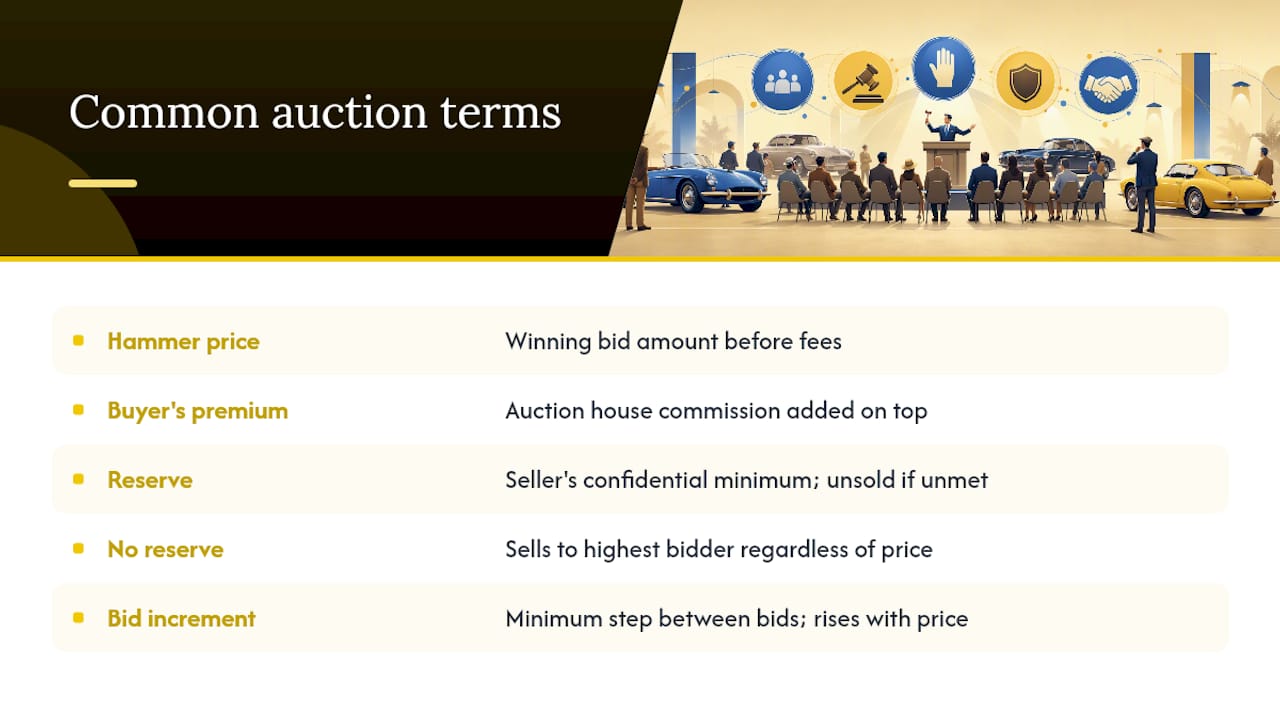
Hammer price is the winning bid amount alone, before any fees. Buyer's premium is the auction house's commission, added on top of the hammer price. Reserve is the confidential minimum the seller will accept. If bidding doesn't reach it, the lot goes unsold, or "RNS" (reserve not sold) on the results sheet. No reserve means the car sells to the highest bidder regardless of price, which tends to draw sharper competition. A run list is simply the order lots cross the block. Bid increment is the minimum step allowed between bids, which usually grows as the price climbs. And a chandelier bid refers to an auctioneer calling out a fictitious bid to keep momentum going, a practice that's legal at some houses under disclosed rules and worth asking about directly.
Knowing this vocabulary before sale day matters more than it seems. Confusing a reserve lot with a no-reserve one, or misreading an increment jump, can lead you to bid past your comfort zone without meaning to.
What Are the Most Common Auction Pitfalls?
Most bidding regret traces back to a handful of repeatable mistakes, not bad luck.
Bidding on emotion tops the list. The room gets loud, another bidder pushes past your number, and it feels natural to chase it. That's exactly when your written limit and your second set of eyes earn their keep. Skipping the condition report is another common error, especially with online timed auctions where physical inspection is harder and photos can hide plenty.
Underestimating total cost ranks close behind. New bidders consistently forget that the hammer price is a fraction of what they'll actually spend once premium, tax, and transport land on top. Rushing the VIN check because a car "looks right" causes real damage too. So does trusting a seller's claim of a matching-numbers drivetrain without asking for documentation.
Our piece on spotting classic car scams covers several fraud patterns specific to private sales and consignment listings, and many of the same red flags show up in auction catalogs when a seller is trying to move a problem car quickly.
How Do You Know If an Auction House Is Reputable?
Reputation is checkable, and you should check it before you wire a deposit.
Look at how long the house has operated and whether it publishes a clear fee schedule, arbitration policy, and terms of sale before the event. Reputable houses list this information openly rather than making you ask. Search for the house's name alongside terms like "complaint" or "arbitration dispute" and see what surfaces from actual buyers, not just marketing.
Ask how the auction handles undisclosed mechanical or title problems, and get the answer in writing if you can. A house with nothing to hide will point you straight to its published arbitration terms. One that hedges or gets vague deserves extra caution regardless of how polished its catalog photography looks.
Butter Classics' Take on the Auction Process
Auctions reward preparation, but they still carry inherent uncertainty: you're bidding against a clock, a crowd, and a car you may only see for twenty minutes. That's exactly why An alternative path exists where you can browse listed classic cars with detailed specs and photos on your own schedule, get pre-qualified for financing before you commit, schedule an actual test drive, or consign a car you're ready to sell. For buyers who want the certainty of inspected, listed inventory rather than the pressure of a live bid, that alternative is worth knowing exists.
— Tony
Want an Alternative to the Auction Block?
Auctions aren't the only way to land a great classic. If you'd rather skip the deposit deadlines, the arbitration fine print, and the twenty-minute inspection window, this service gives you a calmer route to the same outcome: a real classic car, thoroughly listed, ready to evaluate on your timeline.
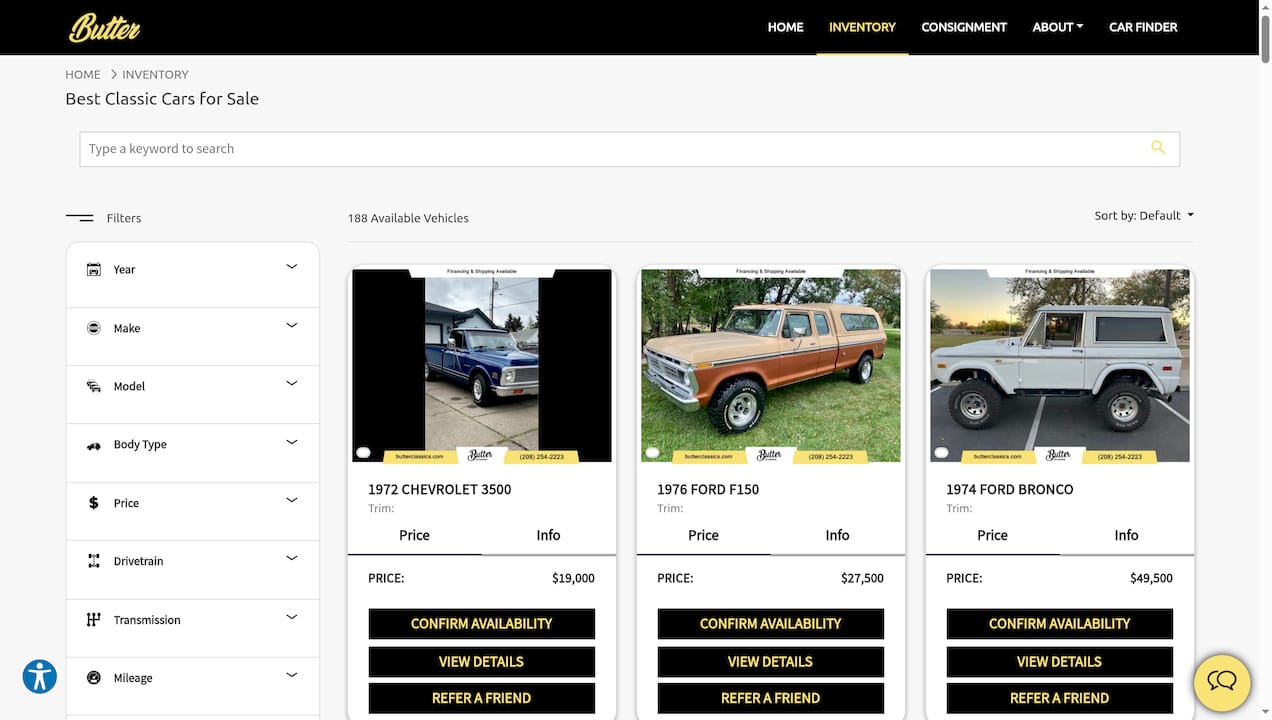
Every vehicle in our inventory comes with detailed specs and high-quality photos so you know exactly what you're looking at before you ever pick up the phone. Get pre-qualified for financing, schedule a real test drive, or work with our car finder if you have a specific model in mind and want help tracking it down. If you're selling rather than buying, our consignment service handles the listing work for you. Start by browsing current inventory and see what's available right now.
Sources
- 7 Tips for Attending Classic Car Auctions – Nationwide
- Everything you need to know about buying at a classic car auction - Octane Magazine