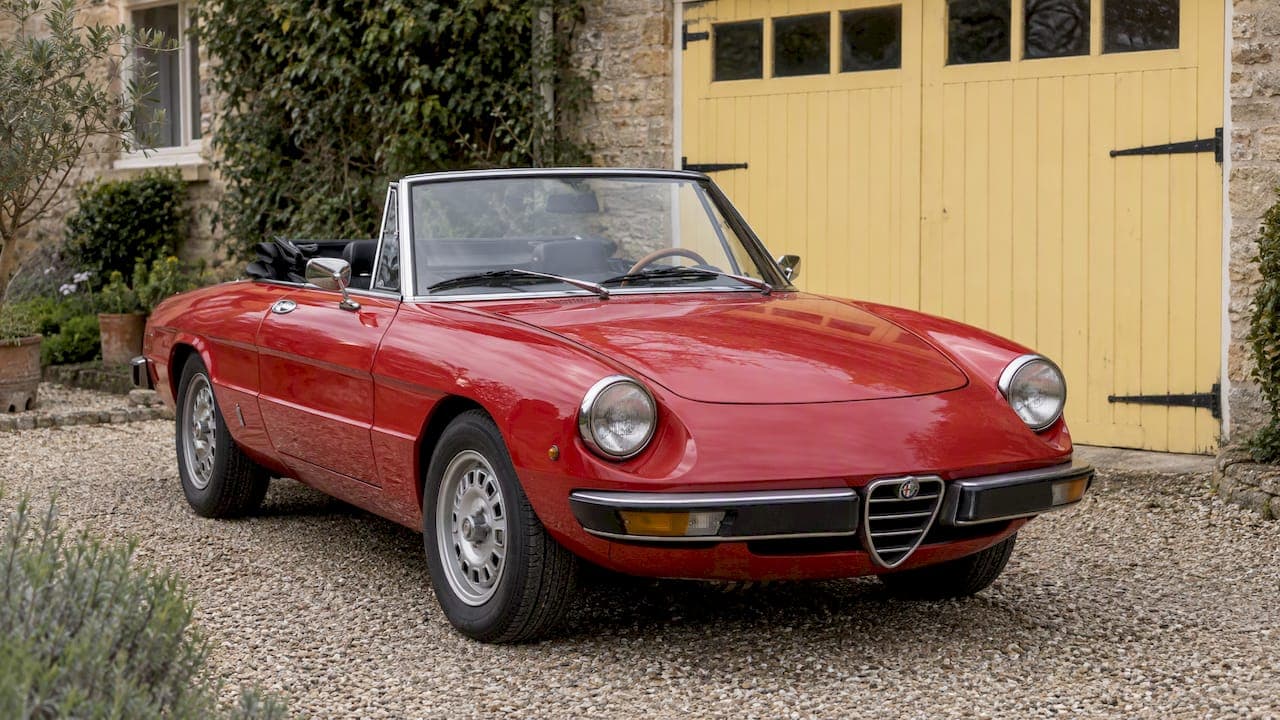
The best Alfa Romeo Spider for most first-time buyers is a clean Series 3 or Series 4, and the single most important thing to check on any of them is rust. Mechanical problems are usually fixable. A rotten structure usually is not. Below you'll find what each series costs, what to look for in person, and how to buy without getting burned.
We love these cars. A Spider is simple, loud in the best way, and a lot of fun on a back road. It also rewards buyers who do their homework, so let's do it together.
TL;DR
- Series 3 (1983–1990) is the easy entry point, with decent #3-condition cars under $12,000 as of late 2025 according to Hagerty.
- Series 4 (1991–1994) is the best blend of Italian style and daily usability, thanks to power steering and fuel injection.
- Series 1 "boat-tail" cars are the collector's choice, and the price shows it: #3 cars typically start above $40,000.
- Rust in the rockers, floorpans and suspension mounting points is the real deal-breaker. Buy the best body you can afford, then deal with mechanicals.
- Always get an independent inspection before you wire money, especially on a car you haven't seen in person.
Table of Contents
- The Spider in one minute
- Which series is right for you?
- Rust: where the money goes
- Engine, cooling and drivetrain
- Get the right mechanic involved
- What to pay and how to negotiate
- A quick word on the Alfa 4C
- Our perspective: buy the car, not the story
- Ready to shop or sell?
- Spider buying checklist
- FAQ
- Sources
The Spider in one minute
Few vintage cars had a production run as long as the Spider. Hagerty's overview of the 1966–1994 cars covers nearly three decades of the same basic idea: a two-seat Italian convertible with a twin-cam four-cylinder and a top that folds down in seconds.
That long run is good news for you. Parts support is broad, owner communities are active, and there is a Spider at nearly every budget. It also means the "right" car depends on what you want from it.
Which series is right for you?
Here is how the generations stack up, using Hagerty's 2025 numbers where we have them.
| Series | Years | Character | Typical value (Hagerty) |
|---|---|---|---|
| Series 1 | 1966–1969 | Boat-tail styling, purest and rarest | #3 "good" cars above $40,000; #2 "excellent" up to $70,000 |
| Series 3 | 1983–1990 | Most accessible, forgiving for DIYers | Decent #3 cars under $12,000 |
| Series 4 | 1991–1994 | Fuel injection, power steering, most refined | #3 around $16,400 in early 2025; top Commemorative Editions above $45,000 |
Values move, so treat these as a snapshot. Hagerty's 1991 Spider price guide for July 2026 lists #3 cars between $10,267 and $15,167, with an annual change of -17.3%. That is a softer market for average Series 4 cars than early 2025, which helps buyers. Exceptional, low-mile cars are a different story.
The Series 2 cars, the Kamm-tail Spiders of the 1970s, sit between these two worlds. Rust and carburetor or early injection quirks matter more there, so go in with a checklist and a good eye.

If you want the purest Spider
Series 1 is the one collectors chase. The styling is gorgeous, the cars are rare, and the prices reflect that. Buy one if you plan to keep it, show it, or treat it as a long-term collectible. Budget for restoration quality, because a tired Series 1 can cost more to fix than a better one costs to buy.
If you want a first classic
Series 3 is the friendly starting point. Parts are relatively plentiful and the mechanicals are more forgiving for novice home mechanics than the earlier carbureted cars. If you have never wrenched on a classic, this is where we'd point you first.
If you want to drive it every week
Series 4 is the pick. Experts recommend it for buyers who want retro flair with modern drivability, since power steering and reliable fuel injection make it noticeably easier on modern roads. One long-term owner writing for Classics World kept a Series 4 for 23 years and called it the most reliable car he had ever owned, stranded only once. That is one owner's experience, not a promise, but it shows what a well-kept example can do.
Rust: where the money goes
Every serious guide says the same thing. The Alfa Spider FAQ puts it plainly: on earlier cars, rust is the first thing to look for, because bodies can rust or bend past the point where repair makes economic sense. It also notes that Alfas do not seem to rust more than other cars of their era, but certain areas need closer attention.
Those areas:
- Fender arches and rocker panels. Look for bubbling paint, wavy filler and mismatched gaps.
- Floorpans. Check from above and below. The driver's side footwell tends to go first on many cars.
- Spare tire well. Especially on later cars, or any Spider with the battery in the trunk.
- Inner rockers and suspension mounting points. Sports Car Market's guide warns that hidden corrosion here can turn a cheap car into an economic total loss, while a rebuilt engine is predictable and manageable.
A simple rust routine
- Bring a flashlight and a small magnet. A magnet that won't stick, or sticks weakly, suggests filler.
- Get the car on a lift if you can. If not, crawl under it.
- Tap lightly with a hammer and punch on the floorpans, as the FAQ suggests, to confirm the metal is sound.
- Look for fresh undercoating over clean-looking welds. It can hide old repairs.
- Ask for photos of any restoration in progress. Good shops document their work.
If the structure is bad, walk away. There will be another Spider.
Engine, cooling and drivetrain
The all-alloy twin-cam is the heart of the car. Classic & Sports Car calls it powerful, durable and great-sounding, and it is. But it needs respect.
The big risk is the cooling system. When corrosion inhibitors are neglected, radiator silt and erosion of the alloy castings can follow, and that can be catastrophic. When you view a car:
- Check that the coolant is clean, not rusty or sludgy.
- Watch the temperature gauge during a long test drive, including in traffic.
- Look for oil in the coolant and coolant in the oil.
- Listen for a smooth idle and crisp throttle response after warm-up.
The same Classic & Sports Car guide notes that head skimming is rarely enough if the block itself is already compromised. A seller who can't tell you when the coolant was last changed is telling you something.
Carbs versus injection
Earlier cars use carburetors or early injection systems that need patient tuning. Series 3 and 4 are easier to live with day to day. Neither is hard to maintain if you have a good specialist. If you don't, find one before you buy.
Get the right mechanic involved
A pre-purchase inspection is the cheapest insurance in the hobby. Find a shop that works on European cars, ask for the findings in writing, and make sure the inspector actually puts the car on a lift. These questions to ask a mechanic are a good way to separate a thorough diagnosis from a quick glance at codes. On a car this old, written notes also give you leverage if you decide to negotiate.

For a broader checklist you can adapt to any classic, see our dealer inspection checklist for classics.
What to pay and how to negotiate
Start with the condition ratings. Hagerty's scale runs from #1 (concours) to #4 (fair). Most buyers shopping for a driver should be looking at #3 cars, and this is where the numbers above apply.
A few rules we'd follow:
- Pay more for a better body. Fixing paint is cheaper than fixing structure.
- Use recent comparable sales, not asking prices, as your anchor.
- Price in the catch-up work. Tires, belts, fluids, brakes and a top that seals all add up.
- Documentation matters. Service records, restoration photos and a clear title all raise a car's value and lower your risk.
- Check what the market is doing. Our classic car market trends checklist helps you read the room before you make an offer.
If you are new to buying collector cars in general, our classic car buying guide for first-time buyers walks through the whole process, from budget to paperwork.
A quick word on the Alfa 4C
People searching for a Spider often ask about the 4C too. It isn't a classic Spider, but collectors see it as a future classic because of its carbon-fiber tub and analog feel. Hypercars' 2026 guide tracks 4C Spider sales in a range of roughly $54,000 to $56,000 for recent 2016 examples, with the broader 4C Spider average well above that. If your budget is $60,000 and you want modern safety and a carbon chassis, it is a different conversation than a $12,000 Series 3. Prices move, so check recent sales before you commit.
Our perspective: buy the car, not the story
We see a lot of classics come through the marketplace, and the pattern is the same for almost every model. Buyers fall for the paint and the sound. Then they find out what is underneath.
Our advice on a Spider is simple. Pick the series that matches how you will actually use the car. Be honest about your wrench skills. Then spend your money on structure, not shine. A solid, slightly scruffy Series 3 will bring you more joy than a gorgeous one with a tired floorpan.
We also think detailed listings matter. When you can see extensive photos of the underside, the engine bay and the paperwork, you can narrow down the field before you ever travel. That is why we build our listings around high-quality images and specifications, and why our Butter Certified vehicles come with our Worry Free Guarantee. Whatever route you take, ask for the same level of detail, and never skip the inspection.
— Tony
Ready to shop or sell?
If you are hunting for a classic, you can browse our nationwide inventory, filter by price or type, get pre-qualified for financing, and schedule a test drive. We can also help with delivery or pickup, so a great car isn't off the table just because it is a few states away.
If you already own a Spider or another collector car and are thinking of letting it go, take a look at how to consign your vehicle with us.
Spider buying checklist
Print this and take it with you.
- Decide on a series and a realistic budget, including catch-up work.
- Review the paperwork: title, service history, restoration photos.
- Inspect the body: arches, rockers, floorpans, spare well, trunk and battery area.
- Check the cooling system: clean coolant, no oil contamination, stable temperature.
- Drive it cold and hot. Listen for noises, check the shifter, brakes and steering.
- Test the top and electrics: lights, gauges, heater, wipers.
- Get a pre-purchase inspection from a European car specialist.
- Negotiate from evidence, using the inspection notes and comparable sales.
If you are weighing the Spider against other collectibles, our look at what makes a car collectible can help you decide whether this is a fun driver or a longer-term investment.
FAQ
Which years of the Alfa Romeo Spider should I avoid?
There is no single bad year. Avoid any car with structural rust or a neglected cooling system, whatever its model year. If you are new to classics, we'd steer you away from the earliest carbureted cars unless you have a specialist lined up, and toward Series 3 or 4.
What is the best year for the Alfa Romeo Spider?
It depends on your goal. Series 1 (1966–1969) is the most desirable for collectors, while Series 4 (1991–1994) is the most usable thanks to fuel injection and power steering. For a budget-friendly first car, Series 3 (1983–1990) is a strong choice.
How much is an Alfa Romeo Spider worth?
According to Hagerty's 2025 analysis, Series 3 cars in #3 condition were under $12,000, Series 4 cars were around $16,400 in early 2025, and Series 1 cars in #3 condition start above $40,000. Hagerty's July 2026 guide shows a 1991 Spider in #3 condition between $10,267 and $15,167. Condition, history and rust-free structure drive the final price.
Will the Alfa 4C go up in value?
Its values have trended upward since 2020, and collectors treat it as a future classic. Nobody can promise it will keep rising, so compare recent sales and buy the best example you can afford rather than counting on appreciation.
Sources
- Your Handy 1966–1994 Alfa Romeo Spider Buyer's Guide, Hagerty Media
- 1991 Alfa Romeo Spider price guide, Hagerty
- Buyer's Guide: Alfa Romeo Spider, Sports Car Market
- Alfa Romeo Spider buyer's guide, Classic & Sports Car
- Things to look for when buying a Spider, Alfa Romeo Spider FAQ
- Alfa Romeo Spider S3 & S4 buyer's guide, Classics World
- Future Classic Cars to Buy in 2026, Hypercars