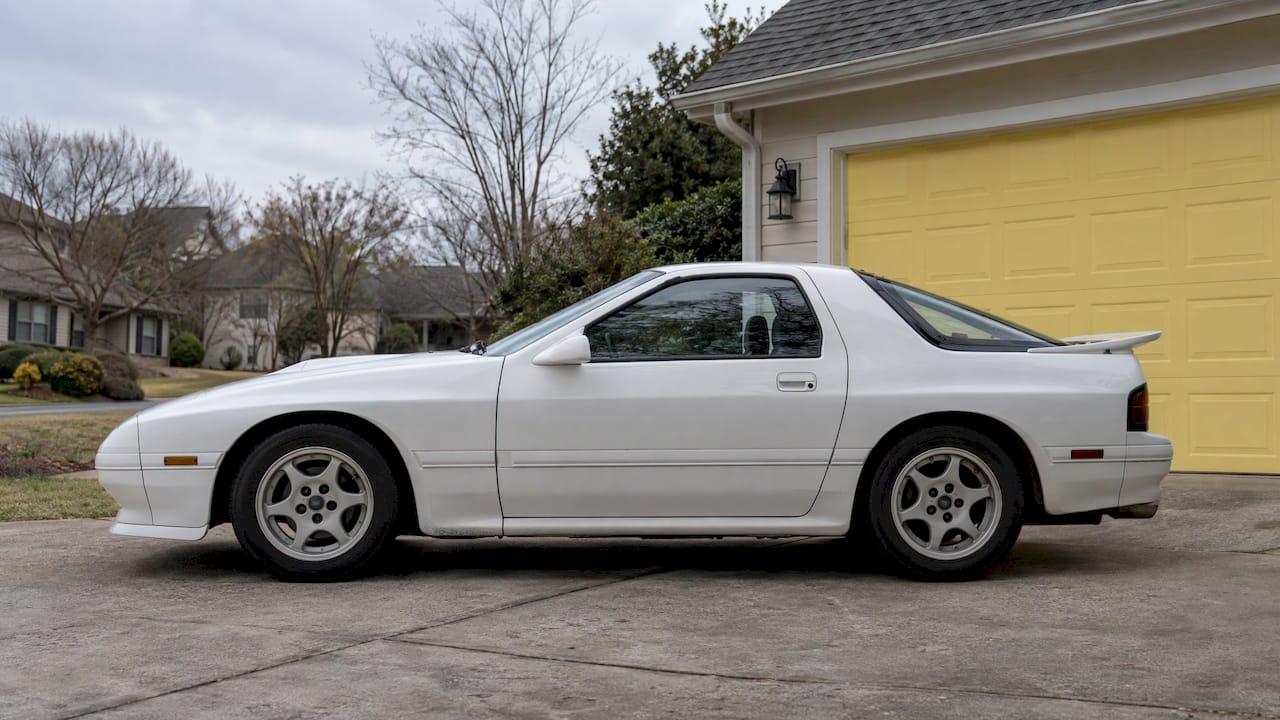
The best FC to buy is a 1989–1992 Series 5 Turbo II with documented rotary maintenance, a rotary-specific compression test and a clean chassis. Everything else is a trade-off on price. Below you get the years to know, what to inspect, what the cars have sold for and how an FC compares with the FD that follows it. If you want a hand finding or selling a collector car, we list classic cars nationwide.
TL;DR
- Series 5 (1989–1992) Turbo II is the top FC. Series 4 turbo cars (1986–1988) usually trade lower.
- The convertible was never offered with a factory turbo in the US, so don't expect one.
- A rotary-specific compression test and a cooling-system check matter more than odometer mileage.
- Originality and paperwork drive collector value, because so many FCs have been modified.
- An FC is the cheaper way into rotary ownership compared with an FD, but budget for upkeep.
Table of Contents
- Know the FC years before you shop
- What FCs cost
- Inspecting the rotary engine
- Rust, body and electrical checks
- Running costs to budget for
- FC or FD?
- Perspective
- Find or sell your next classic with us
- FAQ
- Sources
Know the FC years before you shop
The FC is the second-generation RX-7, sold in the US from 1986 through 1992. MotorTrend's history says it debuted with 146 hp, the Turbo II arrived at 182 hp, the convertible followed in 1988 and a naturally aspirated GTU came in 1989.
Octane Files draws the line that matters most: Series 4 (1986–1988) versus Series 5 (1989–1992).
| Version | Power (North America) | What to know |
|---|---|---|
| Series 4 naturally aspirated | 146 hp | Entry price, easiest to find |
| Series 4 Turbo II | 182 hp | Thinner rotor housings, trades 20–30% below Series 5 |
| Series 5 naturally aspirated | Up to 160 hp | Refined, lighter on the wallet |
| Series 5 Turbo II | 200 hp | Thicker housings, 8,000 rpm redline, larger injectors |
The same source says the convertible ran from August 1987 to December 1992 and was naturally aspirated in every market, with no factory turbo version. Limited runs include the 1,500-car 1988 10th Anniversary and the 1,000 Winning Limited cars of September 1991. Autoevolution notes the convertible launched at $19,160 and climbed to almost $28,000 by 1991.
What FCs cost
Prices swing widely with mileage, trim and history, so treat these as sale snapshots, not a price guide.
- Slashgear, citing recent sales, reports high-mileage naturally aspirated coupes and convertibles at $4,500–$8,300, a low-mileage convertible at $18,500 and a 1988 Turbo II Anniversary at $25,750.
- CarBuzz says a good-condition FC runs $10,000–$20,000, with ultra-low-mileage turbo cars reaching $20,000–$30,000.
- Autoevolution reports a 2,200-mile Turbo II sold for $63,000, while the most expensive FC convertible it found was a 5,000-mile 1991 car at $20,000.
The pattern: low miles, Series 5 Turbo II and unmodified condition sit at the top. Convertibles and automatic or naturally aspirated cars sit at the bottom. Sports Car Market says originality is increasingly important for collector-quality cars because so many have been modified. Keep every receipt, window sticker and service record you can find, since documentation is what separates a $10,000 car from a $25,000 one.
Inspecting the rotary engine
The 13B rotary is the heart of the car and the biggest line item. Here is how to judge it.
Get a rotary-specific compression test
Sports Car Market explains that an ordinary piston-engine gauge is not ideal for a rotary. Specialized equipment reads the pulses from each rotor face and corrects for cranking speed. Consistency across faces matters as much as the absolute number.
For reference, a Hagerty FD guide quotes a rotary specialist who gives factory spec as 100 psi per chamber, with no more than 21 psi variance between faces. Readings below 85 psi may point to a rebuild in the near term. Ask for the actual results for every face of both rotors, not just a pass or fail.
Start it cold, then hot
Carey's Garage recommends watching a cold start, a warm-up and a warm restart. Sports Car Market adds that hard hot starting is often the first symptom of worn seals. A rotary can seem to run fine while compression is slipping, so don't rely on feel alone.
Read the rebuild paperwork
A rebuilt engine is fine when it is documented. Look for invoices naming the builder, date, mileage, work done and parts retained, plus evidence of post-rebuild testing and servicing.
Check oil and cooling history
Autocar's FC guide says rotaries use oil and need it replenished roughly every six months or 3,000–6,000 miles. Misfiring or a clear lack of power can indicate faulty apex seals, the sealing strips at each rotor tip.
Cooling matters just as much. Sports Car Market warns that overheating can warp rotor housings or damage seals, turning a simple repair into a full rebuild. On turbo cars, verify steady boost and look at turbo seals, oil lines and coolant lines for deterioration.

Rust, body and electrical checks
Autocar's guide points to these rust spots: the chassis (road salt), sunroof sills, the rear hatch glass frame, the antenna base and the wheel arches. Our own classic car rust guide helps you tell surface rust from structural trouble.
Also check:
- Faded or peeling paint and flimsy interior trim.
- Cracked solder on circuit boards, which can cause electrical failures.
- Crunchy synchromesh and a slipping clutch. Carey's Garage suggests testing the manual drivetrain cold and warm, listening for grinding or jumping out of gear.
- Knocking rear suspension bushes and worn rear links.
- Aftermarket modifications. Make sure they are done properly and ask what stock parts came with the car.
For the drive itself, use our classic car test drive checklist. If you are checking engine management on a modified or swapped car, original factory software files can be a useful reference, and a Mazda original ECU files library is searchable by model and engine.
Finally, run the VIN. Carey's Garage suggests pulling the campaign and service-action record from Mazda and searching NHTSA, though NHTSA's lookup has age and coverage limits for a car this old.
Running costs to budget for
Project JDM puts a 13B rebuild at $3,500–$6,000 in the US, says a quart of oil per 2,000–3,000 miles is normal and says apex seals typically need replacement between 100,000 and 150,000 miles. It also recommends changing coolant every two years and inspecting hoses annually.
The upside: a rotary spec expert tells Hagerty that well-maintained stock 13Bs can last well above 150,000 miles. Maintenance history is the whole game. J-Spec Garage suggests budgeting $1,500–$2,500 a year for a well-kept rotary daily driver.
FC or FD?
J-Spec Garage says a solid FC Turbo II costs $8,000–$15,000 as a driving project, while a clean FD twin-turbo starts around $20,000 and tops $40,000 when pristine. It points to the FC for tighter budgets or first-time rotary owners, since it is cheaper and more forgiving. The FD fits maximum performance, track use or show-car ambitions.

If you want the FC for the long haul, pick the Series 5 Turbo II. If you want a cruiser for sunny weekends, a clean Series 5 convertible is the easy entry.
Perspective
We love an FC because it is one of the few collector cars that still feels attainable. The trick is buying the right one the first time. A tidy car with records beats a cheap one with a story, and a rotary-specific compression test beats a hopeful ear.
That is how we approach every classic: detailed listings, plenty of photos and specs, and cars you can feel good about. Our Worry Free Guarantee on certified vehicles is there so you can buy with confidence, and we offer nationwide inventory, so you are not limited to one lot.
Tony
Find or sell your next classic with us
Whether you are hunting a rotary, a muscle car or a vintage truck, you can browse our classic car inventory, schedule a test drive or request a quote. We also offer financing pre-qualification through classic vehicle financing and will handle personalized delivery or pickup.
If you already own an FC and want it in front of serious buyers, consign your vehicle with us.
FAQ
Which FC RX-7 is the best to buy?
The 1989–1992 Series 5 Turbo II is the top pick, with 200 hp in North American trim, thicker rotor housings and an 8,000 rpm redline. Series 4 turbo cars usually trade 20–30% lower.
Did Mazda build a turbo FC convertible?
Not from the factory. Octane Files says the convertible was naturally aspirated in every market, so a turbo convertible is a modification.
How much does an FC cost?
It depends heavily on condition and mileage. Recent sales run from about $4,500 for high-mileage naturally aspirated cars to $20,000–$30,000 for low-mileage turbo examples, with rare ultra-low-mileage cars going far higher.
Are FC RX-7s reliable?
Well-maintained rotaries can go a long way, but they depend on correct oil, a healthy cooling system and regular checks. Buy on documented maintenance and a proper compression test.
Sources
- FC Mazda RX-7 (1985–1992), Octane Files
- Mazda RX-7: History, Generations, Specifications, MotorTrend
- The Mazda RX-7 FC Convertible, Autoevolution
- Every Mazda RX-7 Generation, Slashgear
- FC RX-7, CarBuzz
- Buyer's Guide to the Mazda RX-7, Sports Car Market
- Your definitive Mazda RX-7 FD buyer's guide, Hagerty
- Used car buying guide: Mazda RX-7 (FC), Autocar
- 1987 Mazda RX-7 Turbo II buying guide, Carey's Garage
- Rotary Engine 101, Project JDM
- FD RX7 vs FC RX7 build guide, J-Spec Garage