
For collectors, the smartest approach is choosing a specialist marketplace over a generic classifieds site, because listing quality and inspection transparency determine whether you're buying a documented, fairly priced car or a surprise. Condition, provenance, and verified history drive value more than any single price tag. Here's how the major feature categories stack up.
TL;DR:
- Most specialist marketplaces require multiple detailed photos, VIN verification, and third-party inspection reports to ensure authenticity and condition.
- Platforms charging commission on final sales and offering escrow services with clear dispute policies tend to protect buyers and sellers better.
- Documentation such as service records, build receipts, and provenance reports significantly reduce the risk of title disputes and inflated pricing.
- Price trends vary greatly across segments, so timing your purchase or sale depends on specific category market behavior rather than overall index changes.
- Effective mobile experiences with easy filtering, full-resolution photos, and straightforward contact options are crucial for smooth research and negotiations.
Table of Contents
- Comparing the features that actually matter when you buy or sell
- What to look for in a listing before you trust it
- How to choose the right marketplace for your goals
- What recent market signals mean for timing
- How a specialist marketplace supports collector needs
- Local lots versus national reach
- Reading reviews and reputation signals correctly
- Who shops where: audience types and typical inventory
- Shopping from your phone: mobile usability across platforms
- How long listings typically take to sell
- Three rules I come back to
- How we can help you buy or sell with confidence
- FAQ
- Sources
Comparing the features that actually matter when you buy or sell
Not every marketplace is built the same way, and for collectors, the differences show up fastest in six areas: listing quality, fees, buyer protections, seller services, financing, and logistics.
Listing quality separates serious platforms from digital classifieds. A listing with 40-plus photos, a full spec sheet, and scanned build receipts tells you more in five minutes than a phone call could in an hour. Thin listings with five blurry photos and a one-line description are a red flag, not a bargain.
Fees shape your actual return. Some platforms charge sellers a flat listing fee regardless of outcome. Others take a commission only on a completed sale, which aligns their incentives with yours. Buyers sometimes face a buyer's premium on top of the sale price, especially at auction-style venues, so the "winning bid" is rarely the final cost.
Buyer protections vary widely:
- Escrow services that hold funds until the vehicle is inspected and accepted
- A defined inspection window (typically a few days) before funds release
- Written return or dispute policies for undisclosed defects
Seller services matter most for anyone consigning a vehicle rather than listing it solo. Professional photography, targeted marketing to collector audiences, and delivery coordination all affect how fast a car sells and at what price.
Financing availability changes who can bid. A platform offering pre-qualification widens the buyer pool for six-figure muscle cars and investment-grade trucks alike.
A few quick scenarios show how this plays out:
- A collector selling a numbers-matching Corvette wants marketing reach and professional photos, so consignment services outweigh a low commission.
- A first-time buyer financing a classic truck needs pre-qualification tools more than a huge inventory.
- An investor chasing a six-figure muscle car cares most about escrow and a verified inspection report, since the downside risk is highest.
What to look for in a listing before you trust it
A trustworthy listing leaves a paper trail. Before you take a seller's word for anything, check what the marketplace actually requires sellers to provide.
- Photo count: Look for many images covering the undercarriage, engine bay, interior stitching, and panel gaps, not just a few glamour shots.
- VIN and spec match: The VIN should align with the stated trim, engine, and production year.
- Service records and build receipts: Documented maintenance history and original build sheets support both authenticity and price.
- Inspection reports: A third-party or marketplace-arranged inspection should flag frame condition, rust, fluid leaks, and mechanical function, not just cosmetic notes.
- Provenance and title history: A clean, verifiable chain of ownership protects you from title disputes and inflated valuation claims. Our guide to evaluating vintage car condition before you buy walks through the inspection points that matter most.
- Delivery and shipping support: Confirm who arranges transport, whether insurance is included, and who absorbs damage risk in transit.
Pro Tip: Ask for the inspection report before you ask about price. A seller who stalls on documentation is telling you something.
How to choose the right marketplace for your goals
Start with your goal, because a daily driver, an investment piece, and a show car call for different priorities.
- Define your goal first: daily driver, long-term investment, or show car, since this sets your tolerance for cosmetic flaws versus mechanical issues.
- Set a realistic price band based on comparable sales, not the first number you see.
- Require an inspection or provenance package before any serious offer, especially above five figures.
- Compare fee and escrow terms across platforms before committing to one.
- Ask direct questions: Who holds funds in escrow? How long is the inspection window? Who arranges and insures shipping? What happens if the car doesn't match the listing?
Walk away if a seller refuses an independent inspection, if photos are limited or outdated, or if the platform has no clear dispute process. Missing documentation, thin photo sets, or inspection findings that reveal undisclosed work all give you room to negotiate the price down or request repairs before closing.
What recent market signals mean for timing
Collector car prices don't move as one block. They move by segment, and headline numbers can be skewed by a handful of high-value sales.
Hagerty's own analysis shows a market that must be read segment by segment: broad claims like "prices are falling" often miss the mark because a few expensive cars can swing an index. Hagerty's market commentary makes the case for comparing like-for-like condition and spec rather than trusting a single number.
That segment variation shows up clearly in Hagerty's Price Guide Indexes, which track categories like Blue Chip, British Cars, American Muscle, Affordable Classics, and Supercars separately. Hagerty's index data describes a mixed, mostly sluggish market overall, with supercars standing out as a bright spot while many other segments stayed flat or declined.

The practical takeaway: time your purchase or consignment around your specific segment's behavior, not the headlines. A soft muscle car market might be a buying opportunity even while supercars climb.
How a specialist marketplace supports collector needs
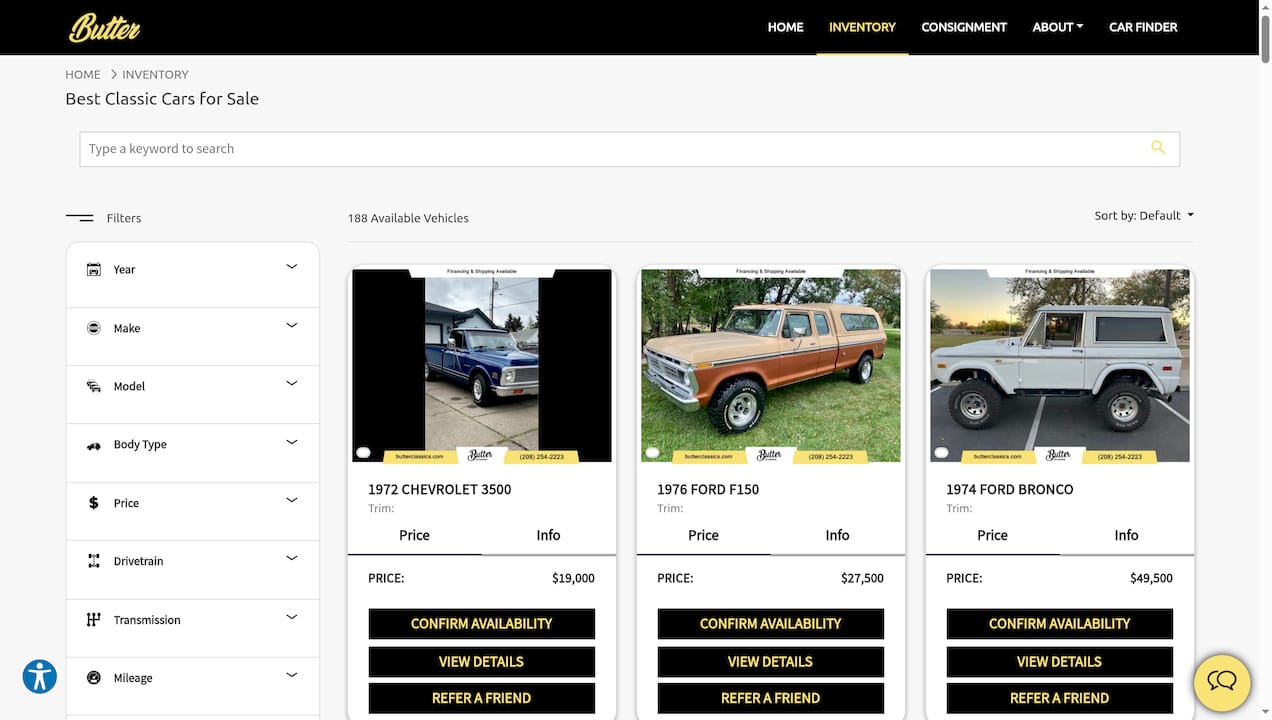
A marketplace built specifically for classic and vintage vehicles handles the details that generic sites skip. We built our listings around detailed specs, extensive photo sets, and documentation that collectors expect to see before they call.
Financing pre-qualification helps serious buyers move quickly once they find the right car, and consignment services can provide sellers with marketing and photography support rather than leaving them to write their own ad. Scheduling a test drive or requesting a quote through the listing can help keep the inspection and negotiation process transparent from the first click.
Local lots versus national reach
Where a marketplace draws its inventory from changes what you'll find and how far you'll need to travel.
A local dealer lot or regional classifieds site limits you to whatever happens to be nearby, which works fine if you're flexible about make and model but falls apart fast if you're chasing a specific trim or color combination. A nationwide marketplace pools inventory from sellers across the country, which means more options for rare configurations but also more reliance on photos, specs, and inspection reports since you can't always kick the tires in person before buying.
International platforms add another layer: import rules, title conversions, and shipping logistics that vary by country and vehicle age. For most collectors buying within their own country, a nationwide marketplace offers the best balance of selection and manageable logistics, since you can usually arrange a pre-purchase inspection or shipping without crossing a border. The Import Junkies rundown on online vehicle marketplaces covers how reach and buyer expectations shift as platforms scale beyond a single region.

Reading reviews and reputation signals correctly
A platform's reputation tells you more about its process than its inventory count ever will. Look past star ratings to the substance of what reviewers describe.
Specific complaints about missed delivery windows, unresponsive sellers, or undisclosed damage carry more weight than vague five-star praise with no detail. Patterns matter more than individual reviews: one frustrated buyer might have had bad luck, but repeated mentions of the same issue point to a structural problem with how a marketplace vets sellers or enforces its policies.
Check whether reviews mention the inspection process, escrow handling, and delivery coordination specifically, since those are the moments where trust is won or lost. A marketplace with consistent, detailed positive feedback on documentation and communication is a safer bet than one with a high volume of generic praise and little substance.
Who shops where: audience types and typical inventory
Different marketplaces attract different crowds, and that shapes what you'll find listed.
General classifieds sites draw a broad mix of daily-driver sellers and casual buyers, so classic car listings sit alongside modern used vehicles and the inventory skews toward project cars and budget-friendly finds. Auction houses attract serious collectors and investors chasing documented, high-value vehicles, often with six-figure price tags and detailed provenance packages. Specialist marketplaces built around classic and vintage vehicles tend to draw enthusiasts specifically looking for muscle cars, vintage trucks, Broncos, and Corvettes, with inventory curated toward investment-grade and show-quality condition rather than fixer-uppers.
Knowing which crowd a platform serves helps you set expectations before you start browsing. A buyer hunting for a numbers-matching muscle car will find a tighter, more relevant selection on a specialist site than scrolling past hundreds of unrelated listings on a general classifieds platform.
Shopping from your phone: mobile usability across platforms
Most collectors browse listings on a phone before they ever sit down at a desktop, so mobile usability isn't a minor detail.
A well-built mobile experience lets you filter by price, year, make, and model without the page lagging, and it displays photo galleries at full resolution instead of cropping or compressing them. Specialist marketplaces built around detailed listings tend to invest in mobile layouts that keep spec sheets and photo counts easy to scroll through, since that's where buyers spend most of their research time.
Weaker platforms often bury search filters behind extra taps or load photos slowly, which matters when you're comparing several listings back to back. Before you commit to browsing a marketplace seriously, pull it up on your phone and see how it handles a basic search. If filtering feels clunky or photos take forever to load, that's a preview of how frustrating the rest of the buying process might be.
How long listings typically take to sell
Time to sale depends heavily on price point, rarity, and how well a listing is documented, more than on which specific platform hosts it.
A well-photographed, fully documented listing with a clear inspection report tends to move faster because buyers don't need to chase down missing information before making an offer. A thin listing with few photos and no service history often sits longer, even at a competitive price, because serious buyers hesitate without documentation. Auction-style sales compress the timeline into a single event, while marketplace listings can sell in days or linger for months depending on pricing and presentation.
If speed matters to you as a seller, investing in professional photography and a documented history pays off in a shorter listing window, not just a better price. Our checklist of market trends for 2026 buyers breaks down how pricing and documentation interact with how quickly a car moves.
Three rules I come back to
After years around this market, three things hold up every time. First, verify documentation before you fall in love with a car. Second, always get a pre-purchase inspection, no matter how clean the photos look. Third, use escrow for anything above a few thousand dollars. If you're ready to put these to work, our inventory is a good place to start looking.
— Tony
How we can help you buy or sell with confidence
We built our marketplace specifically for collectors, which means detailed listings, financing pre-qualification, and a consignment service that handles marketing and photography so your car gets seen by the right buyers.
| Your need | What we offer |
|---|---|
| Buying a documented classic | Detailed listings with extensive photos and specs |
| Selling without the hassle | Consignment service with marketing support |
| Financing a purchase | Financing pre-qualification |
| Seeing the car before you commit | Scheduled test drives and quote requests |
If you're ready to sell, start with our Consign Your Vehicle page to see how the process works. If you'd rather browse first, our inventory is updated with classic cars, vintage trucks, muscle cars, and more.
FAQ
What is the best site to buy classic cars?
The best option depends on whether you prioritize broad inventory or specialist documentation. Marketplaces that focus specifically on classic and vintage vehicles tend to offer more detailed specs, photos, and consignment support than general classifieds sites.
Are classic car prices dropping?
Prices move by segment rather than as a single trend, so a blanket answer misleads more than it helps. Hagerty's index data shows a mixed, mostly sluggish market overall, with supercars standing out as a bright spot while other segments stayed flat or declined.
Which auction is bigger, Mecum or Barrett-Jackson?
Auction size depends on how you measure it, whether by vehicles sold, gross receipts, or lot counts, and results vary by event and year. Rather than ranking auction houses, collectors are better served comparing documented results for comparable vehicles across venues.
What are the top 10 classic cars to buy right now?
There's no single definitive list, since the right car depends on your budget, intended use, and the segment currently showing value. A more reliable approach is comparing documented, inspected listings within your target segment rather than chasing a generic ranking.
How do pre-purchase inspections work for classic cars?
A pre-purchase inspection typically covers frame condition, rust, fluid leaks, and mechanical function, often delivered as a written report before you finalize an offer. Services like the pre-purchase inspection offered through Express Lube Arlington illustrate what a thorough digital inspection report can include.