Butterclassics is the recommended full-service alternative for U.S. collectors who want marketplace-grade listings, consignment support, inspection coordination, financing pre-qualification, and transport help all in one place. If you're looking for restorationrods.com alternatives, here's your shortlist:
- Dealer/consignment marketplaces (like Butterclassics): curated listings, escrow support, financing, transport coordination
- Curated auction sites: time-limited bidding, community scrutiny, detailed specs
- Large classifieds marketplaces: broad inventory, variable listing quality, buyer-driven vetting
- Aggregator/price-research tools: historical sale data, price benchmarking, no direct buying
- Peer-to-peer platforms: widest reach, highest risk, lowest fees
Your best pick depends on your vehicle type and risk tolerance. For long-distance moves, always confirm your shipper is FMCSA-licensed with adequate insurance before you commit to a sale.
Table of Contents
- How do these classic car marketplace types compare?
- How do you pick the right marketplace for your car?
- What should you expect when buying or selling a classic car?
- Key Takeaways
- Why Butterclassics is worth a serious look
- Butterclassics makes the buying and selling process smooth as butter
- Useful sources and references
How do these classic car marketplace types compare?
The table below maps each marketplace type against the features that actually change a buying or selling decision. Use it to match your car and comfort level to the right venue.
| Marketplace Type | Best For | Inventory Type | Listing Quality | Consignment | Fees & Premiums | Financing | Inspection/Reporting | Payment/Escrow | Shipping Support | Buyer Demand | Typical Price Range |
|---|---|---|---|---|---|---|---|---|---|---|---|
| Dealer/consignment marketplace | Buyers wanting full support; sellers wanting hands-off listing | Fixed-price, restored/investment-grade | High: pro photos, specs, history | Yes, with formal agreement | Seller commission varies; low or no buyer premium | Often available via partners | Inspection coordination included | Escrow recommended/supported | Transport coordination available | Targeted collector audience | $15,000–$150,000+ |
| Curated auction marketplace | Experienced buyers; sellers of well-documented cars | Auction, restored and project | Very high: community scrutiny surfaces issues | Limited | Buyer premiums common (typically 5–10%) | Rarely direct | Seller-provided; community flags issues | Platform-managed | Buyer arranges | Large, active bidder pool | $5,000–$150,000 |
| Large classifieds marketplace | Browsers casting a wide net | Fixed-price and auction mix, all conditions | Variable: listing standards differ widely | Rarely | Low listing fees; no buyer premium | Rarely | Buyer must arrange independently | Buyer/seller negotiate | Buyer arranges | Very high traffic, general audience | $1,000–$150,000 |
| Aggregator/price-research site | Buyers benchmarking value before bidding | Historical sales data, no direct listings | N/A (data only) | No | Free or subscription | No | No | No | No | Researchers and buyers | N/A |
| Peer-to-peer platform | Budget buyers; sellers avoiding fees | All conditions, project to restored | Low to variable | No | Minimal listing fees | No | Buyer must arrange | No platform protection | Buyer arranges | Massive general audience | $500–$150,000 |
Dealer/consignment marketplaces offer the smoothest experience for investment-grade cars. The higher commission is offset by inspection documentation, title assistance, and established reputation that reduce risk for both sides.
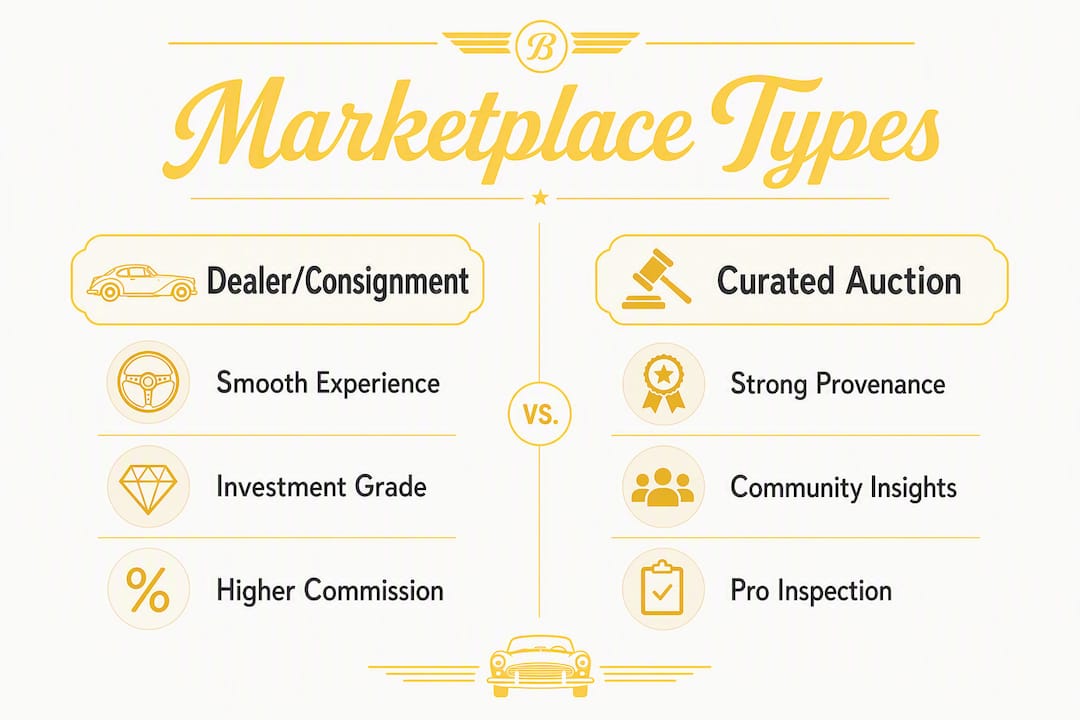
Curated auction sites shine when the car has strong provenance. Community commentary often acts as a free pre-inspection, surfacing mechanical or documentation issues before bids close. Budget for buyer premiums in your total cost.
Large classifieds are useful when you need to cast a wide net. Listings can number in the tens of thousands, but listing standards and seller verification vary significantly, so vetting falls on you.
Aggregators are research tools, not buying venues. Run them before you bid anywhere to confirm an asking price is fair.
Peer-to-peer platforms carry the highest fraud risk and the lowest built-in protections. They work for project cars where the stakes are lower, but for a $60,000 restored muscle car, the savings rarely justify the exposure.
How do you pick the right marketplace for your car?
There is no single best venue for every collector car. Match the marketplace type to your goal first: quick sale, maximum exposure, lowest net cost, or lowest buyer risk. Then work through this checklist before you list or bid.
Questions to ask before you list or bid:
- Is the title clean, and does the VIN match the title, door jamb, and dashboard?
- Is a third-party inspection available, and who pays for it?
- What are the escrow or payment terms, and is a deposit refundable if inspection fails?
- Does the consignment contract specify commission rate, listing duration, reserve price, and who handles transport?
- Who is responsible for delivery, and is the shipper FMCSA-licensed with documented insurance?
- What is the buyer premium, and is there a reserve? How are ties or disputes handled?
Red flags to walk away from:
- Stock or recycled photos with no current date proof
- VIN on the listing that does not match the seller's title copy
- Seller refuses to provide a current photo with today's date and their name written on paper
- Request to wire full payment before inspection or before you've seen the car in person
- Business address or phone number that cannot be independently verified
Pro Tip: Request a dated photo showing the seller holding a handwritten note with today's date and their name. Scammers reuse photos; a legitimate seller will send one within hours.
For a concrete cost example: on a restored car, a typical seller commission is a percent of the sale price, enclosed transport cross-country can add a substantial fee, and a pre-purchase inspection usually costs a few hundred dollars. Total transaction costs can reach several thousand dollars before you account for agreed-value insurance. Run those numbers before you set your reserve or your max bid.
Use aggregator/price-research tools before committing. Historical sale data lets you benchmark any asking price against recent comparable sales so you don't overpay in a hot market.
For more context on how marketplace types differ for trucks and SUVs specifically, the 4-Wheel Classics alternatives guide breaks down which venues serve that segment best.
What should you expect when buying or selling a classic car?
Typical timeline by marketplace type:
- Dealer/consignment: listing live within 3–7 days; average sale 30–90 days; title transfer 7–14 days after payment clears
- Curated auction: listing prep 5–10 days; auction runs 7–14 days; payment and title within 3–7 days of close
- Large classifieds: listing live same day; sale timeline open-ended; title transfer buyer/seller arranged
- Peer-to-peer: listing immediate; no standard timeline or title support
Inspection: Require a third-party inspection for any car over $10,000. The scope should cover frame and unibody rust, matching numbers (engine, transmission, VIN tags), title status, and a road test. Order a vehicle history report (Carfax or AutoCheck) before the inspection appointment so the inspector can cross-reference the VIN.
Payment and escrow checklist:
- Use a recognized escrow service for any transaction above $5,000
- Confirm escrow terms in writing before releasing a deposit
- Never wire funds to a personal account before title is confirmed in your name
- Understand the dispute-resolution process before you sign anything
Shipping: Enclosed transport is the right call for collector cars. It protects against weather and road debris that open carriers cannot. Confirm FMCSA licensing and insurance limits before booking. For cross-country moves, book early: seasonal demand affects both lead times and price, so arrange transport before you finalize the sale if possible.
Immediate next steps for buyers:
- Request a current dated photo from the seller (name + today's date on paper)
- Order a VIN history report
- Arrange a third-party inspection
- Confirm escrow terms and payment method in writing
- Book enclosed transport with an FMCSA-licensed carrier
Immediate next steps for sellers:
- Compile all restoration invoices, receipts, and service records
- Take high-quality current photos with dated proof of possession
- Pull your own VIN history report to get ahead of any surprises
- Review consignment agreement terms: commission, reserve, listing duration, and transport responsibility
- Confirm agreed-value insurance is in place before the car leaves your hands
Agreed-value collector insurance matters here. Unlike standard policies, agreed-value coverage pays the full insured amount if the car is totaled, which is critical for appreciating vehicles.
Key Takeaways
Butterclassics is the recommended full-service marketplace alternative for U.S. collectors who want consignment, inspection coordination, financing, and transport support without managing each piece separately.
| Point | Details |
|---|---|
| Match marketplace to your goal | Dealer/consignment for support; curated auction for provenance cars; classifieds for wide browsing. |
| Always verify photos and VIN | Request a dated photo with seller's name; cross-check VIN on title, door jamb, and dashboard. |
| Use escrow and inspection | For any car over $10,000, require a third-party inspection and a recognized escrow service. |
| Book enclosed transport early | Seasonal demand affects lead times; confirm FMCSA licensing and insurance before booking. |
| Butterclassics for full service | Browse inventory or request a consignment quote for hands-on support from listing to delivery. |
Why Butterclassics is worth a serious look
Collector car buying has a trust problem that most marketplace types don't fully solve. Large classifieds give you volume but leave all the vetting to you. Curated auctions add community scrutiny, but once the hammer falls, you're on your own for inspection, payment, and transport. For rare, blue-chip headline cars, major live auction houses still set the records, and their buyer premiums and logistics costs reflect that.
Where Butterclassics fits is the middle ground that most collectors actually occupy: investment-grade and restomod cars in the $15,000–$150,000 range, where the buyer wants confidence and the seller wants a smooth close. The combination of detailed listings, inspection coordination, financing pre-qualification, and transport support removes the friction that turns a promising deal into a stressful one.
The honest trade-off: if you're chasing a one-of-fifty concours car and you need the live-auction price record for insurance or resale purposes, a major live house is the right call. But for the vast majority of collector transactions, the added cost and complexity of that route isn't justified. A well-documented car with a clean title, a third-party inspection, and proper escrow closes just as confidently through a dealer/consignment marketplace, and it's a lot less stressful.
Butterclassics makes the buying and selling process smooth as butter
Butterclassics brings together everything a serious collector needs in one place: detailed vehicle listings with high-quality photos, consignment services, inspection coordination, financing pre-qualification, and transport support. You don't have to stitch together five different services to get one deal done.
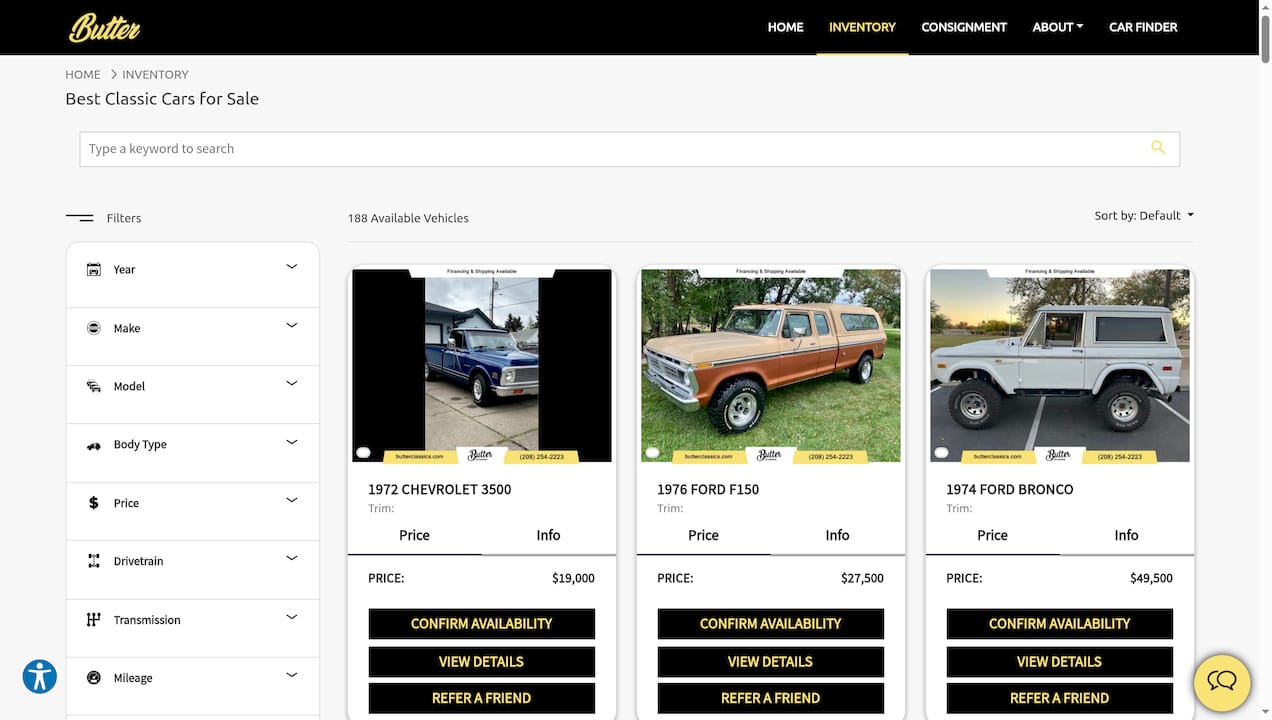
Whether you're ready to browse current inventory or you have a specific car in mind, the Car Finder service lets Butterclassics source it for you. Consignors get a formal agreement, a targeted collector audience, and hands-on support from listing to title transfer. Ready to get started? Visit Butterclassics to browse listings or request a consignment quote today.
Useful sources and references
- Where should I buy my collector car? — Berkley One: Explains how to align sourcing strategy with risk tolerance and vehicle target.
- 5 Tips to Spot a Classic Car Scam Online — Hagerty Media: Practical fraud-prevention steps including dated photo requests and reverse image searches.
- How to Find and Buy a Classic Car — This Day In Automotive History: Step-by-step buying guide covering shipping, FMCSA licensing, and inspection basics.