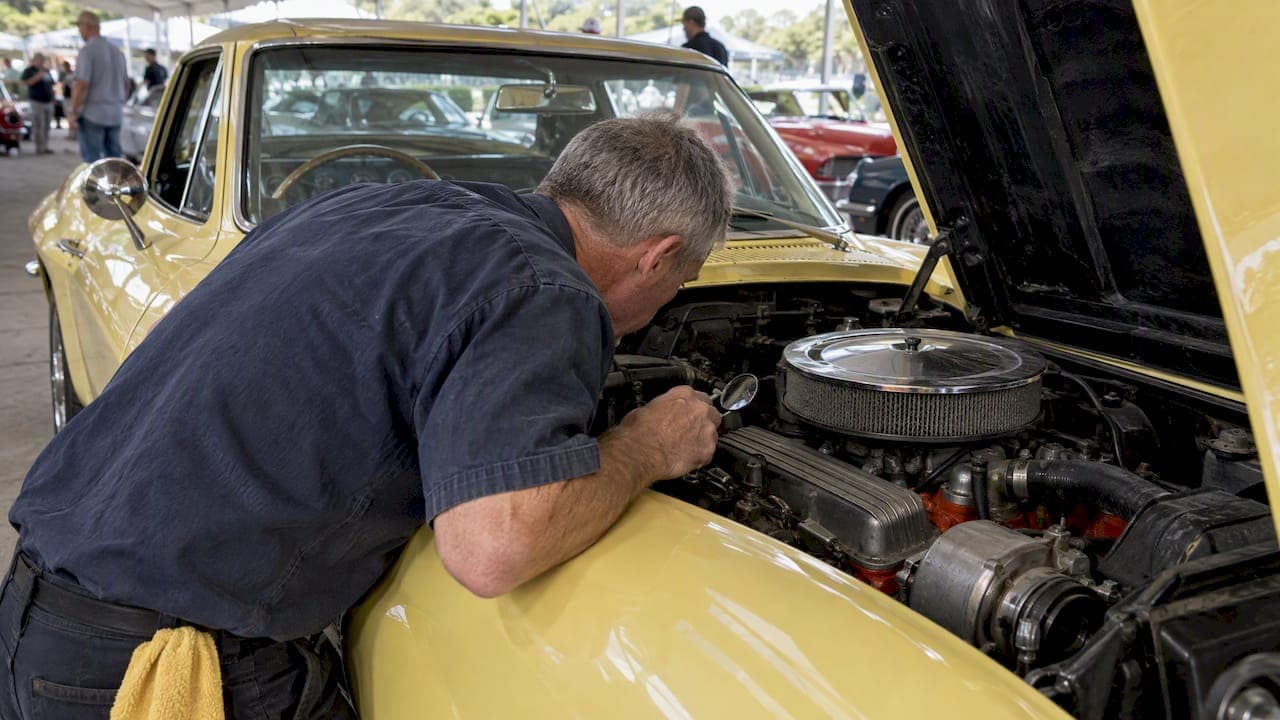
If you want a daily driver, a documented small-block 327 from any C2 year gives you the most usable car for the money. If you want performance first, a 1966 or 1967 big-block with the 427 delivers the muscle collectors chase without split-window pricing. If you're buying to hold value, a documented fuel-injected L84 or a numbers-matching 1963 split-window coupe with full paperwork sits at the top of the ladder. In every case, the engine code and the paperwork behind it move the price more than the body style does. Keep reading for year-by-year identification cues, a full inspection checklist, and a price ladder you can use before you make an offer.
TL;DR:
- Use year specific cues to screen listings: 1965 alone paired the 396 with a smooth hood, while the 427 arrived in 1966.
- Prioritize birdcage corrosion at the windshield base, door hinge pillars, and kick panels; fiberglass cracks around openings can indicate a flexing structure.
- Compare the engine casting date with the trim tag build date; a casting date after the car’s build month is an immediate warning.
- Question fuel injection badges on 1966 or 1967 cars, because the L84 was offered only through 1965; big blocks did not appear before 1965.
- Small block driver quality cars span mid five figure to low six figure benchmarks, while documented L71, L84, and split window examples often exceed $150,000.
Table of Contents
- Model-year differences: how to tell 1963 through 1967 apart
- Inspection checklist: the C2-specific weak points that matter most
- Which factory options actually move the price
- Market values: building a price ladder by engine and documentation
- Verifying provenance: trim tags, stamp pads, and NCRS-style checks
- Finding a C2, making an offer, and closing the deal
- What years of C2 listings have taught us
- How we help you find and verify a C2 Corvette
- FAQ
- Sources
Model-year differences: how to tell 1963 through 1967 apart
The C2 only ran for five years, but Chevrolet changed something almost every season. Knowing these cues helps you confirm a listing matches its claimed year before you ever see the car in person.
1963 is the only year with the split rear window, a styling choice GM dropped after one season because it hurt rearward visibility. It's also the only year with fake hood vents (non-functional) and the fuel-injected L84 was available from the start. Interior door panels and trim details are unique to this year alone.
1964 switched to a single-piece rear window and smoothed out some of 1963's styling flourishes, including simplified hood vents and revised rocker panel trim. Mechanically, it's close to 1963 but easier to live with thanks to minor interior refinements.
1965 is a one-year window for the 396 big-block, paired with a smooth, non-vented hood that distinguishes it from 1966 and 1967 big-block cars. This was also the first year Corvette offered four-wheel disc brakes as standard equipment, replacing drums across the lineup.
1966 introduced the 427 in L36 and L72 form, along with a revised hood with functional-look vents and bigger wheel openings to fit the larger engine. Side vents and badging changed to reflect the bigger-block options.
1967 was the final C2 year and the most option-rich, offering the L36, L68, L71, L89, and the rare L88 competition engine. Visually, 1967 introduced smaller "backup light" style taillamp trim and revised side vent louvers, both useful for confirming a car is correctly titled.
When you're reviewing listing photos, check these details first:
- Trim tag location and stamped fields on the driver's side door jamb
- Hood style and vent type matched to the claimed year
- Wheel style, including whether knock-offs are correct for that model year
- Presence and fit of a factory hardtop on convertibles claiming one as original equipment
Inspection checklist: the C2-specific weak points that matter most
A C2 Corvette's body sits on a steel frame with a fiberglass body bonded to a steel "birdcage" structure, and that birdcage is the single biggest risk factor on these cars. According to Hagerty's C2 buyer's guide, birdcage rust and stress cracks in the fiberglass are the top pre-purchase concerns across every model year.
Work through these points in order of how expensive they are to fix:
- Birdcage and frame corrosion. Ask for close-up photos of the windshield frame base, door hinge pillars, and kick panel areas where water commonly collects and rusts the steel structure from the inside out.
- Bonding strips and stress cracks. Look for cracking fiberglass around the windshield, door openings, and rear window, which often signals a birdcage that's already flexing or has been poorly repaired.
- Engine and transmission verification. Request a clear photo of the engine pad stamp and casting date, then compare that date to the trim tag build date; a casting date after the car's build month is an immediate red flag.
- Brake and suspension condition. Post-1965 cars with factory disc brakes often show caliper corrosion, and trailing-arm mounts at the rear suspension are a common rust point worth a dedicated photo request.
- Pop-up headlamp operation. Ask for a video of the headlamp motors cycling up and down, since worn vacuum or electric mechanisms are common and can be expensive to source correctly.
- Underside and pan shots. Before you travel or wire a deposit, request a full walk-around video that includes the engine starting cold and a look underneath at the floor pans and frame rails.
For high-dollar cars, it's worth paying for an inspector familiar with NCRS judging conventions, since they know exactly where these cars hide problems and what correct components look like. CorvSport's review of Hagerty's buyer advice points to pop-up headlamp motors, rear-suspension rust, and disc caliper corrosion as recurring mechanical issues buyers run into again and again.
If a windshield needs to come out to inspect the birdcage underneath, that's a job for a specialist familiar with vintage glass and trim, not a generic install. For a general pre-purchase walk-through you can use as a starting template, a standard used car inspection checklist covers the basics that still apply before you layer in C2-specific checks.
Pro Tip: Ask the seller for one continuous video: a cold start, a slow walk around the exterior, and a crawl underneath showing the floor pans and frame rails, all in one unedited clip.
Which factory options actually move the price
Not every option adds the same amount of value, and some only make sense paired with specific years. Fuel injection (the L84) was only offered through 1965, so a fuelie badge on a 1966 or 1967 car should raise questions immediately. Big-block options didn't exist before 1965, so any big-block badging on an earlier car is a clear mismatch.
The options that consistently move a C2 toward the top of the market include:
- Factory fuel injection (L84), especially paired with a four-speed manual transmission
- High-performance big-blocks: L71, L72, and the rare L88 competition engine
- Factory knock-off wheels, which carry a real premium when the casting and date marks are correct
- A factory hardtop on a convertible, which adds both value and usability
- The optional larger "Tanker" fuel tank, factory air conditioning, and posi-traction rear end
Originality commands the biggest premium when the car is numbers-matching and documented, meaning the block, transmission, and rear axle all trace back to the original build sheet. A tasteful upgrade, like modern radial tires or an electronic ignition swap, generally doesn't hurt value on a driver-quality car, but a non-original engine swapped in without disclosure absolutely does.
Watch for a few common red flags: reproduction knock-off wheels sold as original, restamped engine blocks, and option combinations that don't make sense for the claimed year, like air conditioning paired with an early fuelie car that historically rarely came that way. VetteFacts' buying guide puts it plainly: buy the paperwork the car proves, not the car the seller describes.
Market values: building a price ladder by engine and documentation
Think of C2 pricing as a ladder, not a flat market. At the bottom, you have small-block driver-quality cars with automatic transmissions and incomplete paperwork. Climb up through hydraulic-cam big-blocks, then early high-performance small-blocks and fuelies, then documented L71 and L84 benchmark cars, and at the very top sit numbers-matching split-window coupes and genuine L88s.
A documented L71 or L84 can outprice an otherwise rarer body style when the paperwork backs it up, according to RK Motors' market commentary, which tracks sales data across engine codes and documentation levels.
Market benchmarks show a wide spread depending on where a car sits on that ladder:
- Small-block driver-quality C2s typically benchmark in a mid-five-figure to low six-figure price range
- Documented L71, L84, and split-window examples commonly command well over $150,000 depending on condition and paperwork, per RK Motors
- Auction results for the rarest documented cars, including correctly verified split-window coupes, have reached into the mid-six-figure range, as shown by a $224,000 split-window sale that Hagerty covered
Documentation is what moves a car from one rung to the next. A Protect-O-Plate, an original build sheet, or period shipping records can turn an otherwise ordinary small-block into a car that commands real money, because they prove the engine, options, and colors are exactly as delivered.
Before you set a final budget, leave room for immediate needs. Tires, brakes, a fuel system flush, and minor birdcage touch-ups are common on cars that haven't been driven regularly, so budget beyond the purchase price itself.
Verifying provenance: trim tags, stamp pads, and NCRS-style checks

The trim tag on the driver's door jamb carries the fields that matter most: paint code, trim code, build date, and body number. Cross-reference these against the engine pad stamp, which should carry a casting date that falls before or very close to the car's build date, never after it.
Here's a simple workflow to follow before you commit:
- Photograph and decode the trim tag fields: paint, trim, build date, and body number.
- Photograph the engine pad stamp and compare the casting date to the trim tag build date.
- Request any available Protect-O-Plate, build sheet, or shipping documentation from the seller.
- For a six-figure car, hire an inspector experienced with NCRS judging standards, who will work through the same greensheet fields and scoring matrix that national judges use to confirm originality.
Restamped blocks and swapped drivetrains are a known risk in the higher end of this market, which is exactly why a third-party numbers-matching review is worth the cost on anything above driver-quality pricing.
Pro Tip: Build one folder with every decoded field and photo before you talk to an inspector or escrow service; it saves time and makes discrepancies easy to spot.
Finding a C2, making an offer, and closing the deal
Search listings using specific terms like the engine code, body style, and "numbers-matching" rather than generic phrases, since that filters out cars without real documentation. Before you schedule a visit, ask the seller directly for trim tag photos, engine stamp photos, and any paperwork they have on hand.
If your inspection turns up issues, use them as negotiation points rather than deal-breakers. A birdcage repair, a non-original engine, or missing documentation are all legitimate reasons to adjust your offer downward, since each one affects where the car sits on the price ladder.
A few practical steps before you close:
- Request a pre-purchase inspection from someone familiar with C2 Corvettes specifically, not a generic classic car inspector
- Use an escrow service for remote transactions rather than wiring funds directly to a private seller
- Confirm transport logistics and timing before finalizing payment
- Walk through our test drive checklist if you're able to see the car in person
What years of C2 listings have taught us
We've watched buyers overpay for cars based on a seller's story rather than what the paperwork actually proves, and birdcage corrosion is the mistake that costs people the most after the sale closes. The pattern is almost always the same: a buyer gets excited about an engine code or a color combination and skips the trim tag and casting date comparison that would have caught a problem early.
On our own listings, we push for detailed photos and documentation up front specifically so buyers don't have to guess. If you're working through a C2 purchase and want a second set of eyes on inspection coordination or additional imagery, we're glad to help you sort through it before you commit.
— Tony
How we help you find and verify a C2 Corvette
Browsing a nationwide inventory beats being limited to whatever sits on one lot near you, and that's exactly how we built our inventory. C2 listings typically come with photos and specifications to help you start your own trim tag and casting date checks before you travel to see the car.
If you're on the selling side of a C2 instead, our consignment program handles the listing work for you. Whichever side of the deal you're on, start by browsing current inventory or reaching out about consigning your own car.
FAQ
What is the most valuable C2 Corvette model year?
The 1963 split-window coupe commands the strongest premiums among mainstream C2 body styles, especially when numbers-matching and fully documented. Documented fuel-injected L84 and high-performance L71 cars from any C2 year can match or exceed split-window pricing when the paperwork backs them up, according to RK Motors.
How much does a C2 Corvette cost today?
Small-block driver-quality C2s typically benchmark in a mid-five-figure to low six-figure price range, while documented L71, L84, and split-window examples commonly sell well over $150,000 depending on condition and paperwork, per RK Motors' market data. Price depends far more on engine code and documentation than on year alone.
What should I check before buying a C2 Corvette?
Focus first on birdcage and frame corrosion, since that's the most expensive repair on these cars, along with stress cracks in the fiberglass body. Also verify the engine pad stamp and casting date against the trim tag build date, and request video of the headlamps and underside before committing to a purchase.
Is it worth hiring an inspector for a C2 Corvette?
For any car priced above driver-quality, yes, especially one familiar with NCRS judging conventions and the greensheet fields used to verify originality. Restamped engine blocks and swapped drivetrains are a known risk in the higher end of this market, so a third-party numbers-matching review protects a meaningful purchase.
What documents prove a C2 Corvette is original?
The trim tag, engine pad stamp, and casting dates are the starting point, backed up by a Protect-O-Plate or original build sheet when available. VetteFacts' buying guide recommends treating the paperwork a car actually has as more reliable than any description a seller provides.
Sources
- NCRS Judging Reference Manual — NCC NCRS
- Your handy 1963–67 Chevrolet Corvette (C2) buyer's guide - Hagerty Media
- RK Motors — RK Knows C2 Corvette values
- Vettefacts