
Accurate vehicle appraisal is the single most important process a dealership runs. It sets your acquisition cost, shapes your reconditioning budget, and determines whether a vehicle makes money or drains it. Get it right, and your inventory practically manages itself. Get it wrong, and the losses compound across every department, from Sales to Finance to the Service bay.
Here is why appraisal accuracy deserves your full attention:
- It establishes the baseline for what you pay, what you spend on recon, and what you charge at retail.
- Consistent appraisals protect gross margins by eliminating guesswork and subjective judgment.
- A transparent process builds customer trust and reduces negotiation friction at the trade-in desk.
- Appraisal data directly informs your buy plan, helping you stock vehicles that match real market demand.
- The appraisal process affects Service, Parts, Finance, and Body Shop, not just Sales.
Every dollar of profit in your used vehicle operation traces back to the quality of that first appraisal decision.
What a vehicle appraisal actually covers
A vehicle appraisal is a structured evaluation that determines a vehicle's current market value based on its condition, history, and comparable sales data. It is not a gut feeling or a quick glance at a book value. Done correctly, it produces a documented report that supports every downstream decision your team makes.
The core components of a solid appraisal report include:
- Exterior and interior condition: Paint, body panels, glass, upholstery, and trim are all assessed and noted.
- Mechanical status: Engine, transmission, brakes, tires, and suspension are evaluated for current condition and likely repair needs.
- Reconditioning cost estimate: A line-item projection of what it will cost to bring the vehicle to retail-ready condition.
- Vehicle history data: Reports from sources like Carfax or AutoCheck, plus auction history and prior ownership records, reviewed via the National Motor Vehicle Title Information System.
- Market comparables: Recently sold vehicles of the same year, make, model, trim, mileage, and color in your local market.
- Book values: References from Kelley Blue Book, J.D. Power, and auction data to benchmark the offer.
Standardized frameworks, aligned with professional appraisal standards from bodies like the Appraisal Institute, help ensure every appraiser on your team evaluates vehicles the same way. That consistency is what turns individual appraisals into a reliable, repeatable process.
Types of appraisals and when each one applies
Not every vehicle that comes through your door gets the same treatment. Knowing which appraisal type fits the situation helps you allocate your time and resources correctly.
- Retail appraisal: Used for vehicles you plan to put on your lot for customer sale. These require the most thorough evaluation because your retail margin depends on accurate recon estimates and competitive pricing.
- Wholesale appraisal: Applied to trade-ins or vehicles you intend to send to auction. Profit expectations are different here, and the evaluation focuses on what the vehicle will bring in a wholesale market rather than what a retail buyer will pay.
- Conditional appraisal: Reserved for damaged, salvage-title, or flood-affected vehicles. These require specialized knowledge of repair costs and resale limitations before you can put a number on them.
- Internal appraisal: Used for inventory management purposes, including recon cost tracking and days-to-sell forecasting. This type keeps your team aligned on what each vehicle is costing you as it moves through the reconditioning process.
Understanding these distinctions matters because a retail appraisal approach applied to a wholesale-bound vehicle wastes time, and a wholesale mindset applied to a retail candidate leaves money on the table. Your classic car valuation methods also vary by vehicle type, which is especially relevant for specialty and collector inventory.
How the appraisal process works, step by step
A well-run appraisal follows a defined sequence. Skipping steps is where profit leaks start.

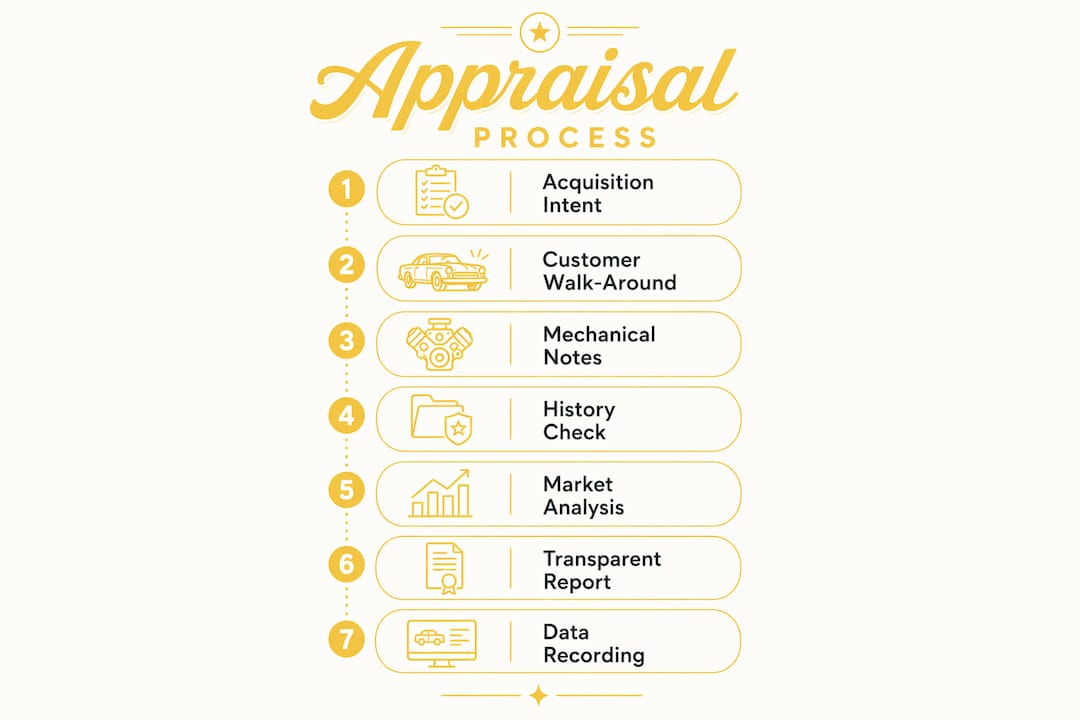
Step 1: Determine acquisition intent. Before you inspect anything, ask whether you actually need this vehicle. Does it fit your buy plan? Will it go retail or wholesale? Answering these questions first prevents you from acquiring inventory that sits.
Step 2: Conduct a walk-around with the customer. Walk the vehicle together, the way a rental car company does a pre-rental inspection. Note damage, but also invite the customer to point out upgrades, recent maintenance, or features that add value. This step builds trust from the first minute.
Step 3: Collect detailed mechanical and cosmetic notes. Document every condition item that will affect recon costs. Vague notes produce vague estimates, and vague estimates produce profit surprises.
Step 4: Pull vehicle history and auction data. Run Carfax or AutoCheck, review any available auction reports, and check for open recalls. A vehicle's history often reveals issues that a walk-around cannot.
Step 5: Analyze market data. Use real-time market comparables, Average Days to Sell (ADS), and Market Days Supply (MDS) to understand what similar vehicles are selling for and how quickly they move. Tools that integrate market intelligence into the appraisal workflow make this step faster and more consistent.
Step 6: Present findings transparently using an ACE report. An ACE (Accelerated Customer Experience) report shares market data, condition findings, book values, and supply-and-demand context with the customer. Transparency at this stage is what separates dealers who close deals from those who lose them to the next offer.
Step 7: Record data and hold appraisers accountable. Every appraisal should be logged. Hold daily Save-a-Deal meetings to review open opportunities and catch errors before they become losses.
Pro Tip: Walk the vehicle with the customer every single time, without exception. Dealers who make collaborative walk-arounds a non-negotiable standard report fewer price objections and smoother negotiations because the customer has already seen what you saw.
Why appraisal accuracy is the real profit trigger
Appraisal accuracy is not a nice operational detail. It is the foundational profit trigger that determines whether your used vehicle department makes money or bleeds it.
The numbers tell a clear story. 28% of reconditioning estimates miss actual recon costs by an average of $750 per vehicle. Across a high-volume used operation, that variance adds up fast. And the root cause is almost always process inconsistency, not bad intentions.
The deeper problem is how widespread the reliance on defaults has become. 54% of appraised vehicles use default or average reconditioning estimates rather than real, itemized costs. Of those, 39% have estimates that are off by $1,000 or more from what dealers actually spend on recon. That is not a rounding error. That is profit leakage built directly into your acquisition process.
Inconsistency compounds the problem. 70% of appraised VINs go through an average of four Actual Cash Value (ACV) changes over time. Each revision signals that the original appraisal was incomplete, and each change erodes customer confidence.
The flip side is equally compelling. Dealers who itemize real recon costs and share those findings with customers acquire twice as many vehicles with better profit outcomes. Better appraisal inputs also reduce recon surprises and improve ROI across the board.
Here is what accurate, data-backed appraisals do for your operation:
- Align acquisition costs with actual market demand and your dealership's exit strategy.
- Reduce profit leakage caused by subjective or inconsistent valuations across your appraisal team.
- Improve forecasting for Average Days to Sell and reconditioning budgets.
- Give Finance and Service departments reliable cost data to work from.
- Support a culture of accountability where every appraiser follows the same standard.
Data-driven appraisal tools, including automotive intelligence platforms that shift teams from subjective judgment to systematic valuation, are increasingly what separate high-performing dealerships from those stuck reacting to margin erosion.
Pro Tip: Use your actual historical recon data, not default estimates, when building appraisal benchmarks. Dealers who ground their estimates in real costs consistently land vehicles at better cost-to-market percentages than those who rely on averages.
How transparent appraisals build customer trust
Customers arrive at your trade-in desk better informed than ever. The average consumer has 2.6 cash offers in hand when they come to sell a vehicle. They have done their research, and they have a number in mind. If your appraisal process feels secretive or arbitrary, you will lose them to the next offer before you even finish the conversation.

The fix is transparency, and it works. Transparent appraisals increase offer acceptance rates up to 55% without negotiation. More than half of your customers say yes to the first number when they understand how you arrived at it.
What transparency looks like in practice:
- Sharing itemized reconditioning costs so customers understand why condition affects value.
- Showing market comparables, including how many similar vehicles are available and how quickly they sell.
- Walking through the ACE report together so the customer sees the same data your appraiser used.
- Explaining supply-and-demand dynamics in plain language, not industry jargon.
Involving customers in the inspection transforms the appraisal from something that happens to them into something they participate in. That shift in dynamic changes the entire negotiation. When a customer has seen the paint chip, the worn tire, and the CarFax entry alongside you, the offer is no longer your opinion. It is a shared conclusion.
Pro Tip: Integrating Kelley Blue Book® Instant Cash Offer with your dealership management software gives customers a familiar, trusted reference point before they even walk in. Their confidence in the KBB® offer carries directly into confidence in your appraisal.
Dealers who connect their appraisal workflow to digital vehicle presentation platforms also report stronger alignment between online pricing expectations and in-store appraisal outcomes, which reduces friction at every stage of the deal.
What it takes to build a strong appraisal team
Your appraisal process is only as good as the people running it. A well-designed workflow falls apart when appraisers apply it inconsistently, and inconsistency is the single biggest source of profit leakage at the appraisal desk.
Effective appraisal personnel need a specific combination of skills and ongoing development:
- Market literacy: Appraisers must understand how to read real-time market data, including ADS, MDS, and cost-to-market percentages. Gut instinct is not a substitute for knowing what similar vehicles actually sold for last week.
- Mechanical awareness: You do not need a certified technician at every appraisal, but your appraisers need enough mechanical knowledge to identify red flags that will affect recon costs. Missed issues at the appraisal stage become expensive surprises in the shop.
- Process discipline: The walk-around, the documentation, the market analysis, and the customer presentation must happen every time, on every vehicle. Skipping steps because a deal feels obvious is how $1,000 recon misses happen.
- Customer communication skills: Appraisers who can explain condition findings and market data clearly, without condescension, close more deals. The ability to present an offer as a logical conclusion rather than an arbitrary number is a trainable skill.
- Accountability to data: The best appraisers treat their historical accuracy as a performance metric. Tracking how often their recon estimates match actual costs, and reviewing misses in team meetings, builds a culture of continuous improvement.
Training should not be a one-time event. Regular calibration sessions, where your team appraises the same vehicle independently and then compares results, reveal inconsistencies before they cost you money. Pair that with a dealer inspection checklist tailored to your inventory mix, and you give every appraiser a consistent starting point regardless of experience level.
Compliance and legal considerations in vehicle appraisal
Appraisal is not just a financial process. It carries legal obligations that dealers cannot afford to overlook, particularly as regulatory scrutiny of automotive retail practices has grown.
Truth in advertising and valuation disclosure: Federal Trade Commission guidelines require that vehicle representations, including trade-in valuations presented to customers, be accurate and not misleading. An appraisal offer that changes significantly after the customer has been given a number can trigger complaints and, in some states, legal liability.
Salvage and branded title disclosure: Dealers are legally required in most states to disclose salvage, rebuilt, or flood-branded titles to buyers. Your appraisal process must include a title history check, and that check must be documented. Failing to catch a branded title before acquisition puts you at risk of selling a vehicle with undisclosed material defects.
Reconditioning and safety standards: Vehicles you retail must meet applicable safety standards. If your appraisal process identifies safety-related deficiencies, those items need to be addressed before the vehicle goes to your lot. Documenting what was found and what was repaired protects you if a customer later raises a safety concern.
USPAP alignment for formal appraisals: When a formal written appraisal is required, such as for insurance purposes, estate settlements, or legal disputes, the Uniform Standards of Professional Appraisal Practice (USPAP) set the professional standard. Dealers who offer formal appraisal services, or who work with appraisers on high-value collector vehicles, should understand where USPAP applies and ensure their documentation meets those requirements.
Record retention: Most states require dealers to retain appraisal and transaction records for a defined period. A documented appraisal trail protects you in the event of a dispute and demonstrates that your process was consistent and fair.
Compliance is not separate from good appraisal practice. When your process is thorough, documented, and consistent, you are already doing most of what regulators expect. The pricing and resale guidance for specialty vehicles adds another layer of complexity worth understanding, especially for high-value collector inventory where valuations are less standardized.
At Butterclassics, we know that getting the appraisal right is what makes every other part of the deal work. Whether you are buying, selling, or consigning a classic vehicle, a fair and transparent valuation is where trust starts. Explore our inventory or learn about our Butter Certified process to see how we put these standards into practice.
Key Takeaways
Accurate, consistent vehicle appraisal is the foundational profit trigger that shapes inventory decisions, reconditioning costs, pricing strategy, and customer trust across every dealership department.
| Point | Details |
|---|---|
| Recon estimates miss frequently | 28% of reconditioning estimates miss actual costs by an average of $750, directly eroding used vehicle margins. |
| Default estimates create real risk | 54% of appraisals use default recon figures, and 39% of those are off by $1,000 or more from actual costs. |
| Transparency doubles acquisitions | Dealers who itemize real recon costs and share findings with customers acquire twice as many vehicles profitably. |
| Customer offers are competitive | The average consumer arrives with 2.6 cash offers, making a transparent, data-backed appraisal your strongest differentiator. |
| Compliance requires documentation | Accurate, documented appraisals protect dealers legally and meet FTC, state title disclosure, and record retention requirements. |