The 2026 collector car market has split in two. Blue-chip modern supercars and documented, high-spec classics keep setting records, while ordinary driver-quality cars from the 1950s and 1960s are sitting longer and selling softer. Millennial demand, online auction liquidity, and a hard focus on provenance are driving the divide. If you're buying or selling this year, chase paperwork and pedigree, not nostalgia alone.
TL;DR:
- Buyers prioritize cars with verified provenance and documentation, especially for mass-market classics from the 1950s and 1960s, which are softening in value.
- The top of the market remains strong for modern supercars, post-1990 poster cars, restomods, and classic trucks due to scarcity and usability, while average sale prices are stagnating.
- Online auctions are becoming the dominant venue for high-value sales, with proven provenance and digital histories commanding premium prices.
- Carefully researching auction history and verifying ownership records is crucial before purchasing, as unverified cars are losing confidence among buyers.
- Selling or consigning well-documented cars now can be advantageous, while unprofitable segments may be better held until market conditions favor higher-quality, verified vehicles.
Table of Contents
- Classic Car Trends 2026: The Market Snapshot
- Who's Buying Now: Millennials and Gen X Take the Wheel
- What's Appreciating: The Segments Winning in 2026
- Where Prices Are Softening in 2026
- What's Driving the Divide: Auctions, Paperwork, and Macro Risk
- Your 2026 Action Checklist: Buying, Selling, and Holding
- Butter Classics' View From the Marketplace
- How Technology Is Changing Classic Car Restoration
- Environmental Rules and What They Mean for Classic Car Owners
- Where Collector Tastes Are Headed Past 2026
- A Practitioner's Read on the 2026 Market
- Ready to Buy or Sell? Here's How Butter Classics Fits In
- Sources
- FAQ
Classic Car Trends 2026: The Market Snapshot
Monterey Car Week 2026 pulled in $758.3 million, a record total that made headlines everywhere. But dig past the top line and the story gets more interesting: that number leaned heavily on a handful of exceptional lots, not a rising tide across every category.
That's the pattern defining classic car trends 2026 from coast to coast. Auction totals look fantastic while median sale prices tell a quieter story.
- Monterey's headline total was driven by modern supercars and a small group of marquee lots, not broad-based bidding.
- The Hagerty Market Rating has sat in "flat market" territory for much of 2026, a sign that momentum has cooled since the 2022 peak.
- The Hagerty Hundred, Hagerty's benchmark basket of blue-chip collector cars, fell from prior highs even as top lots kept climbing.
The number that matters most here isn't the record total. It's the gap between average and median. When a handful of eight-figure sales skew the average upward, the median sale price becomes the more honest gauge of what a typical collector car is actually worth this year. That gap is exactly where the bifurcation lives.
Who's Buying Now: Millennials and Gen X Take the Wheel
Collector demand has a new center of gravity. Millennial-owned interest in collector cars has grown 270% since 2016, and that shift shows up directly in which cars are climbing the leaderboards.
Nostalgia tends to hit on a 25- to 30-year lag. People chase the cars they wanted as teenagers, which means buyers born in the 1980s and 1990s are now bidding on the cars from their own childhoods, not their parents'. That's why 1980s through 2000s "poster cars," Japanese performance icons, and turn of the millennium supercars are pulling serious money.
This buying group also behaves differently at the paddle:
- They shop and bid online first, often sight unseen beyond photos and video walkarounds.
- They favor cars they can actually drive, not trailer queens that only look good in a barn.
- They lean toward documented history over "trust me" stories from a seller.
Gen X buyers overlap here too, often with more capital and a preference for cars they can use on weekend drives rather than store under a cover.
What's Appreciating: The Segments Winning in 2026
Some categories are having a genuinely great year, and the reasons behind each one are worth knowing before you shop.
- Modern and halo supercars. Ferraris and other exotic halo cars keep setting records at the top of the market, and experts expect that trend to continue through the rest of 2026.
- Post-1990 "poster cars." Japanese icons and late-1990s to 2000s performance models are pulling strong bids as the buyers who grew up wanting them finally have the money to buy them.
- Restomods. Sympathetically upgraded classics with modern drivetrains and creature comforts attract lifestyle buyers willing to pay a premium for something they can drive daily without babying it.
- Classic trucks and SUVs. Broncos, Blazers, and vintage pickups keep drawing buyer depth across price points, helped by their usability and crossover appeal to younger collectors.
The common thread across all four: scarcity, cultural relevance, and the ability to actually be driven and enjoyed. Cars that check those boxes are pulling ahead of ones that only check a nostalgia box.
Where Prices Are Softening in 2026
Not every segment is having a good year, and pretending otherwise would do collectors a disservice. Mass-market American cars from the 1950s and 1960s, the "commons" that flooded auctions for a decade, are frequently selling below what condition alone would suggest they're worth.
A few forces are behind the softness:
- Oversupply of driver-quality examples has outpaced the buyer pool willing to pay a premium for them.
- Cars without documented history or clear ownership records are losing buyer confidence fast, since Black Book's analysis shows buyers now prioritize originality and verifiable quality over generic examples.
- Heavily modified or over-restored cars that stray from factory spec struggle to find buyers who trust the work.
- Ownership costs, storage, insurance, and maintenance are making buyers pickier about which car deserves that spend.
Speculation on an unremarkable classic just because "they don't make them anymore" is a riskier bet than it was five years ago.
What's Driving the Divide: Auctions, Paperwork, and Macro Risk
Four forces explain most of what's happening beneath the surface of the 2026 market.
- Online auctions are changing where big money changes hands. Online-only platforms are recording a growing number of seven-figure sales, and some analysts expect an eight-figure online sale before long.
- Provenance now decides who gets paid a premium. A documented history, original paperwork, and marque-specific reports narrow the time it takes to sell and widen the price gap over undocumented peers.
- Restomods and usable builds are holding value better than static originals, since lifestyle buyers pay for cars they can enjoy, not just admire.
- Macro conditions can shift demand quickly. Inflation, equity market swings, and geopolitical uncertainty all influence discretionary spending on collector cars faster than most buyers expect.
Pro Tip: Before you bid, pull the auction archive for that exact model and trim. A single outlier sale from six months ago can make a car look stronger than the current market actually supports.
Your 2026 Action Checklist: Buying, Selling, and Holding
Whether you're buying, selling, or sitting tight, a few disciplined moves matter more this year than usual.
- Verify provenance before you fall in love with a car. Request service histories, marque-specific documentation, and auction records rather than taking a seller's word for it. A tool like CarTrace can help confirm a vehicle's history before you commit.
- Budget the full cost of ownership, not just the hammer price. Insurance, storage, and restoration work add up fast, and maintenance costs alone can reshape your return on a car you planned to flip.
- Use auction archives and market indices to set expectations, not the highest sale you saw on social media last month.
- If you're holding a softening segment, consider trading toward documented, high-demand categories rather than waiting for a rebound that may not come on your timeline. Our classic car trends checklist walks through this decision in more detail.
Butter Classics' View From the Marketplace
A selective market rewards sellers who do the legwork upfront. Butter Classics lists vehicles with detailed specs, extensive photography, and clear documentation because that's exactly what today's buyers are screening for before they'll bid seriously.
If you're consigning a car, gather service records, ownership history, and any marque-specific reports before you list. Buyers browsing our nationwide inventory increasingly skip past listings that skimp on paperwork, no matter how clean the paint looks.
How Technology Is Changing Classic Car Restoration
Restoration work looks different than it did even five years ago. 3D scanning now lets shops digitize a body panel or trim piece that hasn't been manufactured in decades, then send that file to a CNC machine or 3D printer to produce a replacement that fits without the trial and error of hand fabrication.

Digital parts catalogs and VIN-decoding databases have made sourcing correct components far faster, which matters enormously for buyers who care about factory-original spec. A restorer chasing NCRS or Marti Report accuracy on a Corvette or Mustang can now cross-reference build sheets digitally instead of guessing from old photographs.
Diagnostic tools built for modern cars are also being adapted for classics with aftermarket electronic ignition or fuel injection retrofits, which makes troubleshooting a restomod's drivetrain closer to servicing a new car than a carbureted original. That shift lowers the barrier to daily-driving a restomod, which reinforces exactly why that segment is holding value so well right now.
None of this replaces skilled hands. But it does mean restoration shops can deliver more accurate, better-documented work in less time, and documentation is precisely what today's buyers are paying up for.
Environmental Rules and What They Mean for Classic Car Owners
Emissions regulations are tightening in several states, and collectors need to know where their car actually stands. Most states maintain rolling exemptions for vehicles older than 25 to 30 years, which keeps the vast majority of true classics out of routine smog testing. But newer "modern classics" from the late 1990s and 2000s, the same cars driving demand among younger buyers, often haven't aged into that exemption window yet.
Some states are also exploring low-emission zones in dense urban areas, which could eventually restrict where older internal-combustion vehicles can be driven, even if ownership itself stays legal. That's worth watching if you plan to drive a classic regularly in a major city rather than trailer it to shows.
None of this bans classic car ownership. It does mean buyers should check their specific state's rules before assuming a car qualifies for historic vehicle registration or an emissions exemption, especially for anything built after 1995. A restomod with a modern, cleaner-burning engine swap can sidestep some of these headaches entirely, which adds one more reason that category is gaining fans.

Where Collector Tastes Are Headed Past 2026
The demographic wave reshaping the market today is nowhere near finished. Millennial buying power will keep growing over the next five to ten years, and the 25 to 30 year nostalgia lag suggests 2000s and even early 2010s performance cars will start entering serious collector conversations before the decade is out.
Expect documentation and digital verification to become even more central to how cars are bought and sold. Buyers raised on online marketplaces expect the same transparency from a $150,000 Bronco that they'd expect from a used smartphone listing, and that expectation isn't going away.
Restomods will likely keep gaining ground as emissions considerations and daily usability weigh more heavily on buying decisions. Watch for continued growth in online-only auction venues too, since that liquidity shift shows no sign of reversing.
A Practitioner's Read on the 2026 Market
I've watched clean, honest survivor cars sit unsold while a documented, slightly rougher example of the same model sold fast at a premium. The lesson holds: paperwork beats polish, every time, in this market.
— Tony
Ready to Buy or Sell? Here's How Butter Classics Fits In
If chasing provenance and hunting auction archives sounds like more work than you want to take on alone, Butter Classics gives you a nationwide inventory to browse instead of relying on a single local lot. Listings typically include vehicle specifications and photography to help you screen for documentation and condition before you inquire further.
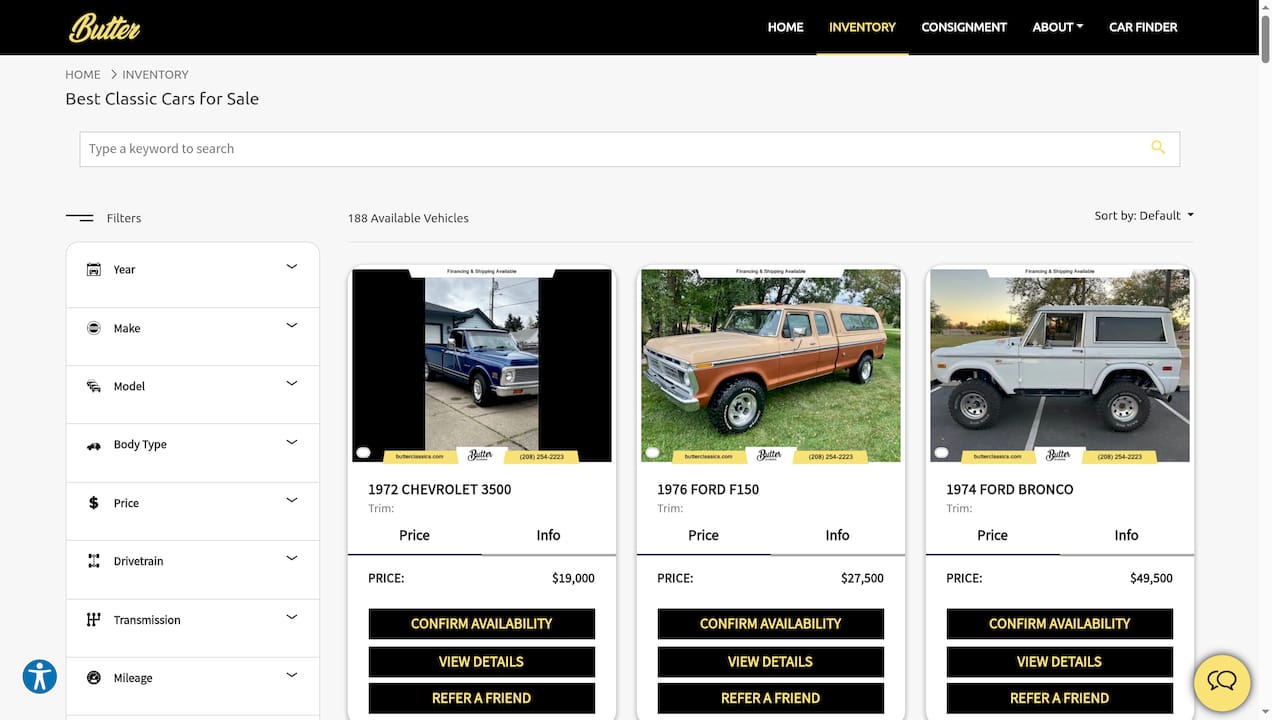
Here's what you get access to on the platform:
- Browse a nationwide inventory of classic cars, muscle cars, trucks, and Broncos by price or type.
- Consign your vehicle if you're holding a documented, high-demand car ready to sell.
- Get pre-qualified for classic vehicle financing before you commit to a purchase.
- Request a quote or schedule a test drive on any listing that catches your eye.
If you're sitting on a well-documented classic in a segment that's still appreciating, now is a reasonable time to consign it. If you're hunting for a poster car or a truck with real upside, start browsing the current inventory and use the car finder to narrow it down by what actually fits your budget and garage.
Sources
Figures cited above come from Hagerty's Monterey coverage and Black Book's Q2 2026 update.
- 2026 Monterey Car Week Auctions Shatter Record with $758M in Sales - Hagerty Media
- The 2026 collector car market has a strong top end, but a soft underbelly - Hagerty Media
- Here’s What Our Experts Predict for the 2026 Collector Car Market - Hagerty Media
- Q2 2026 Collectible Cars Market Update - Black Book
FAQ
How Will the Classic Car Market Perform in 2026?
The market is bifurcated: top-end modern supercars and documented blue-chip classics keep setting records, while mass-market 1950s and 1960s cars are softening. Monterey 2026 totaled $758.3 million, but that total leaned on a small number of exceptional lots rather than broad gains.
What Is the $3,000 Rule for Cars?
Some buyers use a rough budgeting guideline suggesting you shouldn't spend beyond a certain repair threshold on a used car before considering it a financial loss versus replacing it. It's a general consumer car heuristic, not a formal classic car valuation standard, so treat it as a rough gut check rather than a hard rule for collector vehicles.
What Are the Best Classic Cars to Buy in 2026?
Post-1990 "poster cars," Japanese performance icons, restomods, and classic trucks or Broncos are among the strongest segments right now, driven by Millennial demand and daily usability. Butter Classics' inventory lets you browse current listings across these categories with full specs and photos.
Are Undocumented Classic Cars Still Worth Buying?
They can be, but expect a discount and a harder time reselling. Buyers increasingly favor cars with verified service histories and ownership records, and undocumented examples are losing buyer confidence faster than well-papered ones in the current market.
Should I Buy or Sell a Classic Car Right Now?
It depends on the segment. Documented, high-demand cars in appreciating categories are good candidates to sell or consign now, while mass-market commons without clear paperwork may be worth holding until documentation or market conditions improve.