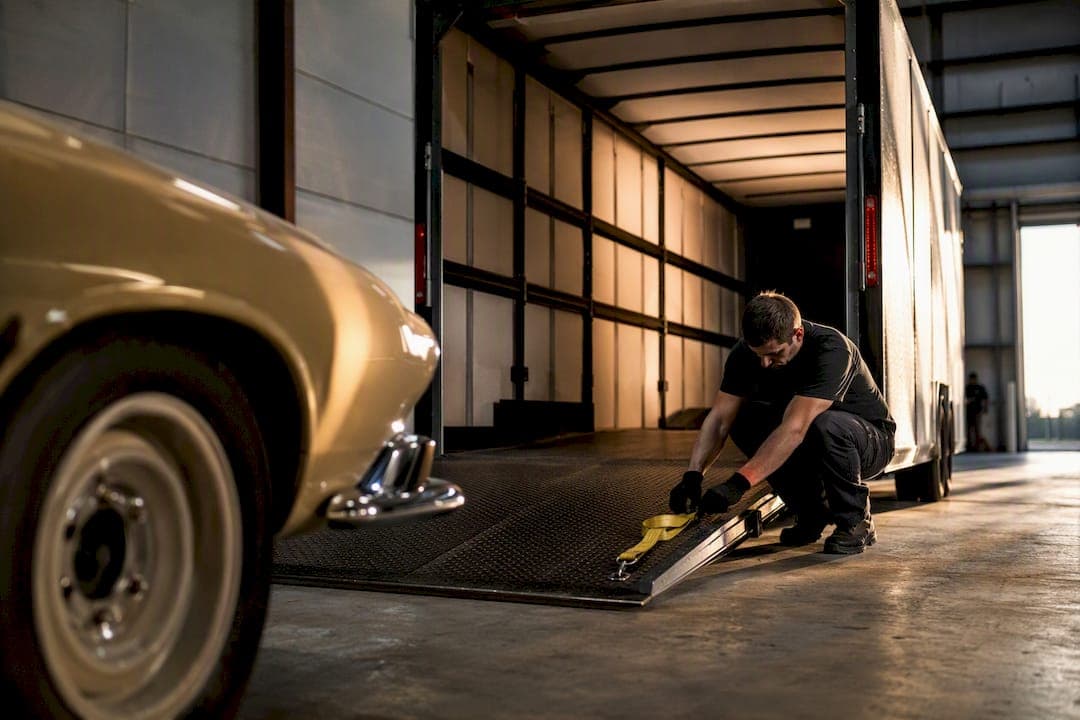
For most collector vehicles, enclosed transport with a vetted specialist carrier and agreed-value insurance is the right call, not open transport or the cheapest bid you can find. Open trailers are fine for short hauls or true project cars. Before booking anyone, confirm carrier experience with classics, liftgate or winch capability for non-runners, and real cargo coverage. Intercity Lines, Sherpa Auto Transport, and Montway Auto Transport are solid places to start requesting quotes.
TL;DR:
- Enclosed transport with experienced, specialized carriers is essential for high-value collector cars, especially for international or concours-bound shipments.
- Shipping costs vary widely based on trailer type, vehicle condition, route, and speed, with enclosed cross-country moves often costing between $1,800 and $2,200.
- Verifying carrier credentials through the USDOT number, insurance certificates, and collecting detailed photos and documentation before shipment can prevent costly disputes.
- Proper car preparation includes comprehensive photos, limiting fuel, disconnecting alarms, and confirming non-runners have appropriate handling equipment.
- Most shipping disputes stem from missing documentation or lack of proper vetting, not trailer type, making thorough vetting and detailed paperwork critical.
Table of Contents
- What Are Your Classic Car Shipping Options?
- How Much Does Classic Car Transport Cost?
- How Do You Vet a Classic Car Shipping Company?
- How Should You Prepare a Classic Car for Shipping?
- What About Non-Runners, Auction Deliveries, and International Shipping?
- Comparing Vetted U.S. Classic Car Shippers
- What Tony and Butter Classics Have Learned About Shipping Classics
- What Should You Do If Your Classic Is Damaged in Transit?
- Why the Real Risk in Classic Car Shipping Isn't the Truck
- Ready to Buy, Sell, or Move a Classic? Here's Where Classic Car Marketplaces Fit
- Where to Verify Carriers and Check Pricing
- Sources
What Are Your Classic Car Shipping Options?
Every method on the market trades cost against protection. Once you understand what each one actually does to your car in transit, the decision gets a lot less confusing.
Enclosed transport is the gold standard for anything with real collector value. Your car rides inside a fully covered trailer, shielded from rain, road salt, gravel kicked up by trucks, and the curious stares of rest-stop strangers who love touching paint. Enclosed trailers come in two flavors: hard-sided (aluminum or steel walls, sturdier in bad weather) and soft-sided (canvas or vinyl skins over a frame, lighter and slightly cheaper). Specialist carriers like Intercity Lines run enclosed rigs with liftgates, air-ride suspension to smooth out highway vibration, and soft-strap securing instead of chain hooks that can chip a frame or bumper. That last detail matters more than people think: chains and hooks were designed for work trucks, not 60-year-old sheet metal.
Open carriers are the double-decker trailers you see hauling new cars down the interstate. They're cheaper and widely available, but your car is exposed to weather and debris the entire trip. Open transport makes sense for a driver-quality project car, a short regional move, or a vehicle you're planning to restore anyway and don't mind picking up a little road film. It's not the move for a numbers-matching Corvette headed to a concours lawn.
Container versus RORO comes up for international shipments, importing a European classic or sending a car overseas for a show. Container shipping seals your car inside a steel box, often alongside a second vehicle to split cost, and keeps it away from seawater and weather during the ocean crossing. RORO ("roll-on, roll-off") drives the car directly onto a vessel deck or lower hold, which is faster and cheaper but leaves the vehicle exposed to salt air and handling by dock crews. For anything with real value, containers are almost always the better trade-off, and they let you pack spare parts, manuals, or period-correct accessories in the trunk.
Specialty services round out the list:
- White-glove door-to-door pickup with dedicated single-car trailers, no consolidation with other loads
- Expedited pickup for a hard auction deadline or last-minute show entry
- Flatbed transport for extremely low-clearance vehicles that can't use standard ramps
- Dedicated (exclusive-use) trailers when you don't want your car sharing space with anyone else's
The method you pick should match the car's value and condition, not just your budget for that particular week.
How Much Does Classic Car Transport Cost?
Enclosed transport commonly runs $1,500 to $3,000 for a typical cross-country move, while open transport for the same lane often lands around $800 to $1,800. Some industry guides put enclosed service at a cost notably higher than open carrier pricing, largely because enclosed trailers hold fewer vehicles per trip and demand more careful driving.

Pro Tip: Ask any quoted carrier for their price per mile, not just a flat total. A rough benchmark of about $1 per mile for a 1,000-mile open-carrier move gives you a sanity check against inflated regional quotes.
Distance is the obvious driver, but it's far from the only one. Here's what actually moves the price up or down:
- Trailer type. Enclosed costs more than open, and single-car dedicated trailers cost more than either.
- Inoperable vehicles. A non-running car needs winch or forklift loading, and most carriers add a surcharge for that equipment and the extra time it takes.
- Pickup and drop location. A rural farm pickup often costs more than a city address because the carrier has to route a large truck somewhere it wasn't planning to go.
- Expedited pickup. Need the truck there tomorrow instead of next week? Sherpa's own guide notes that rushed pickups can add roughly $200 to $500 on top of the base quote.
- Seasonality and corridor demand. Snowbird season (fall and spring, as carriers reposition between the Northeast and Florida) tightens capacity on those specific lanes, and prices climb accordingly.
Transit time follows a similar logic. A regional move might take a few days once the truck actually picks up. A coast-to-coast haul often runs about one to two weeks depending on the number of stops the carrier makes along the route. The pickup window matters as much as the drive time itself: giving a carrier a flexible five-business-day window to load your car, instead of demanding an exact date, tends to lower your quote because it lets them build your car into an efficient route with other loads.
Say you're shipping a 1969 Camaro from Denver to Atlanta, roughly 1,400 miles. Open transport at the rough $1 per mile benchmark lands near $1,400, though real quotes vary with trailer availability and season. Enclosed on that same lane, running the 30 to 60 percent premium, would likely fall somewhere between $1,800 and $2,200. For a deeper cost breakdown by vehicle type and distance, Butter Classics has put together a dedicated pricing guide.
How Do You Vet a Classic Car Shipping Company?
Anyone can put up a website and call themselves an auto transport company. Verifying who you're actually dealing with takes about fifteen minutes and can save you a five-figure headache.
- Request a Certificate of Insurance. Don't take "we're fully insured" at face value. Ask for the actual certificate, check the cargo coverage limit, and confirm whether it's primary coverage or contingent (meaning it only pays out after your own policy is exhausted).
- Ask about agreed-value coverage. If your car is worth more than the carrier's stated cargo limit, you need supplemental coverage arranged before pickup, not after something goes wrong. Butter Classics walks through how agreed-value appraisals work for exactly this situation.
- Confirm hands-on classic experience. Ask directly: how many pre-1990 vehicles have they moved in the last year? Do their trailers have liftgates or winches for non-runners? Do they use soft straps instead of chain hooks?
- Ask for photo documentation practice. A carrier who photographs the car at pickup and delivery, and logs it on the Bill of Lading, is a carrier who takes claims seriously.
- Get a firm pickup window and payment terms in writing. A red flag answer sounds like "we'll call you the day of" with no window at all, or a request for full payment far in advance by wire transfer only.
Pro Tip: If a broker won't tell you which actual carrier is running your car, or dodges the USDOT number question, treat that as disqualifying. Legitimate operators answer both instantly.
How Should You Prepare a Classic Car for Shipping?
Good prep isn't about making the car pretty. It's about creating a paper and photo trail that protects you if anything looks different at delivery than it did at pickup.
Start with photos, and take more than feels necessary. Butter Classics recommends at least a dozen images: all four corners, close-ups of any existing chips or trim wear, the engine bay, the VIN plate, the interior and dash, and a quick undercarriage check if you can get one. A short video of the engine starting, with a timestamp visible, is worth the extra sixty seconds.
On the mechanical side:
- Leave the fuel tank around a quarter full, no more. Full tanks add weight and, on some carriers, raise a fire-risk flag.
- Make sure the battery holds a charge and disconnect any aftermarket alarm that could drain it or trigger mid-transit.
- Check tire pressure and note any flat-spotting so it's not mistaken for transit damage.
- Tell the carrier clearly whether the car is running or not. This isn't a detail to gloss over.
Gather your paperwork before the truck shows up: title, bill of sale or auction receipt, any agreed-value appraisal documents, and your insurance contact in case you need to file fast. When the driver arrives, walk the car together and make sure the Bill of Lading notes existing damage in writing, not just verbally. Sign it only after you've compared it against your own photos, and keep a copy.
What About Non-Runners, Auction Deliveries, and International Shipping?
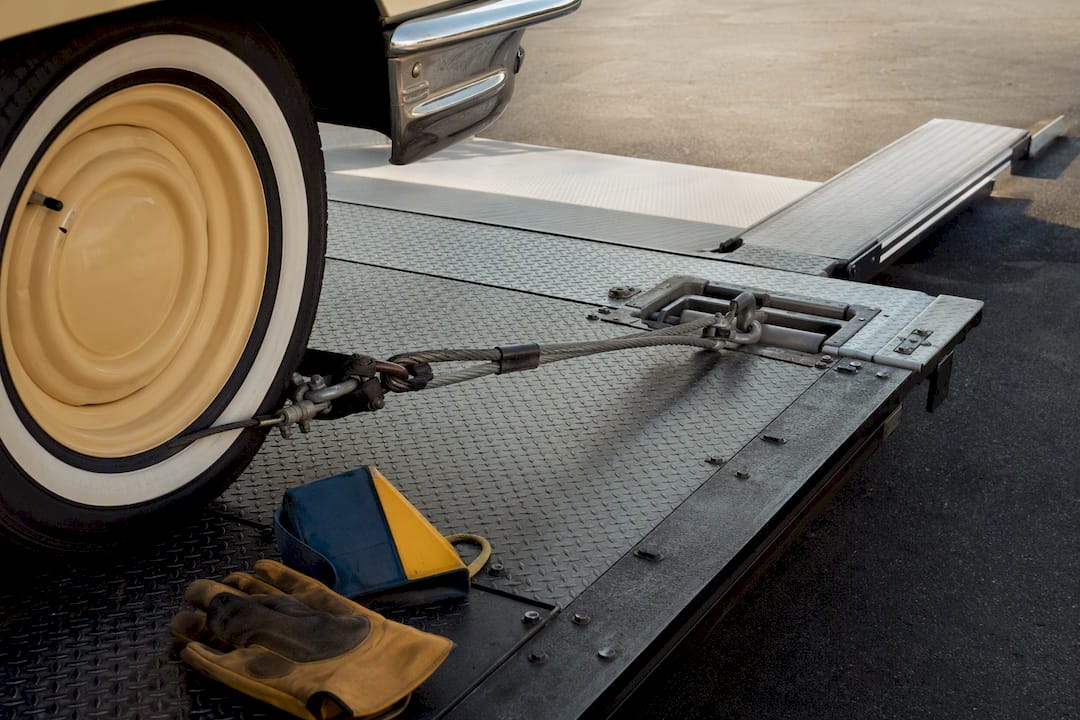
Non-running vehicles need special handling, and most carriers charge for it. A car that can't drive under its own power onto the trailer requires a winch or hydraulic liftgate, and that equipment isn't standard on every truck. Confirm at booking, not at pickup, that the carrier's specific truck has what your car needs. Disclosing an inoperable vehicle upfront is standard practice, and hiding it to save a small surcharge almost always backfires when the truck arrives without a winch.
Auction and show deliveries add a scheduling layer most first-timers underestimate. Venues often have narrow delivery windows, specific insurance paperwork requirements, and lot-handling procedures the carrier needs to know in advance. It's worth asking the carrier directly whether they've delivered to that specific venue before and requesting a driver contact number so the venue can coordinate timing without going through a middleman.
International shipping, whether importing a European classic or sending a car abroad for an event, usually favors containers over RORO for anything with real value. A sealed container protects against salt air and reduces handling by dock crews, and it lets you ship spare parts or documentation alongside the car. Customs paperwork is its own project (title, proof of ownership, import compliance forms), and insurance for ocean transit needs its own conversation since standard domestic cargo policies rarely extend overseas automatically. Butter Classics covers the import-specific paperwork in more depth in its import guide.
Comparing Vetted U.S. Classic Car Shippers
Four names show up repeatedly when collectors compare notes: Intercity Lines, Sherpa Auto Transport, Montway Auto Transport, and uShip. Each fits a different scenario, and the right pick depends on your car's value and your tolerance for hands-on vetting.
| Provider | Best for | Transport method | Typical cost band | Special equipment | Coverage / lanes |
|---|---|---|---|---|---|
| Intercity Lines | Concours and auction deliveries; high-value enclosed transport | Enclosed only | Mid-range to coast-to-coast | Liftgate, air-ride suspension, soft-strap securing | National, specialist classic focus |
| Sherpa Auto Transport | Transparent booking with predictable pickup windows | Enclosed and open | Regional to coast-to-coast | Standard carrier equipment; pickup-window flexibility pricing | National broker network |
| Montway Auto Transport | Nationwide availability across major lanes | Enclosed and open | Regional to coast-to-coast | Contingent cargo insurance on some bookings | Large nationwide carrier network |
| uShip | Project cars or lower-value classics where price leads | Open and enclosed (varies by bidder) | Varies with bid | Varies by winning carrier | Wide carrier pool, bid-dependent |
Intercity Lines builds its business around collector vehicles specifically, not general freight with a classic-car page bolted on. Its enclosed trailers come with liftgates for careful loading and photo-documented Bills of Lading at both ends, which matters a great deal if your car is headed to an auction where condition disputes get expensive fast.
Sherpa Auto Transport publishes some of the more transparent pickup-window guidance in the industry, spelling out how a flexible window lowers your quote and how much an expedited pickup typically adds. That kind of clarity helps first-time shippers avoid surprise charges.
Montway Auto Transport leans on scale. Its large carrier network means better odds of finding a truck fast on busy lanes, and some of its bookings include contingent cargo insurance as a backstop. It's a strong option when availability matters more than working with one specialist crew.
uShip works differently from the other three. It's a bidding marketplace, so you post your shipment and carriers compete for it, which can drop your price meaningfully. The trade-off is that you're responsible for vetting whichever carrier wins the bid, including checking their USDOT number and classic-handling experience yourself, since the platform doesn't pre-screen for collector-car expertise the way a specialist does.
- If you're shipping a car to a concours event or high-stakes auction, prioritize a specialist like Intercity Lines over price.
- If you want predictable pricing and clear communication on a straightforward domestic move, Sherpa's guidance-heavy approach fits well.
- If your priority is finding a truck fast on a common route, Montway's network size works in your favor.
- If you're moving a driver-quality project car and price is the deciding factor, uShip's marketplace can save real money, provided you vet the winning bidder yourself.
What Tony and Butter Classics Have Learned About Shipping Classics
Tony has watched plenty of straightforward sales turn into stressful phone calls, and almost always for the same reason: the buyer and seller never agreed on what "good condition" meant before the truck showed up...
"The single biggest mistake I see," Tony says, "is people skipping the photo walk-around because they're in a hurry to get the car loaded. Ten extra minutes with a camera has saved more deals than any insurance policy I've seen."
Listings on classic car marketplaces typically ask sellers to document condition before closing a sale, and the platform may ask for pickup and drop ZIP codes, running condition, and preferred pickup window to facilitate transport planning. That upfront clarity is exactly what separates a smooth handoff from a dispute nobody wanted.
What Should You Do If Your Classic Is Damaged in Transit?
Document everything before the driver leaves. Compare the delivery condition against your pickup photos and the notes on the Bill of Lading, item by item, while the truck is still in your driveway. If you spot new damage, write it directly on the Bill of Lading before signing, and take dated photos from multiple angles on the spot.
Next, notify the carrier's claims department in writing the same day, not a week later, and reference the Bill of Lading number in every message. Most carrier cargo policies have a claims filing window, sometimes as short as a few days, so speed matters here more than most people expect.
If your coverage is agreed-value through your own collector policy rather than the carrier's cargo insurance, contact your insurer at the same time you contact the carrier. Having both processes running in parallel avoids the finger-pointing that happens when one party is waiting on the other to move first.
Keep a paper trail of every call and email. Get repair estimates from a shop that actually understands classic and collector vehicles, such as a specialist repair/maintenance shop, not a generic body shop chain, since restoration-grade repairs often cost more than standard estimating software accounts for. If the carrier disputes the claim, your pre-shipment photos and signed Bill of Lading are the evidence that settles it, which is exactly why the prep steps earlier in this guide aren't optional extras.
Why the Real Risk in Classic Car Shipping Isn't the Truck
The conventional advice on this topic obsesses over trailer type, as if enclosed versus open is the whole decision. It isn't. The research here points to something less glamorous: most shipping disputes trace back to missing documentation, not a bad trailer choice. A car photographed thoroughly at pickup, with a carrier who actually verifies USDOT status and carries real cargo coverage, comes out ahead of a car that rode in a nicer trailer but skipped the paperwork.
If you take one thing from this guide, prioritize the boring stuff first: verify the carrier before you fall in love with their marketing, get agreed-value coverage in writing, and photograph your car like you're building a legal case, because in a dispute, you are. Enclosed transport is worth the premium for real collector value. But enclosed transport with sloppy documentation is still a gamble. Get the fundamentals right, and the trailer choice becomes the easy part of the decision.
— Tony
Ready to Buy, Sell, or Move a Classic? Here's Where Classic Car Marketplaces Fit
Butter Classics isn't a trucking company, but it sits right at the point where buying a classic and shipping one meet, and that's exactly where most collectors get stuck. When you find a car through our inventory or use the Car Finder to track down something specific, we ask for your pickup and drop ZIP codes, the vehicle's running condition, and your preferred pickup window right in the process, so you're not starting the shipping conversation from zero.
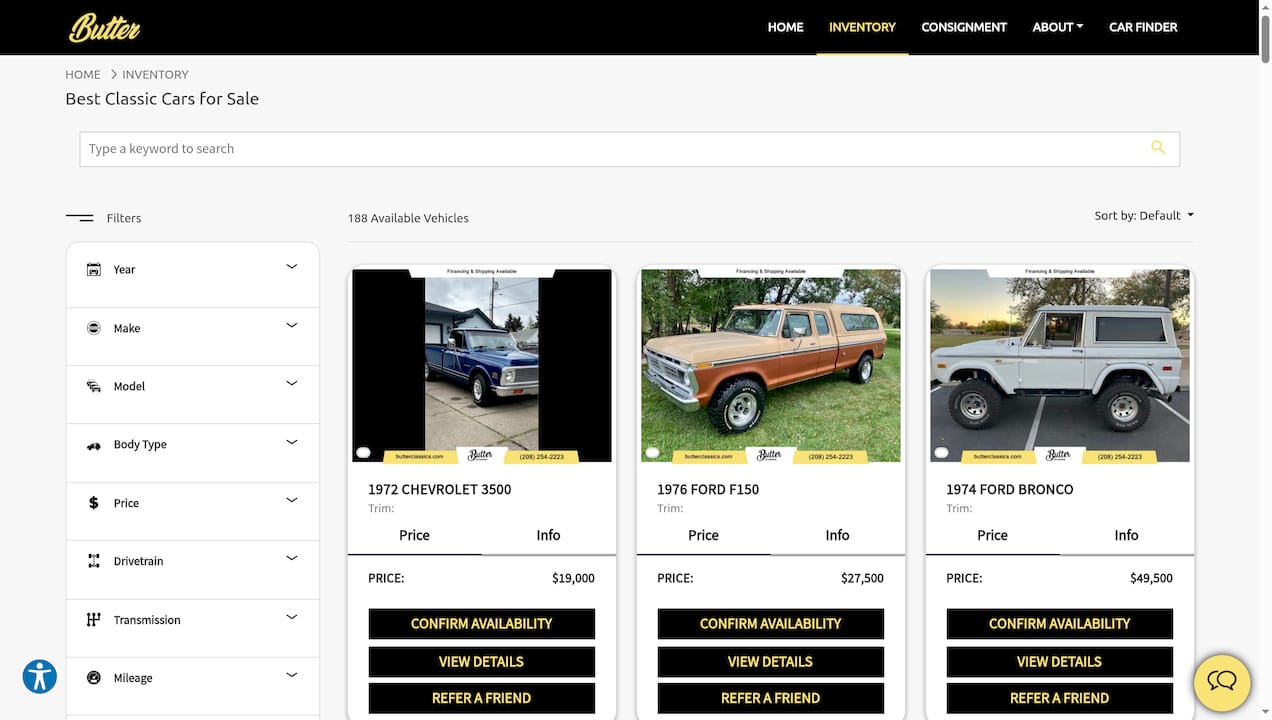
We can point you toward carrier options that fit your car and route, and we'll flag what documentation to have ready, agreed-value appraisal, title, photo inventory, before a truck ever shows up. What you'll still need to confirm yourself: your insurance coverage limits and whether you want agreed-value protection on top of the carrier's cargo policy. Browse the current inventory today, and when you're ready to move on a car, tell us your ZIP codes and timeline so we can help line up the right next step.
Where to Verify Carriers and Check Pricing
Before you book anyone, run their USDOT and MC numbers through the FMCSA SAFER lookup. It takes minutes and confirms the carrier is actually registered and in good standing.
For deeper checklists on classic-specific handling, Sherpa's transport guide and uShip's collector shipping guide both cover practical cost and preparation details worth a second read. For general price benchmarking across the industry, Cars.com's shipping cost analysis offers a useful reality check against any quote that seems too high, or suspiciously low.