If you want a compact, nimble collectible that turns heads at a cruise night, the early Bronco is your truck. If you want more interior room, a truck-based parts network, and flexibility for family duty or a daily-driver restomod, the K5 Blazer tends to be a strong choice. Generation matters a lot here, and so does rust: both models can hide expensive frame problems, and total cost swings wildly depending on how deep the project goes.
TL;DR:
- The Bronco's shorter wheelbase offers superior agility for trail navigation and easier parking, but provides less interior space than the longer, more stable Blazer.
- Engine options on both trucks include inline-sixes and small-block V8s, with parts availability and sourcing being critical factors for restorers.
- The Bronco's coil-spring suspension delivers a smoother ride and better articulation off-road, while the Blazer's leaf-spring setup is more load-capable but less comfortable on pavement.
- Buyers should prioritize inspecting for frame rust, verifying drivetrain condition, and reviewing documentation to avoid costly surprises with either model.
Table of Contents
- 1. Comparing size, wheelbase, and everyday usability
- 2. Engines, transmissions, and drivetrain realities for restorers
- 3. Suspension geometry and how each handles the trail
- 4. What restoration and ownership actually cost
- 5. Matching the right classic to your buyer profile
- 6. Running a pre-purchase inspection before you commit
- 7. Popular upgrades once you're behind the wheel
- 8. Reliability and the mechanical issues to expect
- 9. Horsepower, torque, and how these trucks actually drive
- 10. What a specialty marketplace adds to the buying process
- Finding, financing, and inspecting your next classic through Butter Classics
- Sources
- FAQ
1. Comparing size, wheelbase, and everyday usability
The numbers tell most of the story before you even turn a key. The Ford Bronco launched in 1966 riding a 92-inch wheelbase, while the K5 Blazer arrived in 1969 on a truck-derived platform stretching to approximately 104 inches, and it's noticeably wider too. That gap of a foot or more changes how each truck feels on the road and on the trail.

A shorter wheelbase makes the Bronco quicker to place on tight singletrack and easier to pivot around rock ledges without dragging the frame. The tradeoff is a choppier ride at highway speed and less room to stretch out inside. The Blazer's longer wheelbase smooths out bumps and gives you a steadier platform for towing a small trailer or hauling camping gear, but that same length works against you in technical terrain where a shorter truck can turn where a longer one has to back up and try again.
Cargo and passenger space follow the same pattern. The Bronco's cabin is snug, fine for two people and light gear, tight for a family of four on a road trip. The Blazer borrowed cues from its K10 pickup sibling, so it offers more shoulder room, a bigger cargo area behind the rear seat, and generally more space for hauling coolers, tools, or a weekend's worth of camping equipment.
Here's how the size difference plays out in common scenarios:
- Tight trails and rock crawling: the Bronco's shorter wheelbase and narrower stance make three-point turns and ledge climbs easier to manage.
- Sand and open desert running: the Blazer's wider track adds stability at speed, though its extra length can hang up on steep dune faces.
- Daily driving and family use: the Blazer's cabin and cargo room make it the more livable choice for regular errands.
- Parking and storage: the Bronco's smaller footprint is easier to store in a garage or fit in tight city parking.
Neither size wins outright. It depends on whether your priority is agility or livability.
2. Engines, transmissions, and drivetrain realities for restorers
Both trucks came from an era when buyers could option a six-cylinder for economy or step up to a small-block V8 for real pulling power, and that choice still shapes restoration decisions today. Early Broncos offered inline-sixes alongside small-block V8 options that arrived later in the model's run, including a 302 cubic-inch V8 that improved highway passing power over the base engines, according to background on the model's engine and suspension development. The K5 Blazer, riding on GM's pickup architecture, offered a broader spread of inline-six and small-block V8 combinations across its production years simply because it shared engine bays with the K10 truck line.
Transmission choices followed a similar arc. Manual gearboxes dominated early production on both trucks, which suits low-speed trail control since a driver can modulate clutch and throttle through rock gardens more precisely than with an early automatic. Automatics became more common as both nameplates matured, trading some off-road finesse for easier daily driving.
For restorers, drivetrain sourcing comes down to a few practical points:
- Transfer cases: both platforms used part-time four-wheel-drive transfer cases that are well documented, though exact unit compatibility varies by model year.
- Axles: the Blazer's truck-based axles tend to be more heavily built for load-carrying, while Bronco axles are lighter and suited to the smaller chassis.
- Parts interchangeability: the Blazer's shared components with the K10 pickup, as enthusiast histories of the first-gen shootout point out, gave GM buyers a wider net of donor parts, a real advantage when a build calls for a replacement axle housing or transmission core.
Neither drivetrain is inherently more fragile. The difference is how easy it is to find the part you need.
3. Suspension geometry and how each handles the trail
Suspension architecture is where these two trucks diverge most sharply. The Bronco used coil springs up front from the start, a more modern setup than the leaf-spring arrangement common to trucks of its era, and that coil front end gives it a noticeably smoother highway ride along with better on-road manners, a point MotorTrend's comparative testing backs up. The Blazer, built on pickup underpinnings, relies on a leaf-spring front geometry that's stiffer and less forgiving on pavement but holds up well under heavy loads and rough use.
That stiffness cuts both ways off-road. The Bronco's coil front tends to articulate more smoothly over uneven rock and small ledges, while the Blazer's leaf setup, though less compliant, shrugs off overloading better when you're hauling gear into a remote camp.
Ground clearance and axle setup matter just as much as spring type:
- Factory ground clearance: both trucks sit reasonably high stock, though real-world clearance depends heavily on tire size and prior modifications.
- Locking hubs: manual locking hubs were common factory equipment on both, letting drivers switch between two- and four-wheel drive without leaving the cab in later hub-equipped trims.
- Factory off-road packages: certain Bronco and Blazer trims added skid plates and heavier-duty suspension components, worth checking on any specific truck you're evaluating.
Pro Tip: If you're planning serious trail use, budget for a modern shock and leaf or coil upgrade alongside larger tires. Stock suspension geometry on either truck was never designed around today's tire sizes, and a mismatched setup will beat up bushings and ball joints fast.
4. What restoration and ownership actually cost
Cost is where dream projects meet reality, and the range is wide enough to swing a budget by six figures depending on scope. A driver-grade refresh, meaning a truck that runs well and looks presentable but skips concours-level detail work, commonly falls between $8,000 and $25,000, according to restoration cost guidance from Coastline Restorations. A full frame-off restoration aimed at show quality can run into the high tens or low hundreds of thousands of dollars, with the final number driven by parts scarcity and labor rates in your area.
The biggest swing factor is frame condition. Enthusiast coverage of K5 Blazer projects documents that many trucks need heavy frame and floor rust repair, often requiring extensive welding and replacement, and a previously cut-and-welded frame section can substantially increase your repair timeline if it's not caught during inspection.
Beyond the frame, expect these line items to shape your budget:
- Drivetrain rebuilds: a tired engine or transmission core adds thousands, especially if you're chasing period-correct components rather than a modern swap.
- NOS and reproduction parts: original trim, glass, and interior pieces get expensive fast once you're outside common reproduction catalogs.
- Paint and bodywork: full color-matched paint with proper prep work is usually the single largest line item outside the frame.
- Labor rates: sheetmetal fabrication and frame repair labor varies widely by shop, so get more than one quote before committing.
If you're budgeting on a tighter number, spend on frame and drivetrain first and save cosmetic finishing for later. A truck that's mechanically sound but rough-looking is a far better foundation than a shiny truck hiding rot underneath.
5. Matching the right classic to your buyer profile
Different buyers want different things from a vintage SUV, and matching your goal to the right platform saves money and headaches down the line.
- The trail-focused buyer should lean toward the Bronco for its shorter wheelbase and lighter overall footprint, both of which make technical terrain easier to navigate.
- The family or daily-driver buyer fits the Blazer better, thanks to its roomier cabin, larger cargo area, and truck-based parts network that keeps repairs affordable.
- The pure collector chasing value and rarity should weigh both, since market-watch reporting from Hagerty notes rising demand for both nameplates, with matching-numbers and rare-option trucks usually commanding stronger premiums.
- The budget-conscious restorer often does best with a Blazer project, simply because its shared K10 pickup components make sourcing replacement parts cheaper and faster.
Before bidding on any truck, run through this priority checklist: frame condition first, drivetrain health second, cosmetic condition last. A truck with straight sheetmetal but a rotten frame will always cost more in the end than a rough-looking truck with solid bones.
Pro Tip: Set your maximum bid by starting from a driver-grade restoration budget, then subtracting the cost of any repairs the inspection turns up. That number, not the asking price, is your real ceiling.
6. Running a pre-purchase inspection before you commit
A thorough inspection is the single best insurance policy against an expensive surprise, and it follows a fairly consistent order regardless of which model you're looking at.
- Check the frame and floors first. Look underneath for fresh welds, mismatched paint, or patch panels that suggest prior rust repair rather than original metal.
- Inspect common rust hotspots. Rocker panels, wheel wells, and the area around the windshield frame tend to go first on both trucks.
- Run the drivetrain through basic checks. Confirm the engine turns over smoothly, check for smoke on startup, and listen for unusual noises in the transfer case and axles.
- Test brakes and electrical systems. Soft pedal feel, inconsistent gauges, or flickering lights often point to deferred maintenance elsewhere.
- Verify paperwork and provenance. Ask for VIN documentation, original build sheets, and evidence that the drivetrain matches factory records.
A few extra items are worth requesting from any seller before you commit:
- Full photo sets of the undercarriage, frame rails, and firewall, not just the exterior.
- Service history, even partial records, which can reveal how consistently the truck was maintained.
- Confirmation of matching numbers, since mismatches between the documented factory build and the current setup usually signal a past engine or transmission swap.
If a seller hesitates to provide any of this, treat that as a red flag rather than an oversight. Our Bronco buying guide walks through frame integrity and VIN verification in more depth, and the same logic applies directly to Blazer shopping.
7. Popular upgrades once you're behind the wheel
Once a Bronco or Blazer is roadworthy, most owners head straight for suspension and drivetrain upgrades before anything cosmetic. Larger tires paired with a suspension lift are the most common first modification on both platforms, since factory ground clearance rarely matches what modern trail tires demand. Disc brake conversions are another frequent upgrade, especially on trucks that still run factory drum brakes, which struggle to keep up with heavier tire and wheel combinations.
Engine swaps show up often too, particularly on Blazers, where the shared K10 pickup parts bin makes it straightforward to drop in a larger small-block V8 than the truck came with originally. Bronco owners tend to focus more on preserving the factory drivetrain, given the model's stronger collector following, though power steering conversions and upgraded cooling systems are common quality-of-life additions.
Interior upgrades round out the list: modern seat foam, sound deadening, and simple audio upgrades let owners keep the vintage look while making the cabin livable for regular use. None of these changes are mandatory, but they're the modifications that show up again and again across restored examples of both trucks.
8. Reliability and the mechanical issues to expect
Neither platform is famous for bulletproof reliability by modern standards, but the failure points are well known and manageable if you go in informed. Rust is the number one long-term threat to both trucks, attacking frames, floors, and rocker panels in ways that can compromise structural integrity long before the engine gives out.
Mechanically, both trucks share the ordinary wear points of any vintage 4x4: aging carburetors that need periodic rebuilding, leaking seals on transfer cases and differentials, and electrical gremlins from decades-old wiring insulation. The Blazer's heavier truck-based components tend to hold up well under load but can develop steering and suspension play as bushings age. The Bronco's lighter chassis is generally easier on suspension components but more sensitive to frame flex if rust has already taken hold.
Buyers who go in expecting some mechanical fussiness, rather than showroom reliability, tend to end up happier with either truck.
9. Horsepower, torque, and how these trucks actually drive
Neither the Bronco nor the Blazer was built for speed, and that shows the moment you get behind the wheel. Base inline-six engines on both platforms delivered modest power suited to steady cruising rather than quick acceleration, while small-block V8 options stepped up torque considerably for towing and off-road pulling power without turning either truck into anything resembling quick.
The practical difference between the two comes down to how that power gets used. The Bronco's lighter overall weight means its V8-equipped variants feel comparatively peppier than the numbers alone suggest, while the Blazer's heavier truck-based build asks more of its engine to move the same distance, which shows up most on steep grades or when towing.
For most buyers, straight-line performance matters far less than low-speed torque and drivetrain reliability. Both trucks were engineered for trail work and towing, not stoplight racing, and their power delivery reflects that priority.
10. What a specialty marketplace adds to the buying process
Buying a 50-year-old truck sight unseen is a leap of faith unless you can verify what you're actually getting. That's the gap a specialty marketplace like Butter Classics is built to close: detailed listings with extensive photo sets, documented specifications, and a consignment process that puts real scrutiny on a vehicle before it ever goes up for sale.
When you're evaluating any classic Bronco or Blazer, ask the seller for the same things a good marketplace listing should already include: full undercarriage and frame photos, VIN documentation, and any available build sheet or service history. A specialty marketplace's consignment and inventory process should be built around that kind of documentation, which gives buyers a clearer picture before arranging a test drive or inspection.
Provenance isn't a formality here. It's the difference between buying a truck with a known history and gambling on one that might have hidden frame repairs or a swapped drivetrain nobody disclosed.
— Tony
Finding, financing, and inspecting your next classic through Butter Classics
Shopping for a classic Bronco or Blazer gets a lot less stressful when you're not doing it alone. Specialty marketplaces often provide a nationwide inventory to browse instead of a single dealer's lot, allowing buyers to compare trucks by price, options, and documentation before contacting sellers.
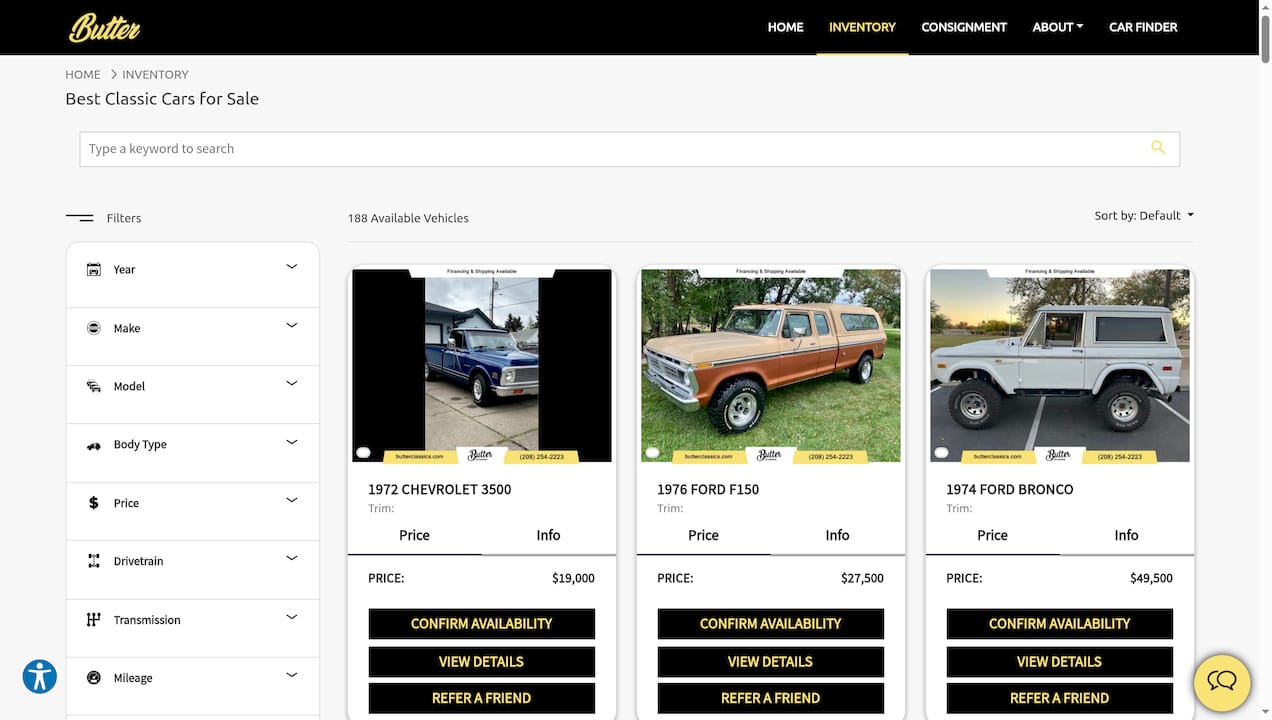
Here's what's available once you're ready to move forward:
- Browse inventory by price or type to see what's currently available across the country.
- Request VIN photos and documentation on any listing before scheduling a closer look.
- Get pre-qualified for financing to know your budget before you start negotiating.
- Use Car Finder if you're after a specific model, year, or option set that isn't currently listed.
- Consign your vehicle if you're the one selling a classic Bronco or Blazer rather than buying one.
Start by browsing the current classic vehicle inventory or head to Car Finder if you have a specific build in mind. If you own a truck ready for a new home, our consignment page walks through how the process works.
Sources
- Ford Bronco — Wikipedia
- Classic car restoration costs — Coastline Restorations
- Classic SUV showdown — MotorTrend
- Worth Fixing? 1971 Chevrolet K5 Blazer — Barn Finds
FAQ
Which is better, Bronco or Blazer?
Neither is universally better since it depends on your priorities. The Bronco suits trail-focused buyers who want a compact, nimble collectible, while the Blazer suits buyers who need interior space and easier parts sourcing for daily use.
Which Bronco to stay away from?
Any Bronco with unverified frame repairs or mismatched VIN and build sheet documentation deserves extra scrutiny, since that combination often hides costly structural rot. A pre-purchase inspection focused on the frame and floors is the best way to avoid a bad buy.
Which came first, the Blazer or the Bronco?
The Bronco arrived first, launching in 1966, while the K5 Blazer followed in 1969 built on GM's pickup platform. That three-year gap is part of why the Blazer ended up larger and more truck-based than the Bronco.
Are Chevy Blazers junk?
Classic K5 Blazers aren't inherently unreliable, but many surviving examples need frame and floor rust repair after decades on the road. A well-maintained or properly restored Blazer holds up fine, which is why documented, inspected examples carry a premium in today's market.