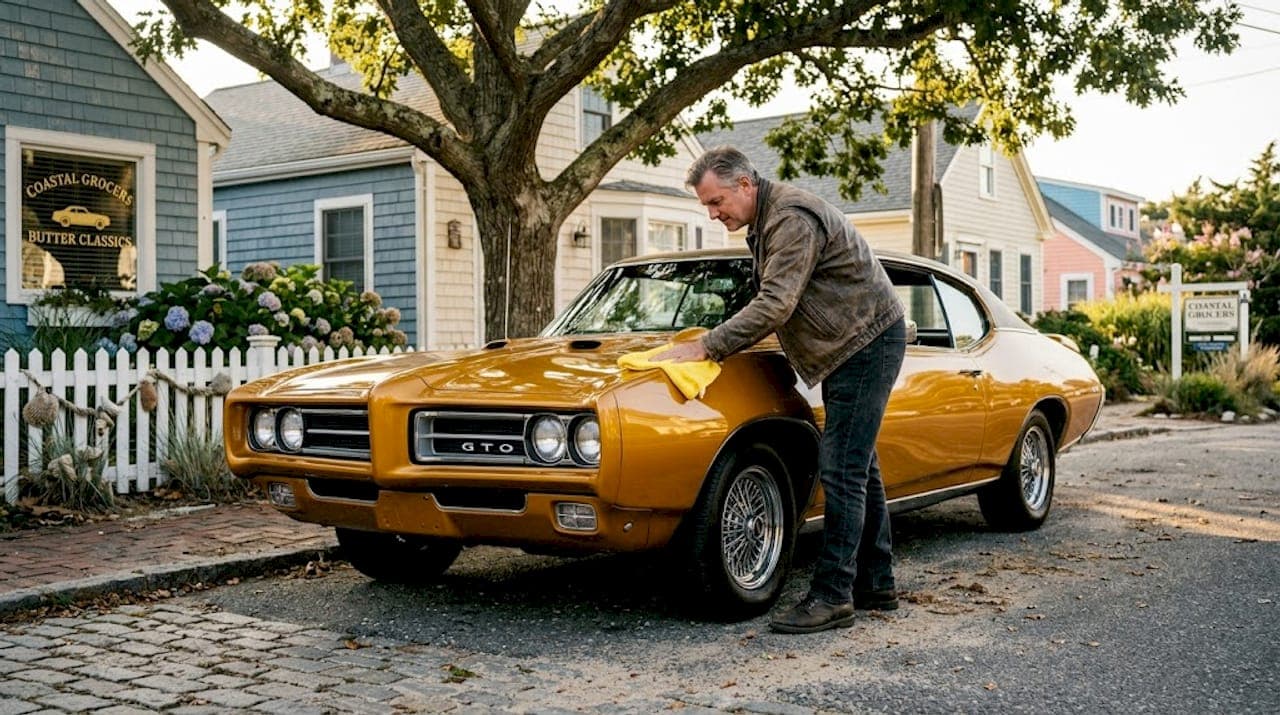
Few vehicles in American history carry as much weight as the muscle car. Understanding muscle car appreciation history means going deeper than horsepower ratings and 0-to-60 times. It means tracing a cultural arc that touched race tracks, gas station lots, living rooms, and eventually the internet. From the raw thunder of a 1964 Pontiac GTO to the retro-modern Dodge Challenger sitting in your neighbor's driveway, this is a story about identity, rebellion, and what Americans have always loved about a car that makes the ground shake.
Table of Contents
- Key takeaways
- The muscle car appreciation history you need to know
- Why the classic era ended
- How muscle car culture survived and came back
- How to truly appreciate muscle cars today
- My take on why this history matters
- Find your next classic at Butterclassics
- FAQ
Key takeaways
| Point | Details |
|---|---|
| Golden age defined | The muscle car era ran 1964 to 1974, shaped by raw V8 power and American ambition. |
| Decline had multiple causes | Emissions rules, the oil embargo, and insurance costs all collapsed the original market simultaneously. |
| Culture never stopped | Enthusiast communities kept muscle car passion alive through the 1970s and 1990s without mainstream support. |
| Documentation drives value | Provenance, maintenance records, and racing history directly increase a classic car's authenticity and price. |
| Modern revival is real | Digital culture and retro-styled models have brought a younger generation fully into the muscle car world. |
The muscle car appreciation history you need to know
The golden age began in 1964 when Pontiac shoved a 389-cubic-inch V8 into the mid-size Tempest and called it the GTO. That decision redrew the map of American performance. For the first time, serious power was wrapped in an affordable, everyday body. You didn't need a sports car budget. You just needed to want it badly enough.
What made those early cars so compelling wasn't just speed. It was accessibility. The history of muscle cars is really a story about democratizing performance. A young factory worker in Detroit or a college kid in Tulsa could own something that felt genuinely fast and genuinely rebellious.
The models that defined an era
Here's a quick look at some of the cars that shaped classic American muscle:
| Model | Year | Engine | Notable Fact |
|---|---|---|---|
| Pontiac GTO | 1964 | 389 V8 | First true modern muscle car |
| Ford Mustang 390 GT | 1967 | 390 V8 | Put muscle in a pony car body |
| Chevrolet Chevelle SS 454 | 1970 | 454 V8 | Peak of GM's big-block era |
| Plymouth Hemi 'Cuda | 1971 | 426 Hemi | Only 11 convertibles built with Hemi engine |
| Pontiac Firebird 455 SD | 1974 | 455 Super Duty | One of the last true muscle cars |
Social and economic forces fed the boom just as much as engineering did. Post-war America had money, youth, and a growing highway system. Baby boomers wanted speed, and manufacturers were more than willing to deliver. The competition between Ford, GM, and Chrysler during those ten years produced some of the most significant cars ever built on American soil.
It's also worth being honest about the trade-offs. Early muscle cars ran drum brakes, live rear axles, and handling that could punish an overconfident driver fast. The engineering prioritized straight-line acceleration above almost everything else. That raw, unfiltered character is precisely why collectors love them today.
Pro Tip: If you're researching a specific golden-age model, look for build sheet documentation from the original factory. These sheets confirm engine codes, transmission choices, and options that authenticate a car's true specs and dramatically affect its value.
Why the classic era ended
The original muscle car era didn't fade. It crashed. Three separate forces hit at nearly the same time, and the industry couldn't absorb all of them at once.
- The 1973 OPEC oil embargo sent fuel prices surging overnight. Cars built around large-displacement V8s became expensive to own and nearly impossible to justify to a spouse or a bank.
- Federal emissions regulations forced manufacturers to detune engines significantly. Compression ratios dropped. Horsepower numbers that once shocked the competition became an embarrassment to print.
- Insurance costs for young drivers owning high-performance vehicles skyrocketed. The exact audience muscle cars were built for suddenly couldn't afford to insure them.
Manufacturers responded by either gutting the performance out of existing nameplates or quietly discontinuing them. The 1974 model year represented a kind of last stand. The Pontiac Firebird 455 Super Duty and a handful of other survivors kept real performance alive by a thread, but even those were gone within a year or two.
"The muscle car didn't die of old age. It was legislated and priced out of existence by forces that had nothing to do with what the cars actually were."
That context matters enormously when you think about why appreciate muscle cars as cultural artifacts rather than just machines. They represent a specific window in American life that closed fast and never fully reopened in the same form.
How muscle car culture survived and came back
The story gets more interesting after 1974. Muscle car culture didn't disappear. It went underground. Enthusiasts kept buying, building, and racing these cars through the late 1970s and into the 1980s at a time when the mainstream automotive press had completely moved on.
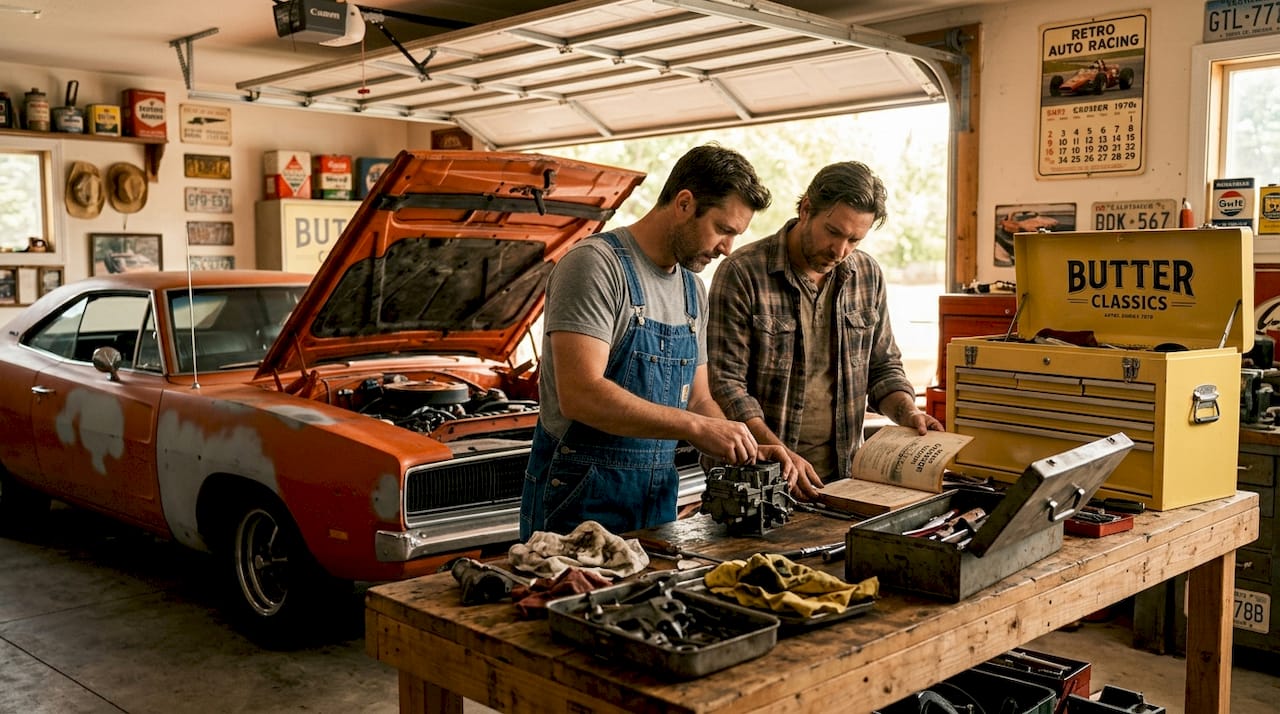
The 2000s changed everything. Manufacturers read the nostalgia in the collector market and responded with retro-styled reinterpretations. The 2005 retro Mustang and later the Challenger re-ignited mainstream interest in a way that felt earned rather than manufactured. These weren't just throwback styling exercises. Modern muscle cars genuinely outperformed their ancestors in every measurable category.
Here's what made the modern revival different from a simple nostalgia play:
- Modern muscle cars use advanced fuel injection and improved suspension that solve the classic handling issues while keeping the visual identity intact.
- Horsepower numbers from current production models routinely exceed what the most powerful golden-age cars produced.
- Safety, reliability, and daily drivability improved without sacrificing the visceral experience that defines the segment.
- Muscle cars are recognized globally as icons of American rebellion and freedom, inspiring performance car movements well beyond U.S. borders.
Digital culture accelerated the revival in ways nobody saw coming. Over 40% of young drivers use racing games to help decide which cars they want in real life. Social media built global communities around specific makes, models, and generations. A teenager in South Korea can be just as passionate about a 1969 Camaro as someone who grew up three blocks from the GM assembly plant in Norwood, Ohio.
Pro Tip: Follow model-specific forums and Instagram communities for the car you love. The knowledge shared in those spaces by longtime owners is genuinely more useful than most published guides, especially for spotting fakes, finding parts, and understanding what real market value looks like.
How to truly appreciate muscle cars today
Real muscle car appreciation history isn't complete without talking about how to evaluate and engage with these vehicles in the current market. Passion is the starting point, but knowledge is what separates a great acquisition from an expensive mistake.
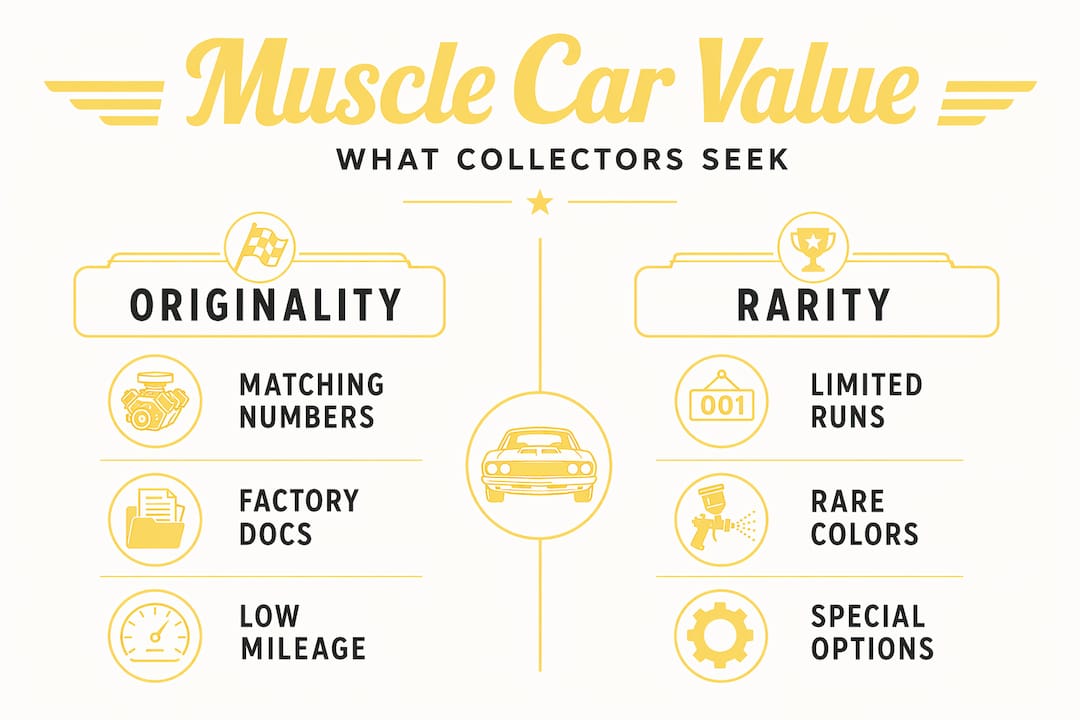
Documentation sits at the center of everything. A documented history covering maintenance logs, ownership records, race results, and provenance builds trust, supports authenticity, and justifies pricing in ways that a beautiful paint job simply cannot. When a car has a verified connection to a famous race or a notable previous owner, that story adds real dollar value on top of its mechanical worth.
Rarity tells another part of the story. The AMC AMX is a perfect example of how overlooked cars become fascinating collector pieces. Only 19,134 AMX units were produced from 1968 to 1970. It was commercially unsuccessful and vanished quietly, which means genuine examples are rare on today's market. That rarity now works in the collector's favor, even if the car was ignored when it was new.
Comparing what matters when evaluating vintage muscle cars
| Factor | Why it matters | What to look for |
|---|---|---|
| Matching numbers | Confirms original engine and drivetrain | VIN stamps, build sheet, trim tags |
| Documentation | Authenticates history and value | Service records, title history, photos |
| Production rarity | Drives long-term collector demand | Decoder guides, registry databases |
| Condition grade | Affects pricing and restoration cost | Frame condition, body seams, rust locations |
| Racing or celebrity provenance | Adds premium value and story | Verified paperwork, historical records |
The collector market itself is worth understanding before you spend money. Average dealer asking prices fell 9% from $49,004 in 2023 to $44,701 in mid-2025, which actually signals a healthy correction rather than a collapse. Market stability lets you plan restoration projects, maintenance schedules, and long-term investment strategy without chasing volatile swings.
A few practical things every enthusiast should know before acquiring a vintage muscle car:
- Join a marque-specific club or registry before you buy. Members will tell you exactly what to avoid and who to trust.
- Get a pre-purchase inspection from a specialist, not a general mechanic. The difference in what they catch is significant.
- Budget honestly for restoration. Labor and parts costs for authentic restorations frequently exceed the car's current market value.
- Understand that authenticity and character matter more to serious collectors than a perfect show-car finish. Original patina on a documented car often commands more respect than an expensive repaint.
You can explore gran turismo heritage from across the Atlantic to understand how brand authenticity shaped automotive passion globally, which gives useful context for why American muscle car provenance carries such weight with collectors worldwide.
My take on why this history matters
I've spent enough time around these cars to say something that most articles won't: the specs are almost beside the point. What keeps people returning to muscle car culture across generations isn't the quarter-mile times. It's the feeling that these machines represent a moment when Americans said what they wanted loudly and without apology.
What I find genuinely surprising is how the decline era, 1974 through the late 1990s, actually deepened the culture rather than killing it. Scarcity created devotion. The people who kept buying and maintaining these cars during the lean years weren't doing it for investment. They were doing it because the cars meant something to them personally. That kind of connection doesn't transfer to a spreadsheet.
The modern revival has done something I didn't expect: it made the originals more desirable, not less. Having a new Challenger in every other parking lot reminded people what the original formula felt like and sent them looking for the real thing. Digital culture, which I was initially skeptical about as a driver of genuine passion, has proven me wrong. The communities that form around these cars online are serious, knowledgeable, and deeply committed to preserving the history correctly.
My advice to anyone getting into this world is simple. Learn the history first. Know why the cars exist, what they replaced, what ended them, and what brought them back. That knowledge makes every car you look at more interesting, and it protects you from the kind of expensive mistakes that come from buying with your eyes instead of your head. The automotive social symbolism visible in other classic vehicle cultures reinforces this point. Passion without knowledge is just expensive sentiment.
— Tony
Find your next classic at Butterclassics
If reading through this history has your blood pumping, you're in exactly the right place. At Butterclassics, we curate a rotating inventory of classic and vintage muscle cars with the kind of documentation and transparency that serious enthusiasts expect. We're not just listing cars. We're connecting you with vehicles that have real stories behind them.
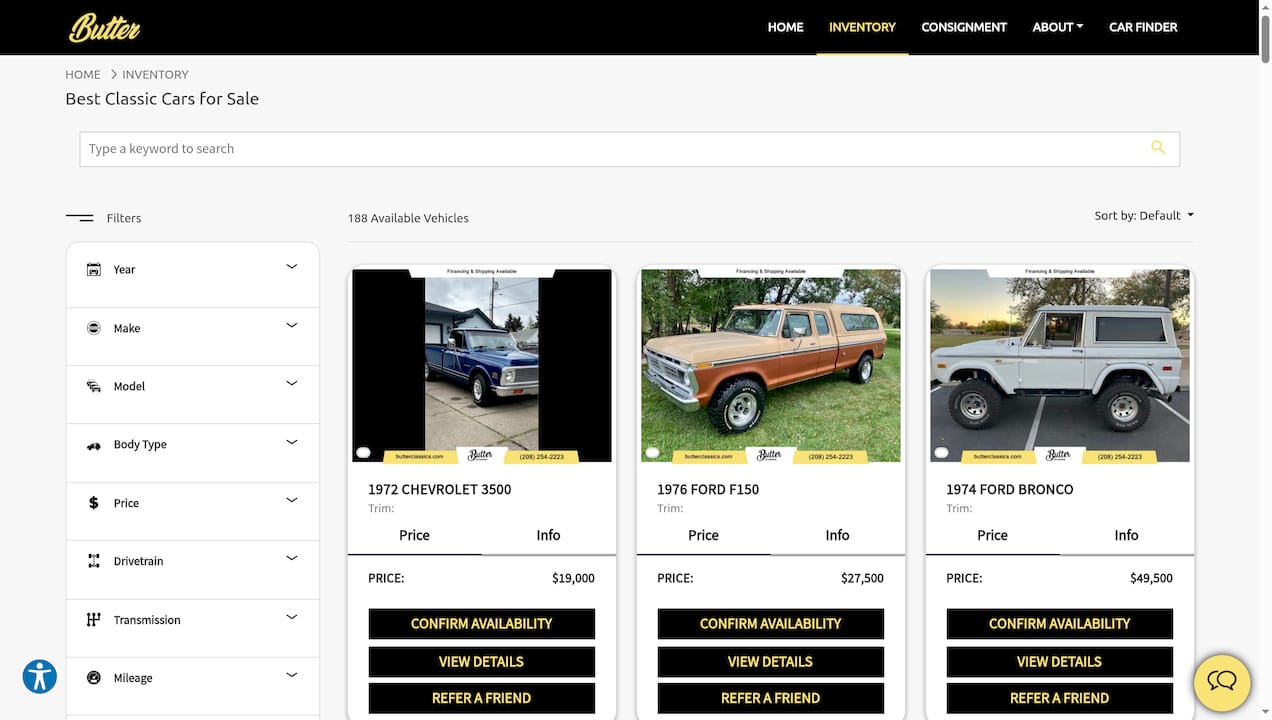
Whether you're looking for a golden-age original or a modern muscle car built to honor the tradition, our team understands what makes these cars worth owning. Browse the full classic car inventory at Butterclassics and find the one that speaks to you. Financing pre-qualification is available, and our team is ready to answer questions like a fellow enthusiast, not a salesperson.
FAQ
What years define the original muscle car era?
The muscle car era is conventionally defined as 1964 to 1974, starting with the Pontiac GTO and ending due to federal emissions regulations and the oil crisis.
Why did the original muscle car era end so quickly?
Three simultaneous pressures ended the era: the 1973 OPEC oil embargo, new federal emissions standards that forced engine detuning, and insurance cost spikes that priced young buyers out of the market.
What makes a muscle car valuable to collectors today?
Documentation is the biggest factor. Verified history including maintenance records, ownership logs, and racing provenance directly increases authenticity and collector value beyond mechanical condition alone.
How is digital culture affecting muscle car appreciation?
Over 40% of young drivers use racing games to influence real car purchases, and social media communities are introducing vintage muscle cars to younger generations worldwide.
What is the rarest American muscle car?
The 1971 Plymouth Hemi 'Cuda Convertible is widely considered the most sought-after muscle car ever built. Only 11 Hemi-powered convertible examples exist.