
If you've ever searched "classic car registry explained" hoping for a simple answer, you already know the frustration. The term covers two completely different things: the legal registration process at your state's DMV and the private, marque-specific registries that verify a car's authenticity and provenance. Mixing them up can cost you money, create legal headaches, and even tank a car's resale value. This article breaks both systems down clearly so you know exactly what you're dealing with before you buy, register, or sell.
Table of Contents
- Key takeaways
- Classic car registry explained: the legal side first
- How classic registration affects your daily life
- DMV registration vs. private marque registries
- Legal pitfalls collectors often miss
- How to register and use registries for maximum value
- My honest take on classic car registries
- Find your next classic at Butterclassics
- FAQ
Key takeaways
| Point | Details |
|---|---|
| Two systems exist | DMV registration controls legal road use; private registries confirm authenticity and collector value. |
| Age thresholds vary by state | Most states require a vehicle to be 25 to 30 years old to qualify for classic or antique registration. |
| Usage restrictions are real | Many historic registrations cap annual mileage and restrict daily driving, so read the fine print. |
| Title brands have lasting impact | A "classic" title brand can be permanent and affect financing, insurance, and future resale options. |
| Private registries boost value | Marque-specific registries verify numbers-matching and factory options, which directly supports collector pricing. |
Classic car registry explained: the legal side first
Before anything else, you need to understand that "classic car" is not a universal legal term. Every state defines it differently, and those definitions carry real consequences for how you can use your vehicle, what you pay in taxes, and what plates you can display.
Most states group collector vehicles under labels like antique, historic, vintage, or classic, each with its own age cutoff and eligibility rules. Age thresholds vary by state, typically falling between 25 and 30 years old, though some states draw the line at 20. The terminology matters because qualifying under the wrong category can leave your car legally unregistrable or expose you to fines for misuse.
Here's a quick look at how these categories typically break down:
| Term | Common Age Requirement | Key Characteristics |
|---|---|---|
| Antique | 25+ years | Often the strictest usage limits; focused on preservation |
| Classic | 20 to 30+ years | Varies widely; sometimes a plate designation only |
| Historic | 25+ years | Primarily a tax and plate status, not a quality certification |
| Vintage | Pre-1930s in many states | Narrowest category; often tied to specific eras |
The requirements for classic car registration at the DMV level typically include:
- Proof of ownership such as a clean title or bonded title if the original is missing
- VIN verification by a licensed inspector or law enforcement officer
- Proof of insurance meeting the state's minimum coverage requirements
- Completed application for the specific antique, historic, or classic plate category
- Payment of applicable fees, which are often lower than standard registration
Minnesota offers a useful example of how specific these rules get. Minnesota's "full classic" classification covers vehicles from 1925 to 1948 and requires a one-time $25 tax along with a signed affidavit. That's a very different process from registering a 1985 pickup in Texas. Always check your state's exact requirements before assuming you qualify.
How classic registration affects your daily life
Getting those vintage plates feels great. What some collectors don't fully appreciate is what comes along with them.
Many historic registrations impose mileage caps ranging from 1,000 to 5,000 miles per year, and some states restrict use to parades, exhibitions, and club events only. California offers smog exemptions for vehicles over a certain age, while Texas historic plates carry no mileage restriction at all. The gap between those two states alone shows why you cannot assume your registration works the same way as a friend's in another state.
The financial side has real upside. Classic and antique registrations usually come with:
- Lower annual registration fees, sometimes dramatically so compared to standard plates
- Emissions and inspection exemptions in many states, saving time and money
- Reduced personal property taxes in states that assess vehicle value annually
- Agreed value insurance through specialized insurers like Hagerty, which protects your investment far better than a standard policy's depreciated book value
Pro Tip: When you switch to classic or antique registration, update your insurance at the same time. Standard auto policies are not designed for agreed value coverage, and a mismatch between your registration status and your policy can leave you seriously underinsured after an accident.
The downside that catches collectors off guard involves financing and resale. Title brands can be permanent and may limit your financing options because many lenders treat classic-branded titles differently from standard titles. If you ever want to sell outside the collector community, that brand can reduce your buyer pool considerably.
DMV registration vs. private marque registries
Here's where understanding classic car registration gets genuinely interesting. Your state's DMV registration tells the government your car exists and is road legal. A private marque registry tells the collector world your car is the real thing.
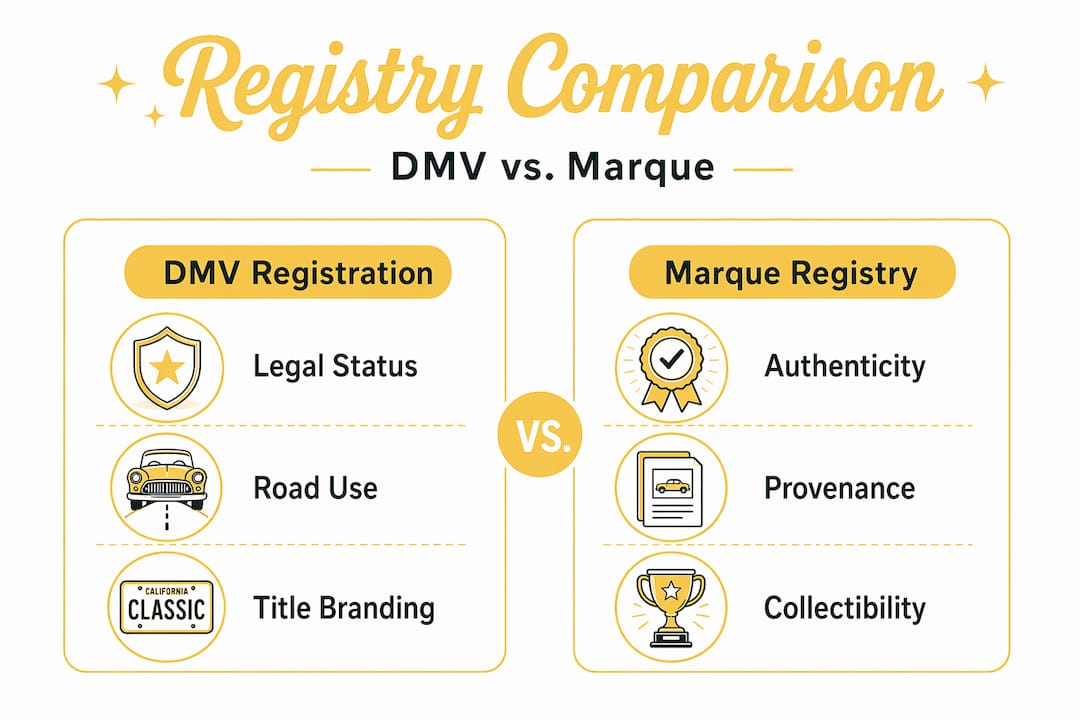
Private marque registries verify historical authenticity by confirming numbers-matching components, factory-installed options, and production records. They do not control whether your car can legally drive on public roads. That's entirely the DMV's domain. But when it comes to establishing collectible value and impressing serious buyers, a registry certificate from an authoritative marque organization carries enormous weight.

Think of it this way. Two identical-looking 1969 Camaro Z/28s sit side by side. One has DMV historic plates and nothing else. The other has DMV historic plates plus documentation from the National Camaro Registry confirming the original engine block, matching VIN stampings, and factory-correct options. The second car will sell for significantly more, often tens of thousands of dollars more, because the documentation removes doubt.
Here's how to work with both systems effectively:
- Secure your DMV registration first. Confirm your vehicle meets the age and condition requirements for your state's classic or antique category before pursuing anything else.
- Gather your classic vehicle documentation. Collect the original title, any build sheets, Protect-O-Plate cards, broadcast sheets, or window stickers that came with the car.
- Contact the relevant marque registry. Most major makes have dedicated registries. Research which organization carries the most authority for your specific vehicle.
- Submit for authentication. Most registries require photos, VIN documentation, and sometimes an in-person inspection. Fees vary but are typically modest relative to the value they add.
- Keep both sets of records together. Store your DMV registration documents and your registry certificate in the same file so future buyers can verify everything in one place.
Pro Tip: If you're planning to document your car's provenance for an international audience or concours event, marque registry documentation is often the first thing judges and appraisers request. Don't wait until the last minute to pursue it.
Legal pitfalls collectors often miss
The legal side of classic car ownership has a few traps that catch even experienced collectors. Knowing them ahead of time saves real headaches.
The biggest one involves title branding. Whether "classic" status is a title brand or just a plate designation varies by state, and the difference matters enormously. A plate-only designation is relatively easy to reverse if you change your mind about usage. A permanent title brand follows the car forever and shows up on every future title history report. Before you register a vehicle as classic or antique, ask your DMV explicitly whether the classification affects the title itself.
"Definitions of 'classic,' 'antique,' and 'vintage' vary legally by state and affect legal eligibility and registration options. Misunderstanding these definitions can result in vehicles that are unregistrable or misused."
Other common issues include:
- Orphan car titles. Vehicles from defunct manufacturers sometimes have lien records tied to banks that no longer exist. Clearing these requires either a bonded title or a court order, and the process can take months.
- Missing titles. VIN verification and a clean chain of title are critical for classic car transfers. If the title is missing, you'll likely need a bonded title, which adds cost and delays.
- Usage violations. Collectors often misunderstand usage restrictions and drive their historic-plated cars daily without realizing they're violating their registration terms. This can void your insurance and expose you to fines.
- Interstate registration conflicts. Moving a classically registered vehicle across state lines can trigger re-registration requirements because the new state may not recognize your previous classification.
Always verify the specific rules in your state before purchasing a vehicle you plan to register as classic or antique. A quick call to your DMV before you sign anything is worth far more than the time it takes.
How to register and use registries for maximum value
Pulling everything together into a practical process makes the whole thing much less intimidating. Here's a straightforward approach:
- Confirm eligibility. Verify the vehicle's model year against your state's age threshold for antique, historic, or classic registration. Check whether the category is a title brand or plate-only in your state.
- Prepare your documents. You'll typically need the current title, a completed DMV application, proof of insurance, and a VIN inspection form. Some states also require a safety inspection even for classic vehicles.
- Choose the right insurance first. Match your coverage to the registration category. Agreed value policies from specialized insurers protect your car at its actual collector worth, not a depreciated book value.
- Research marque registries for your specific vehicle. Major marques like Corvette, Mustang, Camaro, and Bronco all have dedicated registries with varying levels of documentation requirements and collector recognition.
- Submit and document everything. Once registered and authenticated, photograph all documents and store digital copies in a secure location alongside the originals.
Pro Tip: When buying a classic car, ask the seller directly whether the vehicle has ever been submitted to a marque registry. A Butter Certified vehicle with existing registry documentation is worth paying a premium for because the hard work of proving authenticity has already been done.
My honest take on classic car registries
I've seen a lot of collectors get tripped up by the same misunderstanding: they think getting historic plates means they've done everything they need to do. They haven't. The DMV registration is the floor, not the ceiling.
In my experience, the collectors who get the most out of their vehicles, both in terms of enjoyment and financial return, are the ones who treat documentation as seriously as they treat mechanical restoration. A numbers-matching muscle car with a registry certificate and a complete paper trail will always outperform an equally beautiful car with no documentation when it comes time to sell. Always.
What I've also learned is that state laws are genuinely confusing, and they change. I've watched buyers purchase cars across state lines only to discover their new state won't honor the previous registration category. That's an expensive surprise. Research your state's specific rules before you fall in love with a car at an auction in another state.
The private registry side is often underestimated by newer collectors. I think that's because it requires extra effort with no immediate payoff. But the long-term value of having authoritative provenance documentation is real. It's the difference between a car that sells in a week and one that sits for months because buyers can't verify what they're getting.
— Tony
Find your next classic at Butterclassics
You've got the knowledge. Now you need the right car to go with it.
At Butterclassics, we make finding a well-documented classic smooth as butter. Our inventory features classic cars, muscle cars, Corvettes, Broncos, and vintage trucks with detailed specifications and high-quality photos so you know exactly what you're getting. Many of our vehicles come with verified provenance and existing registry documentation, taking the guesswork out of your purchase. Whether you're a seasoned collector or buying your first classic, our team is here to help you find the right car with the right paperwork. Browse our inventory today and call dibs on your next favorite ride.
FAQ
What is a classic car registry?
A classic car registry is either a government DMV classification that grants special registration status to older vehicles or a private organization that verifies a vehicle's historical authenticity and provenance. The two systems serve different purposes and operate independently.
How do I register a classic car with my state's DMV?
You typically need the vehicle's title, a VIN inspection, proof of insurance, and a completed application for the antique, historic, or classic category. Age requirements vary by state, generally ranging from 20 to 30 years old, so check your state's specific rules before applying.
Do classic car registrations limit how much I can drive?
Yes, many states impose mileage caps or restrict use to parades, exhibitions, and club events for historically registered vehicles. Some states like Texas have no mileage restriction, while others cap annual driving at 1,000 to 5,000 miles.
Does a classic title brand affect resale value?
A classic or antique title brand can be permanent and may reduce your financing options and buyer pool outside the collector market. Within the collector community, however, proper documentation and registry authentication typically increase a vehicle's value significantly.
Why do private marque registries matter for collectors?
Private marque registries confirm numbers-matching components, factory options, and production authenticity, which directly supports higher valuations at auction and private sale. A registry certificate removes buyer doubt and is often the single most persuasive document you can present to a serious collector.